
Tangaek — Decoctions · Fruits
海松子 Korean Pine Nut
 Related Crop · Korean Pine Nut →
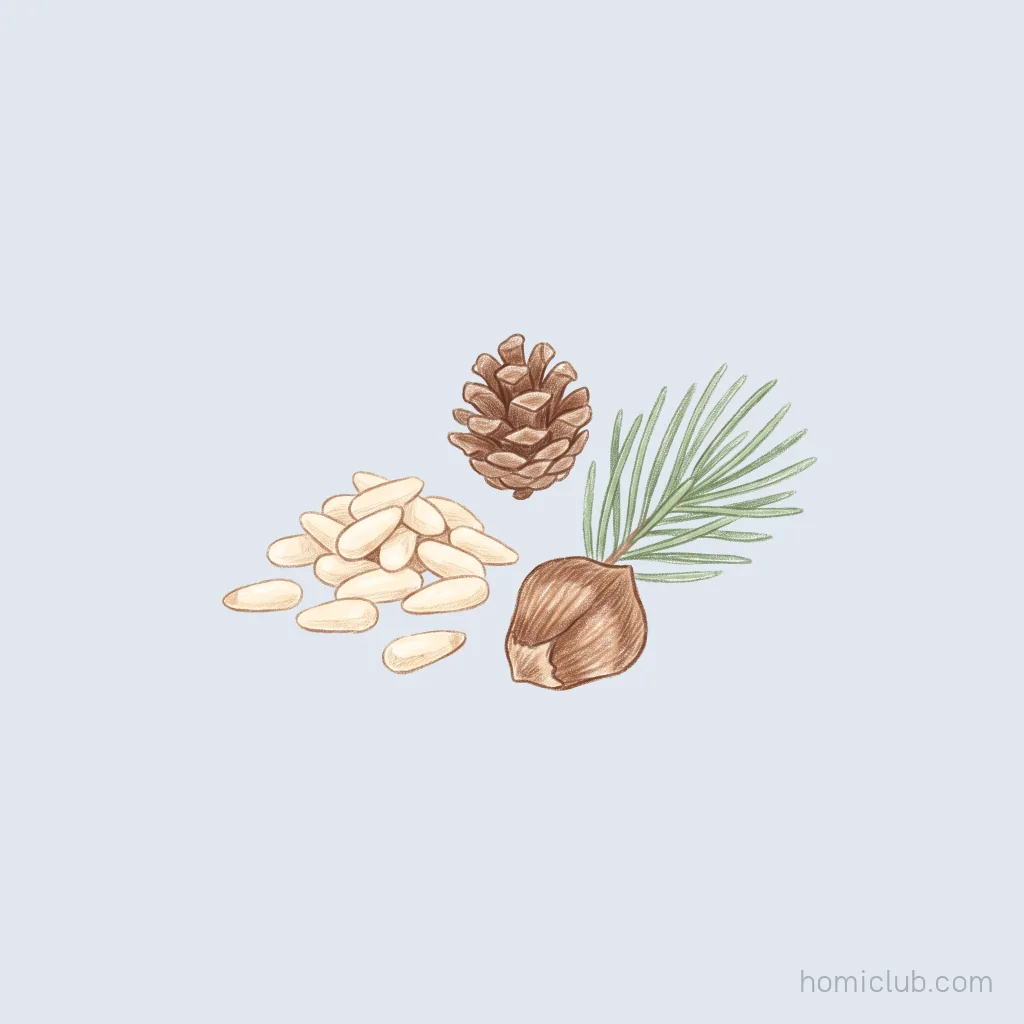
Haesongja is the pine nut, the seed taken from the cone of the Korean pine that grows deep in the mountains. It turns up now in pine nut porridge and sweet rice, and floating on cinnamon punch, and it is the same nut as the jat in the crop guide. The Donguibogam lists it in the fruit section and says to shell it before eating.
Original, read line by line 東醫寶鑑 · Tangaek — Decoctions vol. 2
-
性小溫, 味甘, 無毒.
Its nature is slightly warm, its taste sweet, and it is non-toxic.
-
主骨節風, 及風痺頭眩.
It governs goljeolpung (骨節風, wind in the joints), pungbi (風痺, wind impediment), and dizziness.
-
潤皮膚, 肥五藏, 補虛羸少氣. 《本草》
It moistens the skin, fattens the five viscera, and supplements emaciation and shortness of qi. 《Boncho (本草)》
-
處處有之, 生深山中. 樹如松柏, 實如瓜子, 剝取子, 去皮食之. 《俗方》
It grows everywhere, deep in the mountains. The tree is like a pine or cypress and the seed like a melon seed; strip the cone, take the seeds, remove the shells, and eat them. 《Sokbang (俗方)》
HomiclubThe Korean pine carries its needles in bundles of five, which is why it is also called oyeopsong, the five-needle pine. Pine nuts are the seeds shaken out from between the cone scales and shelled; Gapyeong and Hongcheon are the best-known growing areas.
Related Crop
Korean Pine Nut →
Fruits — more entries
This is a cultural and historical record from a classical text, not a claim about any food’s effects. Nothing here is a health supplement or intended to prevent or treat disease. Consult a medical professional about health concerns. · Text: Korean Medicine Classics DB · Reading: Homiclub