
Tangaek — Decoctions · Vegetables
胡荽 Cilantro (Coriander)
 Related Crop · Cilantro (Coriander) →
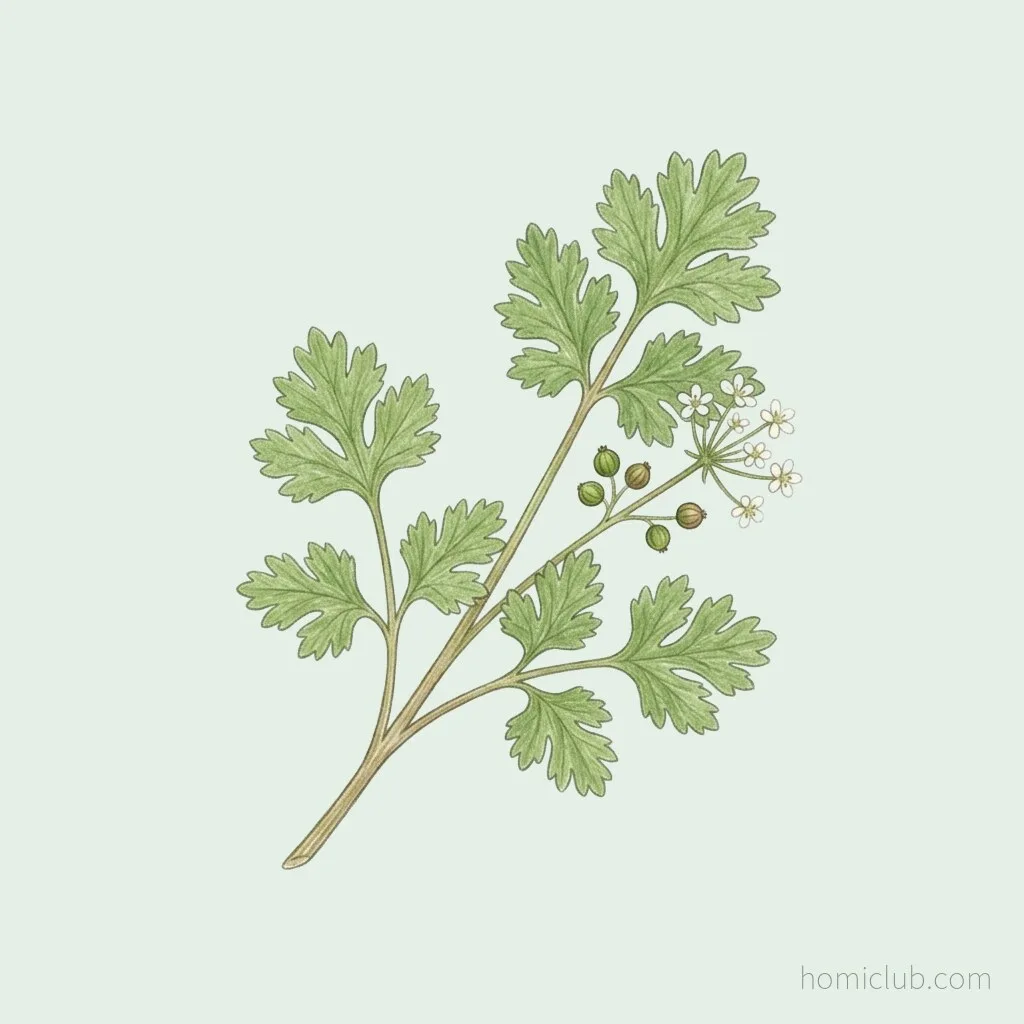
Hoyu is the old name for cilantro, the same herb as the field guide's gosu. The leaf goes onto pho and into spice-forward cooking under the names cilantro and coriander. Donguibogam recorded that northerners renamed it hyangsu to avoid a character in the ruler Shi Le's name.
Original, read line by line 東醫寶鑑 · Tangaek — Decoctions vol. 2
-
性溫一云平, 味辛, 微毒.
Its nature is warm, though one account calls it neutral; its taste is pungent and it is slightly toxic.
HomiclubHoyu is coriander, an annual in the carrot family. English calls the leaf cilantro and the seed coriander. It is the leaf strewn over rice noodles and spiced dishes, and in Korea it has long been grown around Buddhist temples.
-
消穀, 通小腸氣, 通心竅. 療沙疹豌豆瘡不出.
It digests grain, frees the qi of the small intestine, and opens the simgyu (心竅, orifices of the heart). It treats sajin (沙疹, sand rash) and wandu-chang (豌豆瘡, pea-pox) that fail to erupt.
-
生園圃中. 人多生食. 亦是葷菜, 久食, 損人精神, 令多忘, 發腋臭.
It grows in garden plots. People eat much of it raw. It too is a hunchae (葷菜, pungent vegetable), and eaten over a long time it injures a person's spirit, makes one forgetful, and brings on underarm odor.
-
北方人避石勒諱胡, 號爲香荽. 《本草》
People of the north avoided the graph ho (胡), which Seok Reuk (石勒) tabooed, and called it hyangyu (香荽, fragrant coriander). 《Boncho (本草)》
HomiclubSeok Reuk was a Jie ruler who founded Later Zhao in northern China in the fourth century, and he is said to have tabooed the graph ho (胡) used to belittle his origins. Hoyu was renamed hyangyu for that reason, and Chinese still writes coriander as xiangcai (香菜).
Related Crop
Cilantro (Coriander) →
Reading on Cilantro (Coriander)
Vegetables — more entries
This is a cultural and historical record from a classical text, not a claim about any food’s effects. Nothing here is a health supplement or intended to prevent or treat disease. Consult a medical professional about health concerns. · Text: Korean Medicine Classics DB · Reading: Homiclub