- Type
- Leafy Greens
- Difficulty
- Easy
- Season
- Fall
- Sowing
- From seed
Mustard Greens (Gat)
Brassica juncea
Glucosinolates and sinigrin · a pungent leafy green
Mustard greens, known in Korea as gat, get their sharp, peppery bite from glucosinolates and sinigrin, the sulfur compounds particular to the brassica family. The leaves also carry vitamins A, C and K, folate and dietary fiber. In Korea gat is most often fermented into kimchi, and gat-kimchi made from the prized Dolsan gat of Yeosu is the best known version. Sow in spring (March to April) or autumn (August to September); the autumn crop for winter kimchi is cut in November. The flavor deepens as the weather turns cooler.
Year-Round Calendar
- 1
- 2
- 3
- 4
- 5
- 6
- 7
- 8
- 9
- 10
- 11
- 12
- 3
- 4
- 8
- 9
- 5
- 6
- 10
- 11
Where It Grows
- Main producer The largest producer of gat grown for its leaves and stems. The stem gat of Sichuan and the leaf gat of Zhejiang and Hunan are the representative types.
- Main producer Grown on a large scale as an oilseed crop in the winter fields of Rajasthan, Uttar Pradesh and Madhya Pradesh.
- Major producer Mustard seed production is high, and the leaves are used as a vegetable alongside it.
- Major producer Grown for seed on the prairies and sent to the world spice market.
Its origin is the belt running from Central Asia to the Himalayas, so it cannot be pinned to any one country. The same species has diverged along different lines from region to region: in India and Canada it is grown as a seed crop for oil and spice, while in China and Korea it is grown as a vegetable for its leaves and stems. FAO figures likewise divide it between mustard seed and other brassica vegetables, so leaf gat is never counted on its own.
- Optimum
- 15~20℃
- Range
- 0~25℃
- Hardiness
- Half-hardy
A cool-season crop. As autumn deepens and temperatures drop, its sharp, peppery aroma grows stronger. Young plants will take a light frost, but outside the southern coast they seldom come through midwinter in an open field.
In Korea Nationwide
Sown twice, in spring and autumn, but the autumn crop for kimjang (the annual winter kimchi-making) is the mainstay. The Dolsan area of Yeosu, in South Jeolla, is a noted growing region, and along the south coast the crop overwinters (comes through the winter) in open fields.
How to grow
- Light
- Somewhere sunny
- Soil and depth
- 20cm deep
- Spacing
- 20cm
- Watering
- Moderate. The cool season does not ask much
- Feeding
- Base dressing plus one feed a month later
- Harvest
- For kimchi, lift whole before the frosts. Young leaves can be thinned out for salad
What makes the difference. The colder it gets, the sharper the scent. Late August to September is the window
Common problems
- Flea beetles You will see A scatter of tiny holes What to do Fleece over the young plants only
- Aphids You will see Clusters on new growth What to do Wash them off
This page describes how a crop is grown and used. It does not claim health effects for any food, nor is it intended to prevent or treat disease. Component and study notes are references only and do not mean the same result occurs in people. Consult a medical professional about health concerns.
Health Benefits
Glucosinolate and isothiocyanate composition. Compositional analysis confirms that mustard greens, a member of the brassica family (Brassicaceae), contain glucosinolates and their breakdown products, the isothiocyanates. Allyl isothiocyanate (AITC) is the representative compound behind the pungency. This is a compositional record, not a statement about effects.
How to read the cruciferous studies. Many epidemiological studies have examined the association between eating plenty of cruciferous vegetables and various health measures. Most of them pool the whole family together, however, and studies feeding mustard greens alone to people are scarce. An observed association is not causation either. What can be stated today stops at composition.
Fermentation: gat kimchi. Mustard greens are commonly fermented into gat kimchi, and analyses report that the compositional profile shifts as fermentation proceeds. What that shift leads to in the body is beyond what this entry states.
Erucic acid and the seed oil. Mustard seed oil carries a fatty acid called erucic acid, and cultivars bred for reduced erucic acid are the international norm for edible oil use. That is a different setting from eating the leaves as a green or as kimchi.
Nutrition
- Glucosinolates and sinigrin (Source of the pungent flavor) — The sulfur compounds particular to the brassica family
- Vitamins A, C, and K (Abundant) — Micronutrients common in leafy greens
Glucosinolates Mustard greens carry glucosinolates, the sulfur compounds shared across the brassica family. Myrosinase enzymes or gut microbes break them down, and that is where the pungency particular to mustard greens comes from.
Isothiocyanates (ITC) These are the products formed when glucosinolates break down. Allyl isothiocyanate (AITC) is the representative compound behind mustard pungency, and a molecule frequently handled in laboratory-level research. That is to be read separately from what has been confirmed in people.
Sinigrin Sinigrin is the main glucosinolate of mustard seed and the precursor of AITC. When the seed is crushed or meets water, myrosinase breaks it down into pungent AITC, which creates the sharp flavor of mustard powder.
Erucic acid This is the characteristic fatty acid of mustard seed oil. Animal studies reporting fat accumulating in the heart muscle under large, long-term intake led to breeding work on cultivars with reduced erucic acid for edible oil use. That is a different setting from eating the leaves as a green or as kimchi.
Phenolic compounds & flavonoids The leaves and seeds of mustard greens hold a range of phenolic compounds and flavonoids. They are handled as a group showing antioxidant activity in vitro, but what that leads to inside the body is a separate question.
Vitamin A, C, K, folate & dietary fiber Vitamins A, C and K, folate and dietary fiber are all present, and the vitamin K content in particular runs high even among leafy greens.
Pairings
○ Radish, napa cabbage, chili flakes, and salted seafood (jeotgal) — Adding mustard greens to winter kimchi (gimjang) is a Korean culinary tradition, and among these the Dolsan gat-kimchi from the Jeolla region is considered a premium delicacy. The pungency of the mustard greens brings out the sweetness of the cabbage and radish, and the flavor deepens further through fermentation. Napa Cabbage (Baechu) · Korean Radish (Mu) · Spring Cabbage (Bomdong)
○ Raw fish (sashimi) and meat — A piece of gat-kimchi alongside raw fish or meat cuts through fishiness and richness with its peppery heat. Its strong aroma breaks up the monotony of plain protein, making it easier to enjoy larger portions.
○ Pork — Serving gat-kimchi with bossam (boiled pork wraps) is a classic Korean pairing. The pungency and fiber of the mustard greens help break down the fat of the pork, lightening up a heavy meal.
○ Salt and vinegar — Pickled in salt and vinegar, mustard greens become gat-jangajji (a savory pickle). This improves shelf life and deepens the greens' peppery aroma, while fermentation develops new layers of flavor.
○ Garlic and ginger — Combining mustard greens with garlic and ginger reinforces their warming nature. This pairing creates a respiratory-tonic synergy and has traditionally been used to ease chills, coughs, and phlegm. Garlic · Ginger
△ Gastritis and acid reflux — People with gastritis or reflux esophagitis should go easy on heavily seasoned mustard-green kimchi (gat-kimchi). The greens' pungent bite combined with fermentation acids can irritate the stomach lining and worsen symptoms.
△ Hypothyroidism — In large amounts, the glucosinolates in mustard greens can partially interfere with thyroid hormone synthesis. Normal dietary amounts are fine, but high-dose supplement forms are not recommended for people with hypothyroidism.
△ Heavy, long-term use of mustard seed oil — Mustard seed oil is high in erucic acid, which can strain the cardiovascular system with heavy, long-term consumption. Small amounts as a seasoning are fine, but it's not recommended as your everyday cooking oil.
Varieties
- Dolsan gat (Dolsan mustard green) (Seed) — A local line from Dolsan in Yeosu. Wide, tender leaves and mild heat, the usual pick for kimchi.
- Cheong-gat (green mustard green) (Seed) — The plain green-leaved type. Moderate pungency, used in kimchi, soups and blanched sides alike.
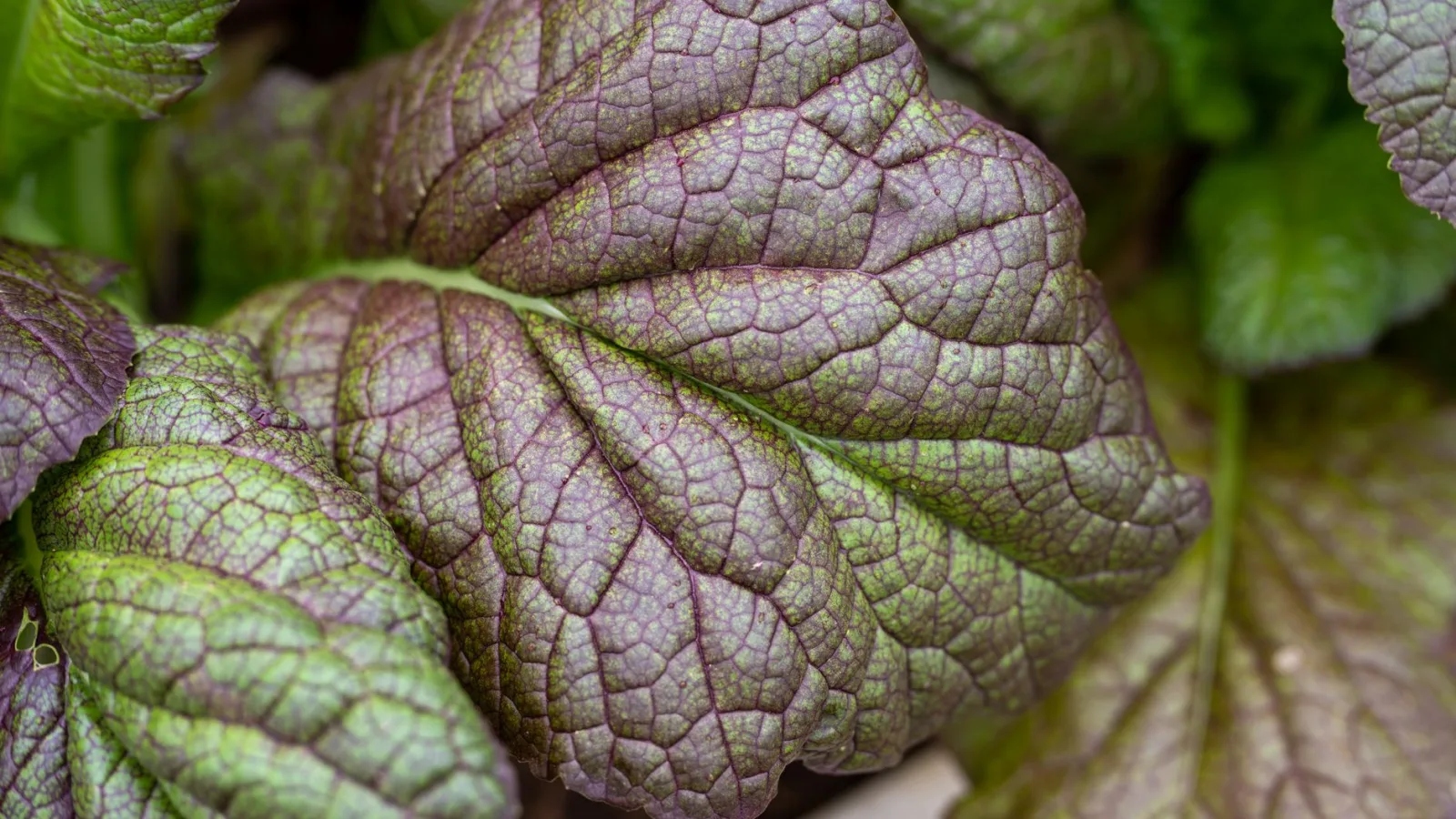
- Jeok-gat (red mustard green) (Seed) — Purple-red leaves. The bite is sharper, and kimchi made with it takes on a red-tinted brine.
- Baby-leaf mustard (jeok-gyeoja, cheong-gyeoja) (Seed) — Finely cut, tender leaves. Ready to thin and pick for wraps or salad in 30-40 days.
Source: Food and nutrition references