

- Type
- Roots & Stems
- Difficulty
- Moderate
- Season
- Spring
- Sowing
- Seed ginger
Ginger
Zingiber officinale
Gingerol — a pungent, aromatic rhizome
The sharp bite of ginger comes from gingerol. Heating or drying the root converts part of it into shogaol, which shifts the character of the pungency. Old medical texts listed the fresh root and the dried root under separate names, and today the rhizome turns up in teas, seasonings, and homemade syrups alike. Ginger likes warm weather, so plant it in spring and harvest in fall.
Year-Round Calendar
- 1
- 2
- 3
- 4
- 5
- 6
- 7
- 8
- 9
- 10
- 11
- 12
- 4
- 5
- 10
- 11
Where It Grows
-
Main producer
Produces more than any other country in the world. Kerala and Odisha, along with the hill country of the northeast, are the main growing areas. Harvest December, January, February
- 1
- 2
- 12
- Main producer Kaduna State and the surrounding area lead production, and most of the crop is dried before export.
- Main producer Shandong, Guangdong and Sichuan lead production, and large volumes held in storage keep it on the market year-round.
- Major producer It is grown on sloping fields in the central hill country.
- Major producer Around Java, several strains differing in pungency and size are grown separately.
- Major producer The northern hill country leads production, and much of the crop is young ginger lifted early.
No wild populations have been confirmed, so its origin is not pinned to a single country. It is thought to have been domesticated in island Southeast Asia and to have passed early to India and China. Production today is concentrated in India, Nigeria and China, while Korea and Japan grow it much like an annual at the northern temperate limit, where it cannot overwinter.
- Optimum
- 20~30℃
- Range
- 15~35℃
- Hardiness
- Not hardy
Ginger is a crop of hot places with rain spread evenly through the year. Growth stops below 15℃, and frost damages the plant right down to the rhizome, so in Korea it cannot overwinter — survive the winter in the ground — and is replanted every year. Sun that is too strong scorches the leaves, so it prefers partial shade.
In Korea Central Korea and south
Seosan and Taean in South Chungcheong, Bongdong in Wanju, North Jeolla, and Andong in North Gyeongsang are the best-known areas. Because the roots must be lifted before frost, the central region and everywhere south of it, where the first light frost comes late, have the advantage.
How to grow
- Light
- Part shade. Strong sun scorches the leaves
- Soil and depth
- 25cm deep, damp but never waterlogged
- Spacing
- 25cm
- Watering
- Steady. Dry ground gives you small rhizomes
- Feeding
- Twice over the summer
- Harvest
- Lift before the frosts. You can take a little young ginger through summer
What makes the difference. It is slow to emerge — close to a month. Do not dig it up to check
Common problems
- Rhizome rot You will see The base goes soft and rots What to do Keep water moving; do not plant in the same ground repeatedly
This page describes how a crop is grown and used. It does not claim health effects for any food, nor is it intended to prevent or treat disease. Component and study notes are references only and do not mean the same result occurs in people. Consult a medical professional about health concerns.
Health Benefits
Old record — Donguibogam. The Donguibogam, in its materia medica section, records ginger as slightly warm in nature and pungent in taste, and lists the dried root separately from the fresh one. This is a record from an old medical text, and it does not reflect present-day judgment or bear on the prevention or treatment of disease.
Today's view — pungent compounds. Compositional analysis confirms that gingerol, the source of the pungency, is most abundant in the fresh rhizome, and that heating or drying converts part of it into shogaol. What can be stated at present goes only as far as composition.
Today's view — inflammation and oxidation markers. These are studies of supplements, and the conditions differ from eating ginger as a food. Meta-analyses using ginger supplements have reported changes in markers of inflammation and oxidative stress, but those results do not carry over to the small amounts used as a seasoning.
Today's view — nausea studies. These are studies of extracts and prepared products, and the conditions differ from eating ginger as a food. A number of studies have examined how ginger preparations affect nausea, but subjects and doses differ from study to study, so the findings cannot be carried over to ginger used as a kitchen spice.
Nutrition
- Gingerol (Pungent compound) — Most abundant in the fresh rhizome
- Shogaol (Forms when heated) — Gingerol converted by heating or drying
Gingerols Gingerols are the core compounds behind the pungency of ginger. They are detected in greatest abundance in fresh ginger, and heating or drying converts part of them into other compounds. Several laboratory studies have examined their anti-inflammatory and antioxidant activity, but most of that work used extracts.
Shogaols Heating or drying ginger converts part of the gingerols into shogaols. This sits alongside the fact that old medical texts listed fresh ginger and dried ginger as separate materia medica, and shogaols tend to exceed gingerols in pungency.
Zingerone Zingerone is another pungent compound, formed when ginger is heated. Because it arises during heating, it contributes to the flavor of cooked ginger.
Essential oils The distinctive aroma of ginger comes from volatile compounds such as zingiberene. These make up its scent and taste, and that is as far as the analysis goes.
Vitamin B6, magnesium & manganese Ginger contains vitamin B6 and micronutrients such as magnesium and manganese. It is a spice used in small amounts at a time, however, so its share of daily intake stays modest.
Pairings
○ Jujube (Korean red date) — Saenggang-daechu-cha, ginger-and-jujube tea, is a traditional pairing with a long history of soothing the stomach and restoring energy. The sweetness of the jujube tempers ginger's heat, and the two ingredients complement each other nutritionally, making the brew easy to drink. Jujube
○ Honey — Honey softens ginger's sharp edge and helps with absorption. A warm cup of honey-ginger tea at the first sign of a cold is a go-to combination in both Eastern and Western traditions.
○ Garlic — Garlic and ginger are both classified as warming in traditional medicine, so they're used together for chills, cold-related stomach pain, and indigestion. Their antibacterial and digestion-aiding actions create a synergy. Garlic
○ Chicken and pork — Ginger is often used to cut the off-flavors of proteins like chicken and pork while aiding digestion. Adding a slice of ginger to samgyetang (Korean ginseng chicken soup) is a well-established practice at the Korean table.
○ Cinnamon — Ginger and cinnamon are both classified as warming and work in synergy for antioxidant activity and blood-sugar control. Mediterranean-diet meta-analyses frequently cite the two spices as having been studied together. Cinnamon
○ Lemon and honey — A warm lemon-honey-ginger tea at the onset of a cold helps on two fronts: boosting vitamin C and soothing the mucous membranes. It's a home remedy used widely across both Eastern and Western traditions.
△ Large amounts of ginger with pork (traditional claim) — Some traditions consider large amounts of pork and ginger together an incompatible pairing, but at everyday dietary levels there's no real concern. If anything, ginger is more often used precisely because it tames pork's gamey notes—a staple technique in both Korean and Chinese cooking.
△ Korean chives — A few traditional Korean herbal texts advise against eating large amounts of chives and ginger together, but the general consensus is that at normal dietary levels there's no problem. Korean Chive (Buchu / Garlic Chive)
△ Patients on medication — People taking anticoagulants, diabetes medication, or blood pressure medication should avoid heavy intake—think several cups of strongly brewed ginger tea every day. Because drug interactions are possible, consult your healthcare provider to set a safe amount.
Varieties
- Bongdong native ginger (Bulb) — Small, tightly jointed rhizomes with a sharp aroma; used for seasoning and tea, and it stores well.
- Large-rhizome type (Bulb) — Fat rhizomes and a heavier yield per plant; low in fibre, so it suits candied ginger and syrup.
- Seosan native strain (Bulb) — A regional strain from west-coast sandy loam; mid-sized rhizomes used mostly for kimchi seasoning.
Source: Food and Nutrition Information
Stories about Ginger
Simmer Kudzu Root with Jujubes and Ginger; Mix Its Starch with Buckwheat Flour
Dug after its leaves fall, kudzu root can be simmered into tea or made into a fine starch, and each one calls for different partners. The tea goes with jujubes, honey, and ginger, and the starch goes with buckwheat or wheat flour for noodles and with honey for pressed sweets.
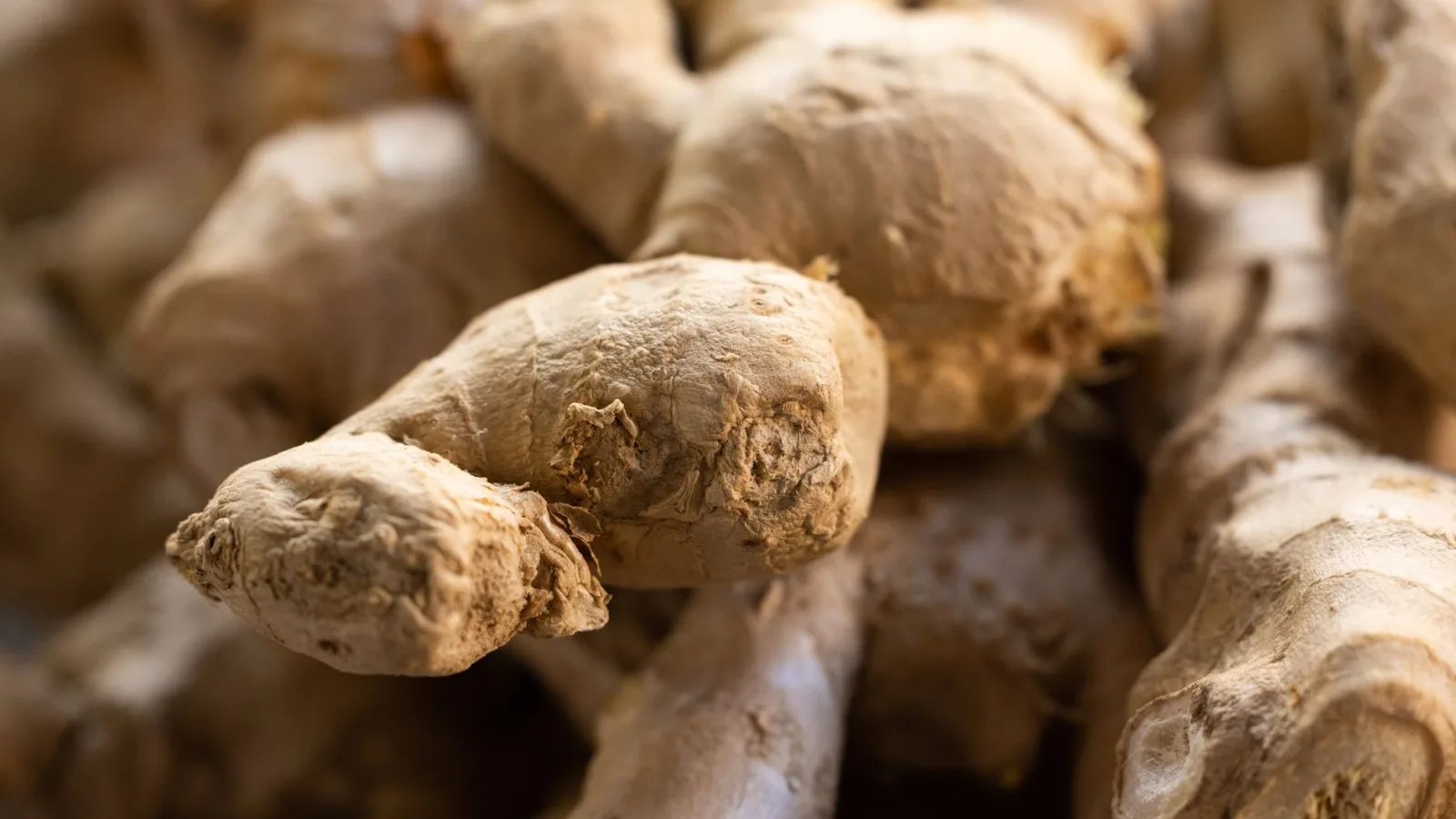
Ginger Through the Eyes of the Donguibogam
Ginger is a kitchen staple, but Korea's 17th-century medical classic, the Donguibogam, treated it as a serious remedy for nausea, chills and cold-weather complaints. Here is what the old text says about fresh and dried ginger, and how its advice compares with what we know today.
Siberian Solomon's Seal, Dug in Fall: Brew It with Jujube, Ginger, and Roasted Barley
Raw hwangjeong (Siberian Solomon's seal) rhizomes are too bitter to eat as they are. Here's how to blanch, steam, and dry them for a tea brewed with jujube and ginger or with roasted barley, and how to pick the spring shoots without losing your fall harvest.
A Mushroom That Tastes Like Almost Nothing: Cooking with Poria in Rice Cake, Porridge, and Tea
Poria is a capless fungus that hardens into white masses on pine roots, and September is when it comes out of the ground. Because it barely tastes of anything, it slips into rice cake, porridge, and jujube-ginger tea without changing the flavor — here's how much to use, and when.