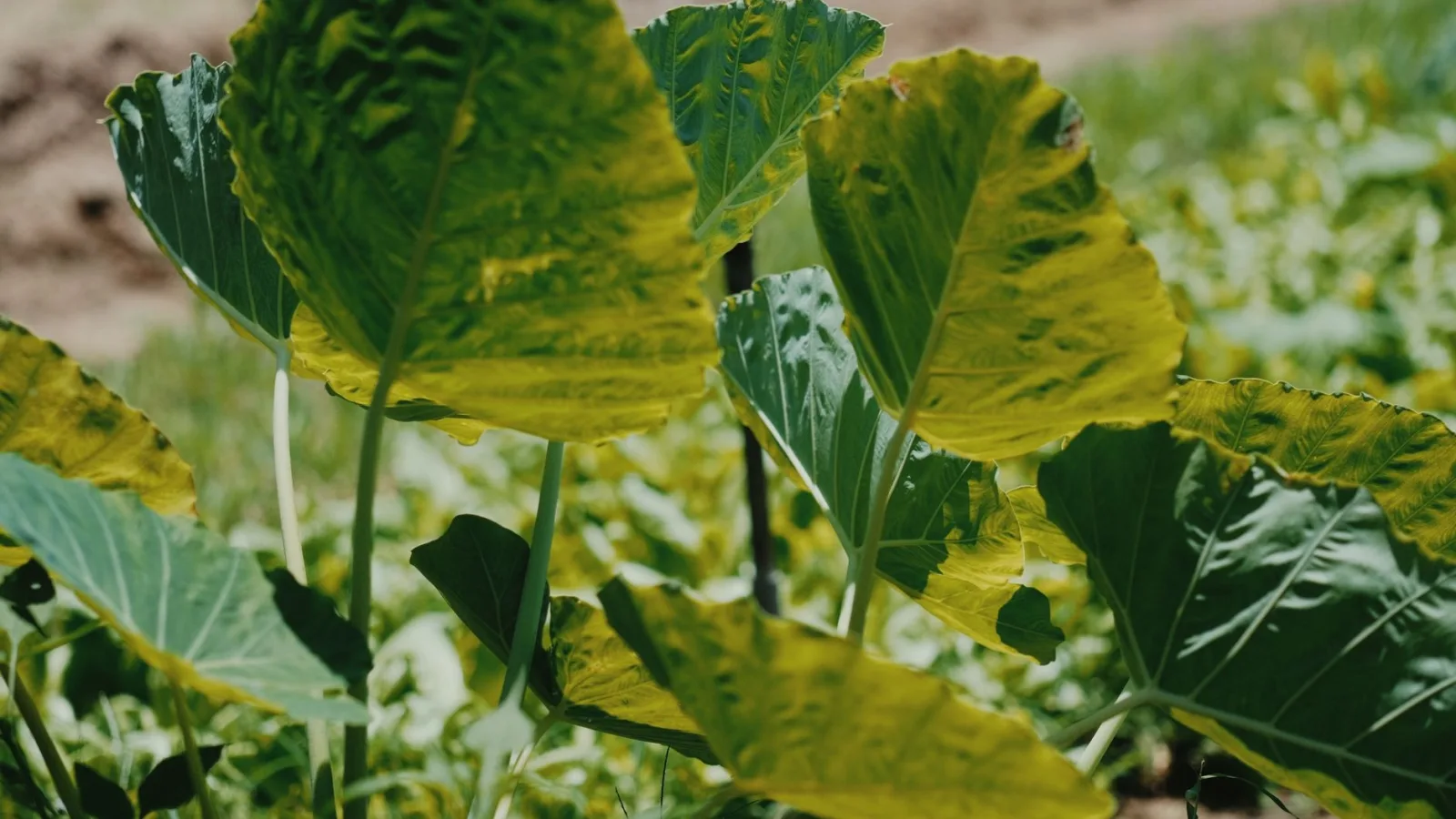
When autumn deepens, the taro tucked under those broad umbrella leaves at the edge of the garden starts to fatten. Brush the soil away with your hands and a whole family comes up at once: a big mother corm with a crowd of little offsets clustered around her. The Donguibogam, the medical compendium compiled in Korea in 1613, recorded exactly this arrangement. The corm at the center, the one that sends up the shoot, it called 芋頭 (udu), the "taro head"; the smaller ones growing off its sides were 芋子 (uja), the "taro children." Older writers knew the plant as 土芝 (toji), the earth's fungus of longevity, and in Korean folk usage it was also called 土蓮 (toryeon), the earth lotus. Hold a freshly dug corm in your palm and that second name suddenly makes sense.
For most Korean families, taro arrives at the table as a bowl of soup on a holiday evening. But how did the old physicians see this ordinary garden crop? Let's open the record together and read it slowly.
What the Donguibogam Recorded
The Donguibogam described the nature of taro (土芝) as neutral (平). It also preserved a dissenting view — that the plant is cold (冷) — and set the two accounts side by side rather than choosing between them. The flavor it gave as pungent (辛). But an important condition comes attached. Raw, the text says, taro is toxic and must not be eaten uncooked (生則有毒); cooked through, the toxicity disappears and the food becomes deeply nourishing (熟則無毒, 甚補益). In other words, the classic treated raw taro and cooked taro as two entirely different ingredients.
As for what cooked taro does, the Donguibogam wrote that it relaxes the intestines and stomach (寬腸胃), fills out the flesh and skin (充肌膚), and smooths the middle burner (滑中). Its action was understood to travel to the spleen (脾), the stomach (胃), and the large intestine. That is why taro was regarded as a gentle building food for patients in recovery, for the elderly and the frail, and for new mothers: it was thought to soothe the lining of the stomach and, with its abundant mucilage, to keep the bowels moving easily. The line about filling out flesh and skin carries an old assumption worth noticing — that when the body has been depleted, strength and complexion are to be restored together. The text even offers a specific recipe: simmered into a soup with crucian carp, it says, taro is better still (和鯽魚作羹, 尤良).
The leaves get their own entry. Taro leaves were described as cold (冷) in nature and free of toxicity, said to relieve restless heat in the chest (除煩) and to stop diarrhea (止瀉). They were also used for fetal restlessness in pregnancy (胎動) and for the tightness and agitation that came with it. The Donguibogam did draw one firm line, though: taro grown in cultivated fields may be eaten, but wild taro (野芋) from the open country is toxic and must not be.
Set Against Today's Nutrition
That phrase — "relaxes the intestines and stomach, smooths the middle" — maps neatly onto the first thing anyone notices about taro today: the slick, ropy mucilage. The stickiness you feel on your fingers while peeling comes from dietary fiber and mucilaginous compounds, which is where the old idea of easing the bowels (通便) and the modern conversation about fiber turn out to be talking about the same thing.
Taro is a starchy root vegetable, valued as a mild ingredient that cooks down soft and easy. The Donguibogam's view of it as convalescent food and our everyday sense that taro sits lightly in the stomach are not far apart. Old texts should be read in their own language, of course. When the Donguibogam says a food "nourishes and supplements," that cannot be carried straight across into the vocabulary of modern clinical medicine. Still, the long-held idea that taro, properly cooked, is mild and restoring is close to how most of us already feel about it at the table.
From Garden to Table
The most common way to meet taro is still taro soup. Simmered clear with dasima (dried kelp) or with fish, just as the Donguibogam suggested, it tastes like a holiday. Steamed taro and braised taro are both worth making, and the leaf stalks, sold as taro stems, go into perilla seed soup or yukgaejang, the spicy beef and vegetable stew.
One thing I want to be firm about, though. As the Donguibogam insisted more than once, taro must always be cooked. The slippery coating on raw corms contains calcium oxalate crystals, which will make bare hands itch and leave a sharp, prickling burn in the mouth. Wear gloves while you peel, or soak the corms briefly in water with a splash of vinegar, and the job goes much more easily. Anyone with a delicate stomach, sluggish digestion, or a history of kidney stones should go easy on the portion.
The earth lotus. In one round corm pulled out of your own soil sits the thinking of people who came long before us, and tonight's dinner besides. This fall, why not set a pot of taro on the stove and let it simmer soft?