- Type
- Tubers & Storage Roots
- Difficulty
- Moderate
- Season
- Spring
- Sowing
- Transplant
Taro (Toran)
Colocasia esculenta
Mucin and potassium - the slippery corm in Chuseok soup
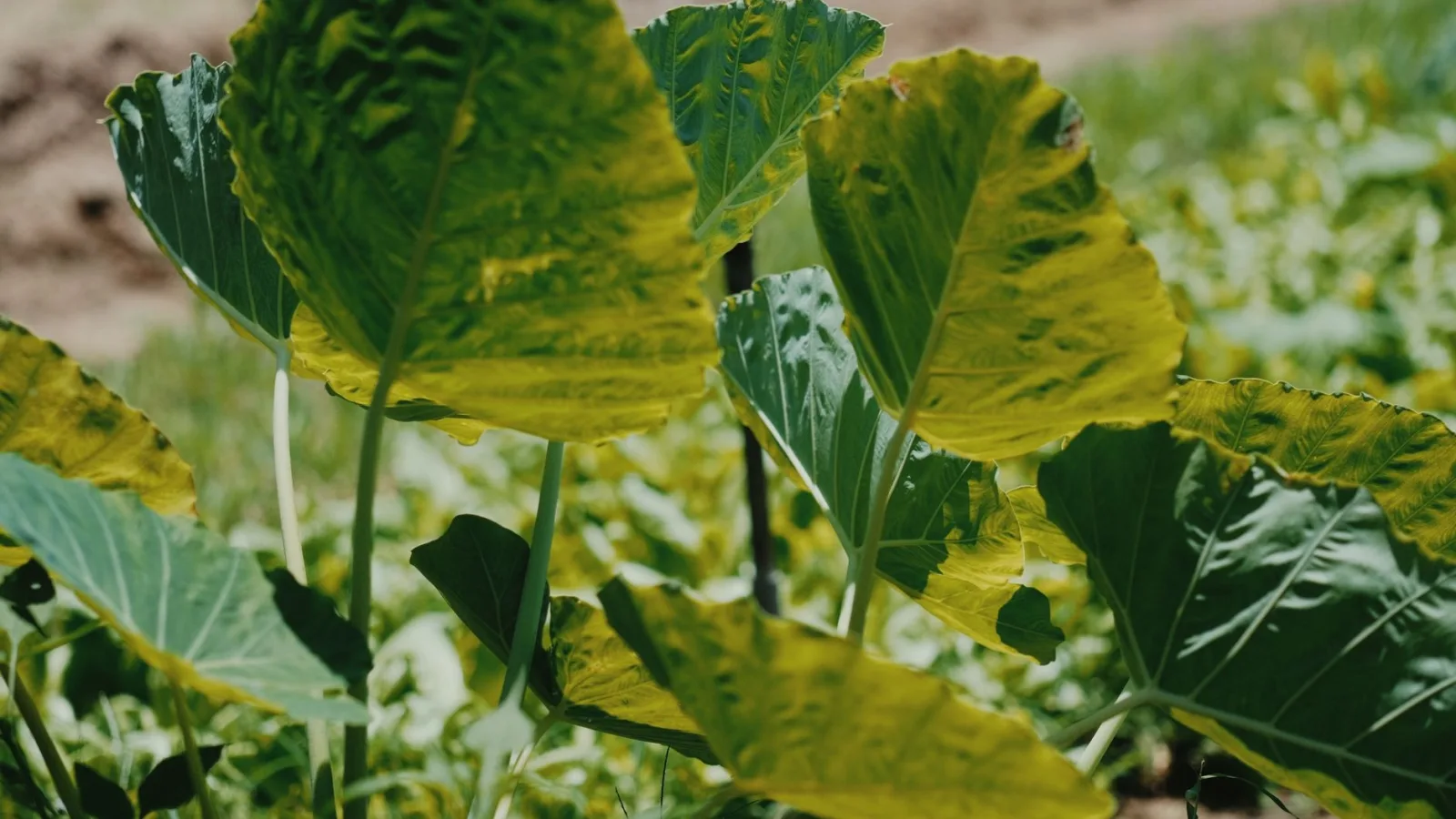
Taro is grown for the corm it swells underground, a vegetable defined by its slippery mucilage, made up of mucin and galactan. It carries plenty of potassium and dietary fiber, and in Korea it is a familiar ingredient, best known as the star of toran-guk, the taro soup traditionally eaten at Chuseok (the autumn harvest holiday). Raw taro has an acrid, throat-tickling bite, so peel it, boil it thoroughly, and discard the cooking water before it goes into a dish. The leaf stalks, sold as taro stems for yukgaejang and namul, are peeled and boiled the same way, with the cooking water discarded. Peeling bare-handed tends to leave the hands itching, so gloves are the better way to handle it. Plant it in April and harvest in September or October.
Year-Round Calendar
- 1
- 2
- 3
- 4
- 5
- 6
- 7
- 8
- 9
- 10
- 11
- 12
- 4
- 9
- 10
Where It Grows
- Main producer Produces roughly 40 percent of world output. The humid forest belt in the south is the centre of production.
- Main producer Grown as a staple crop in the high-rainfall belt along the Gulf of Guinea coast.
- Main producer The largest producer in Asia. The south — Guangxi, Guangdong, Fujian — is the centre of production.
- Major producer Grown in the rainy parts of the southwestern plateau.
- Major producer In the southern forest belt it is planted mixed in with other root crops.
- Major producer A long-standing staple of the Pacific islands, grown as far up as mountain wetlands.
It originates in the tropical wetlands running from northeastern India across Southeast Asia. Eastward it crossed to the Pacific islands and became a staple of Polynesia; westward it travelled the Indian Ocean into Africa, which now accounts for more than three quarters of world production. In Africa it is known as cocoyam — a name also given to the genus Xanthosoma, so the two are easily muddled in both statistics and naming.
- Optimum
- 25~30℃
- Range
- 13~35℃
- Hardiness
- Not hardy
Its natural home is the hot, humid tropics. It needs a frost-free stretch of more than five months to grow, and growth halts below 13℃. The corms go soft once frozen, so they have to be lifted before frost arrives.
In Korea Nationwide
It can be grown anywhere in the country, but the corms must fill out before frost, which favours the south with its long summers and plentiful moisture. Gokseong and Gurye in South Jeolla, and Sancheong in South Gyeongsang, are the best-known growing areas.
How to grow
- Light
- It tolerates part shade well
- Soil and depth
- 30cm deep. It likes damp ground
- Spacing
- 50cm
- Watering
- Plenty. Dry ground gives you no corms
- Feeding
- Base dressing plus one feed in summer
- Harvest
- Lift once frost has knocked the leaves down
What makes the difference. The leaves get big and take up room. Some people grow it partly for the summer shade
This page describes how a crop is grown and used. It does not claim health effects for any food, nor is it intended to prevent or treat disease. Component and study notes are references only and do not mean the same result occurs in people. Consult a medical professional about health concerns.
Health Benefits
Composition review. A comprehensive review of taro's composition and functional properties catalogues its dietary fiber, polysaccharides, and minerals. It is a stocktaking of what sits inside a crop long treated simply as a starchy staple.
Leaf extract (animal study). There is an animal-model report on taro leaf extract combined with tamarind. It studied an extract in animals, a different setting from eating the leaf or the corm as food, and it does not carry across to people.
Fermented poi. Researchers have analyzed the mineral profile and fermentation-microbe diversity of poi, the traditional Hawaiian fermented taro food. What can be said for now stops at the record that fermentation shifts the microbial makeup.
Food safety (heavy metals). A study evaluating heavy-metal reduction in taro grown near mining sites found boiling, peeling, and changing the cooking water to be effective. It is cooking information useful for food-safety management.
Handling and cooking (safety). Raw taro carries calcium oxalate crystals that irritate the mouth and throat, and peeling it bare-handed often leaves the hands itching. Heat alone does not make the crystals disappear. Safety assessments keep arriving at the same handling routine as the way to bring the irritation down: peel it, boil it thoroughly, then discard and change the cooking water.
2025 systematic review. A 2025 systematic review catalogues resistant starch, mucilaginous polysaccharides, anthocyanins, and the lectin tarin in taro. Most of the observations sit at the cell and animal stage and standardizing extraction remains unresolved, so what can be said for now stops at composition.
Nutrition
- Mucilage (mucin and galactan) (the slippery component) — the polysaccharide behind the slippery texture
- Potassium (abundant) — a principal mineral in the corm
- Dietary fiber (abundant) — carbohydrate that passes through undigested
Resistant starch Part of the starch in taro passes through the small intestine undigested and reaches the large intestine, where it becomes food for the gut microbes. Fermentation into short-chain fatty acids is as far as the confirmed picture goes.
Mucilage polysaccharides The slippery viscosity distinctive to taro comes from galactan and other mucilage polysaccharides. The composition is established; what happens in the stomach when a person eats it has not been settled.
Potassium, magnesium & dietary fiber Taro is rich in potassium, magnesium, and dietary fiber, and its potassium content in particular tends to run higher than potato's. It is a composition that carries minerals and fiber together.
Vitamin B6, E & folate Vitamin B6, vitamin E, and folate are present in balance. No single nutrient stands out; the profile is an even spread of several micronutrients.
Calcium oxalate raphides The calcium oxalate crystals behind the irritation and itching of raw taro are distributed through the mucilage, and they sit in the leaf stalks as well as in the corm and the leaves. Heat alone does not remove them: peeling, thorough boiling, and discarding and changing the cooking water are what bring the irritation down. Taro stems are peeled and boiled the same way, with the cooking water poured off; dried stems are soaked first, then boiled and rinsed. Peeling bare-handed tends to leave the hands itching, so gloves are the better way to handle it.
Assorted phenolic compounds in the leaves Taro leaves contain a variety of phenolic compounds. The leaves, however, carry the same calcium oxalate crystals as the corm, so they are always boiled thoroughly before eating and never eaten raw. A quick blanch is not enough, and the cooking water is discarded.
Pairings
○ Beef and ox-bone broth — Simmering taro soup with ox-bone broth and beef is a classic restorative dish of the Korean Chuseok holiday. The collagen in the bone broth meets taro's mucilaginous polysaccharides to deliver both deep flavor and the value of a recovery food.
○ Kelp (dasima) — Taro's mucilage and the alginic acid in kelp work in synergy. The calcium in the kelp also partly neutralizes the oxalate crystals in taro, reducing its irritant bite - a nutritional bonus. Kelp
○ Perilla (deulkkae) — Taro-stem perilla soup pairs the alpha-linolenic acid of perilla seed with taro's dietary fiber. A established autumn delicacy, it lets plant-based omega-3s and mucilaginous polysaccharides work together to benefit both the stomach and the cardiovascular system. Perilla (Deulkkae)
○ Yukgaejang — Dried taro stems are a classic ingredient in yukgaejang, a spicy beef-and-vegetable soup. The fiber and slight stickiness of the taro stems temper the heat of the fiery broth and add a pleasing texture.
○ Soy sauce, garlic, and ginger — Adding soy sauce, garlic, and ginger to braised or steamed taro is a basic Korean seasoning approach. The warming nature of garlic and ginger balances taro's neutral character, while the savory depth of soy sauce rounds out the flavor. Garlic · Ginger
△ Raw or undercooked leaves - never as a wrap — Taro leaves carry the same needle-shaped calcium oxalate crystals as the corm. Eaten raw as a wrap, they leave the mouth and throat stinging and sometimes swollen. Boil the leaves thoroughly before eating and discard the cooking water. Heat alone does not remove every crystal, so a quick blanch is not enough.
△ Taro stems (leaf stalks) - not cooked straight — The leaf stalks carry the same needle-shaped calcium oxalate crystals as the corm and the leaves. Peel them, boil them thoroughly, then discard the cooking water and rinse before they go into a dish. Dried taro stems are soaked first, then boiled and rinsed. Skip that handling and the mouth and throat are left prickling. Trimming raw stems bare-handed tends to leave the hands itching, so gloves are the better way to handle them.
△ Raw taro with milk or cheese — Oxalate in raw taro can bind with calcium, so preparations that use the corm raw are off the table. Taro is a cook-first ingredient to begin with. Peeling it, boiling it thoroughly, and discarding the cooking water carries much of the oxalate away with the water. Heat alone, though, does not remove every crystal.
△ A history of kidney stones — Anyone with a history of kidney stones is safer not eating a large amount of taro at one sitting. Taro contains oxalate, and boiling it and pouring off the cooking water brings that amount down.
△ A sensitive stomach — The stickiness of taro can sit heavily with people whose stomachs are sensitive, so keep the portion small. Cooking taro with ginger, as in braised taro or taro soup, is a long-standing practice.
Varieties
- Corm-type taro (Corm) — Sets many small cormels around the mother corm. Choose this for the round pieces used in taro soup.
- Stalk-type taro (Corm) — Thick, long leaf stalks. Grown for the stalks, which are cut through summer and dried for storage.
- Red-stalked taro (Corm) — Red leaf stalks that stand out in a bed. More acrid, so boil and soak the stalks well before use.
Source: Food and Nutrition Information