

- Type
- Trees & Vines
- Difficulty
- Moderate
- Season
- Fall
- Sowing
- Plant a sapling
Jujube
Ziziphus jujuba
Sugars and triterpenes in a red fruit meant to be dried
Jujubes are the fruit of Ziziphus jujuba, picked once they redden in September or October and then dried. The Donguibogam lists them in its fruit section as daejo and preserved the instruction to split them before adding them to a decoction. The same text adds that eating a lot of fresh jujube causes bloating and diarrhea, and recommends steaming them instead. That is a historical medical record and differs from modern medical judgment. A sapling planted in spring bears nothing that first year; two to three seasons usually pass before the first fruit, and after that it crops in the same spot each year. The tree leafs out so late in spring that people regularly assume it has died, but it is self-fertile and will set fruit as a single specimen, which keeps the demands of one potted tree low.
Year-Round Calendar
- 1
- 2
- 3
- 4
- 5
- 6
- 7
- 8
- 9
- 10
- 11
- 12
- 3
- 4
- 9
- 10
Where It Grows
-
Origin
The place of origin, and the source of almost all of the world's production. Six provinces — among them Xinjiang, Hebei, Shandong and Shanxi — account for nine-tenths of it. Harvest September, October
- 9
- 10
-
Major producer
The growing areas are the inland basins of Gyeongsan and Cheongdo in North Gyeongsang, and Boeun in North Chungcheong. Harvest September, October
- 9
- 10
- Major producer Grown on the dry inland plateau under the name annab.
- Major producer What is grown here is the Indian jujube (Ziziphus mauritiana), a different species from the jujube tree.
It originates in the Yellow River basin in China, and still today almost all of the world's production comes from China. Korea, Iran, the United States and Australia also grow it commercially, but on a far smaller scale. What is widely grown in India, Southeast Asia and Africa is the Indian jujube (Ziziphus mauritiana), which overlaps only in name and use and is a different species, so when the two are shaded onto a single map the species must be named and kept apart.
- Optimum
- 20~30℃
- Range
- 10~38℃
- Hardiness
- Hardy
- Day length
- Not applicable
In a continental climate — hot summers, strong sun, little rain in autumn — the fruit grows large and sweet. The leaves break late and drop early, so the tree takes winter cold well; the trade-off is that frequent rain around ripening splits the fruit and lets mould in. The roots run deep, so it stands up to drought. Flowering is not triggered by day length but by rising spring temperatures, and the flowers open on that year's new shoots.
Harvested 2–3 years after planting. Saplings are planted in March and April, and the first fruit usually appears two or three years later. The month of planting and the month of picking do not fall in the same year. The tree is self-fertile, so a single specimen will set fruit on its own, and because the leaves do not break until nearly May it is easy to assume it has died.
In Korea Nationwide
Inland basins with plenty of summer sun and little autumn rain suit it best. Gyeongsan and Cheongdo in North Gyeongsang and Boeun in North Chungcheong are the known areas. Picking begins in September and October, once the skin has turned red; fruit destined for drying is left on the tree longer before it is picked.
How to grow
- Light
- Six or more hours of direct sun. More sun means higher sugar and less disease.
- Soil and depth
- Not fussy as long as drainage is good. It grows in poor ground, but avoid anywhere water pools.
- Spacing
- Four to five meters in open ground. One tree per pot of 40 cm or more, ideally a naturally compact cultivar of the fresh-eating type.
- Watering
- Deep roots make it fairly drought-tolerant. The exception is August, when the fruit is sizing: a dry spell then leaves you with small fruit.
- Feeding
- Ring the base with compost in March. Heavy feeding produces leggy shoots and less fruit.
- Harvest
- Pick in September or October once two-thirds of the skin has reddened. For drying, wait for full color, then sun-dry or use a dehydrator around 45 C.
What makes the difference. Jujubes leaf out so late, sometimes not until May, that people pull them up thinking they are dead. Wait until June before deciding. The tree is self-fertile, so a single plant will fruit.
Why this one is harder. Left alone it reaches 5-8 m. In a pot, choose a compact cultivar and prune every year to hold the height.
Common problems
- Jujube witches' broom You will see A dense broom of twiggy shoots from one point on a branch, with undersized leaves What to do There is no cure, so dig out and burn infected trees. Control the leafhopper that spreads it as well
- Peach pyralid moth You will see Caterpillars inside ripening fruit with frass stuck to the outside What to do Gather and destroy dropped fruit and bag the fruit on the tree
- Aphids You will see Curled new shoots and sticky leaves What to do Wash them off with water and break the ant trails
This page describes how a crop is grown and used. It does not claim health effects for any food, nor is it intended to prevent or treat disease. Component and study notes are references only and do not mean the same result occurs in people. Consult a medical professional about health concerns.
Health Benefits
What the old text says. Jujube appears in the Donguibogam's fruit section as daejo. The entry keeps a preparation note - split the fruit before putting it in a decoction - and adds the caveat that eating a great deal of the fresh fruit brings bloating and loose bowels, so it is better steamed. This is a record from an old medical text, not a modern medical judgement.
Polysaccharide research. Test-tube and animal studies have reported antioxidant measurements for polysaccharides extracted from jujube. Evidence in humans remains limited.
Not the same as sour jujube seed. The sleep-related research people often cite was largely done on sour jujube seed (suanzaoren), not on the fruit here. Sour jujube is a variety of the same species (Ziziphus jujuba var. spinosa) and the part used is the seed rather than the flesh, so those findings do not transfer to eating jujubes.
Nutrition
- Sugars (About 70 % of the dried fruit) — The basis of the sweetness and the calories
- Vitamin C (Over 60 mg per 100 g of fresh jujube) — A water-soluble vitamin, largely lost in drying
- Dietary fibre (About 6 g per 100 g dried) — Fibre concentrated by drying
- Triterpenic acids (Betulinic and oleanolic acid among others) — Compounds distributed through skin and flesh
Sugar in dried fruit Drying pulls the water out and concentrates the sugar. Dried jujubes run around 70% sugar, which puts their calories per gram well above most fruit. Added to tea or sweet rice dishes they sweeten without any sugar. By the same token, it is worth counting them when you snack on them.
Vitamin C in fresh fruit It is not widely known, but fresh jujube is reported at over 60 mg of vitamin C per 100 g. Almost all of it disappears in drying, so if that is what you are after, eat the fresh fruit that shows up in September. The crisp, apple-textured cultivars are the ones sold for eating fresh.
Fiber and minerals Dried jujube carries roughly 6 g of fiber per 100 g. Potassium and iron come along, and you get more of both if you eat the flesh left after brewing tea. The skin is tough enough to resist chewing, so split them open when using them in tea.
Triterpenic acids Jujube contains triterpenic acids such as betulinic and oleanolic acid. Several test-tube and animal studies have reported on the activity of these compounds. They sit mainly in the skin and flesh.
Pairings
○ Ginger and tangerine peel — Simmered together, dried jujube, ginger, and dried tangerine peel make a winter tea. The sweetness of the jujube carries the heat of the ginger and the faint bitterness of the peel. Split the fruit open so the flavor actually comes out. Ginger · Tangerine peel
○ Chicken soup — Putting jujubes into samgyetang or a plain chicken soup is a long-standing combination. They lend the broth a quiet sweetness and tie the other ingredients together. Leave the pits in while cooking, then work around them when eating.
○ Nuts and seeds — Split a dried jujube, take out the pit, and press a walnut or hazelnut into the cavity, and you balance the sugar with fat. Blood sugar rises more slowly than with a purely sugary snack. Two or three at a time is the right amount. Hazelnut (Korean hazel)
△ The pit — Jujube pits are hard and sharply pointed, and biting one carelessly can crack a tooth. Children can also swallow them whole, so always remove them first. Even for tea, splitting the fruit is safer than dropping it in whole.
△ Blood sugar — At around 70% sugar, dried jujube is among the most sugar-concentrated fruit there is. If you manage your blood sugar, decide on a number before you start. Remember that sugar carries into the water when you brew it as tea, too.
△ Too much fresh fruit — The original text says outright that eating a lot of fresh jujube causes bloating and diarrhea. The skin is tough and the fiber load high, so several at once sit heavily. The same text's advice to steam them first still holds.
Varieties
- Bokjo (Sapling) — Korea's main drying variety. Even-sized and dries well.
- Wolchul (Sapling) — A Korean-bred variety. Harvested comparatively early.
- Apple jujube (Sapling) — A large-fruited line eaten fresh. Crisp, on a smaller tree.
- Boeun landrace (Sapling) — The old line around Boeun in North Chungcheong. Deeply fragrant.
Source: Donguibogam, Fruit Section (大棗) · Rural Development Administration (nongsaro.go.kr)
Stories about Jujube
Simmer Kudzu Root with Jujubes and Ginger; Mix Its Starch with Buckwheat Flour
Dug after its leaves fall, kudzu root can be simmered into tea or made into a fine starch, and each one calls for different partners. The tea goes with jujubes, honey, and ginger, and the starch goes with buckwheat or wheat flour for noodles and with honey for pressed sweets.
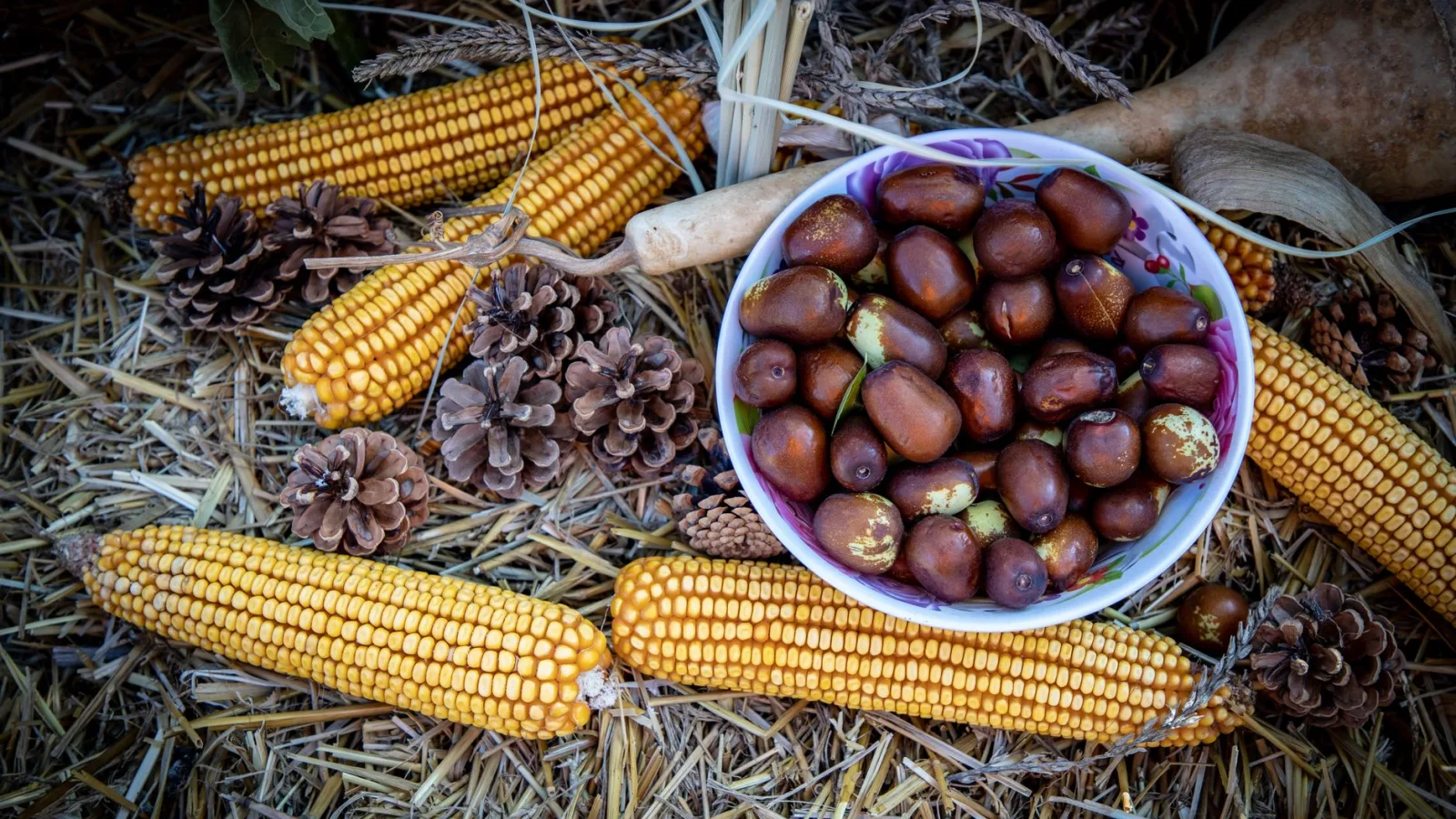
If You Turned to Jujubes for Better Sleep
Many of the sleep studies linked to jujubes actually look at sour jujube seed, not the dried red fruit. Here's what is known about the fruit, how many to eat, and how to prepare them.
Licorice Root: Which Pot, and How Many Slices?
Licorice root's sweetness builds slowly and stays on the tongue, so it matters what you pair it with. Here's how to use it in jujube-ginger tea, pork broth and bitter herbal brews, and why a couple of slices is usually all you need.
Siberian Solomon's Seal, Dug in Fall: Brew It with Jujube, Ginger, and Roasted Barley
Raw hwangjeong (Siberian Solomon's seal) rhizomes are too bitter to eat as they are. Here's how to blanch, steam, and dry them for a tea brewed with jujube and ginger or with roasted barley, and how to pick the spring shoots without losing your fall harvest.