- Type
- Trees & Vines
- Difficulty
- Hard
- Season
- Fall·Winter
- Sowing
- Plant a sapling
Tangerine peel
Citrus reticulata
Hesperidin and limonene in the dried peel of a mandarin
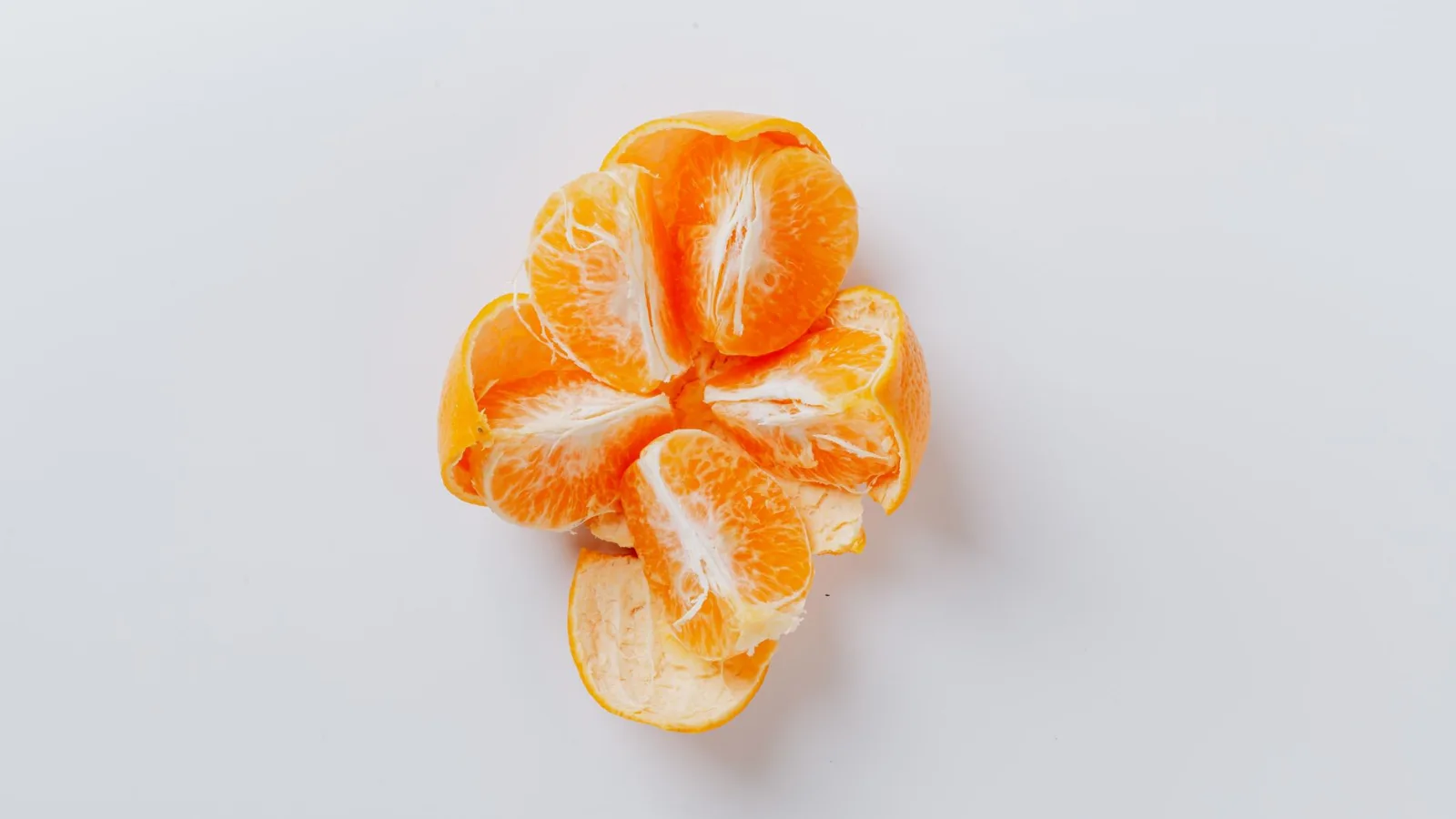
Tangerine peel is exactly that: the rind of the mandarin. Fresh it is gyulpi; aged past a year it becomes jinpi (chenpi). The two are not different trees or different cultivars but the same peel at different ages, so there is no separate jinpi sapling to look for. The Donguibogam splits the preparation in two, using the peel one way with the white inner layer kept and another way with it scraped off, and it adds that in Korea the fruit grows only on Jeju. On Jeju, drying the peel left over from winter mandarins and brewing it as tea is still ordinary practice. The peel is also where pesticide residue and coating wax collect, so choose fruit grown without them where possible, scrub it with coarse salt or baking soda under running water, and wipe it dry. After that, slicing it thin and drying it on a windowsill is all it takes.
Year-Round Calendar
- 1
- 2
- 3
- 4
- 5
- 6
- 7
- 8
- 9
- 10
- 11
- 12
- 3
- 4
- 10
- 11
- 12
Where It Grows
-
Origin
The Nanling Mountains of the south are the mandarin's homeland, and the country still accounts for close to half of world citrus production. For chenpi, the aged dried peel, the peel of Xinhui in Guangdong has long been rated in a class of its own. Harvest October, November, December
- 10
- 11
- 12
-
Major producer
Valencia and Andalusia supply Europe's winter volume. Harvest October, November, December, January
- 1
- 10
- 11
- 12
- Major producer Adana and Mersin, on the Mediterranean coast, are the center of production.
- Major producer The crop is harvested in the Nile Delta in winter and exported.
- Major producer The Souss Valley and the Gharb Plain are the growing regions.
-
Major producer
Satsuma mandarins are grown in Wakayama, Ehime and Shizuoka. Harvest October, November, December
- 10
- 11
- 12
The mandarin (Citrus reticulata) comes from southeastern Asia, an arc running from southern China to northeastern India, and has since spread along the mild-winter coastal belts of the southern temperate and subtropical zones. Few places, however, grow it for the peel; most simply dry what is left after the flesh has been eaten. About the only place that keeps a separate growing area and a separate cultivar line for peel is Xinhui in Guangdong, China. Mandarins on the market are heavily hybridized, so in the statistics citrus cannot be matched one-to-one with a species.
- Optimum
- 20~30℃
- Range
- 10~35℃
- Hardiness
- Half-hardy
An evergreen fruit tree of the subtropics, where winters are mild. It does best where the annual mean temperature is around 15℃, and once the thermometer drops below −5℃ the leaves and branches freeze. A gap between day and night temperatures while the fruit ripens is what lays down deep scent and color in the peel; frequent rain thickens the peel and splits it.
Harvested 3–4 years after planting. Three or four years must pass after a sapling is planted before it carries enough fruit for the peel to be worth using. The month of planting and the month of the first picking do not fall in the same year.
In Korea Jeju and the south coast
Jeju accounts for very nearly all domestic production, and in parts of Goheung and Wando in South Jeolla and Geoje in South Gyeongsang the trees manage overwintering — surviving the cold season outdoors — in open ground. In the central region they must be planted in pots and brought inside for the winter.
How to grow
- Light
- Six hours or more of direct sun. A tree grown for its peel especially needs full sun for the aroma to develop.
- Soil and depth
- Free-draining, slightly acidic soil at pH 5.5-6.5. In a pot, mix in 30% coarse grit and put gravel in the base.
- Spacing
- Three to four meters in open ground. One tree per pot of at least 45 cm diameter.
- Watering
- Water thoroughly once the surface dries. Repeated drought thickens the rind and splits it.
- Feeding
- Organic fertilizer in March and October. If the peel is the point, keep synthetic sprays and foliar feeds to a minimum.
- Harvest
- Pick from October to December once the rind has colored. For green peel, gather unripe fruit separately in September or October.
What makes the difference. Separate the flesh, slice the rind 3-4 mm thick with the white layer left on, and dry it in the shade with good airflow for three to five days. Direct sun drives the aroma off. Once bone dry, seal it in a glass jar and leave it a year or more and it becomes jinpi.
Why this one is harder. It only overwinters outdoors on Jeju and the southern coast. Further north the pot comes inside every winter, and it takes three to four years before the tree carries enough fruit for peel.
Common problems
- Citrus red mite You will see Bleached leaves with red specks on the undersides What to do Blast the leaf undersides with water; on a tree grown for peel, choose physical control over sprays
- Scale insects You will see White shells on branches and fruit stems with sooty mold below What to do Scrub them off with a toothbrush and apply horticultural oil in winter
- Melanose You will see Black speckling scattered over the rind What to do Cut out and burn dead wood and thin the canopy so it dries quickly after rain
This page describes how a crop is grown and used. It does not claim health effects for any food, nor is it intended to prevent or treat disease. Component and study notes are references only and do not mean the same result occurs in people. Consult a medical professional about health concerns.
Health Benefits
What the old text says. Tangerine peel appears in the Donguibogam's fruit section as gyulpi. The entry preserves a preparation rule that splits the peel by whether the white inner layer is kept or scraped away, and notes that in Korea it grew only on Jeju. This is a record from a seventeenth-century medical text, not a modern medical judgement.
Hesperidin research. Studies in test tubes and animal models have reported antioxidant measurements for hesperidin extracted from citrus peel. The amount you get from steeping peel as tea is far below the doses used in those studies.
Nutrition
- Hesperidin (Concentrated in the white pith) — Studied for antioxidant effects
- d-Limonene (About 90 % of the peel oil) — The scent particular to citrus
- Pectin (The soluble fibre of the white pith) — Gives body and sets marmalade
- Nobiletin and tangeretin (Minor flavonoids) — Part of the bitterness and aroma
Hesperidin Peel holds far more hesperidin than the flesh does. It concentrates in the white inner layer, so the more of that you scrape away, the less of the compound remains. The Donguibogam's rule about whether to keep or remove the white runs parallel to this, though the text itself gives no reason for the split. A number of test-tube and animal studies have reported on its antioxidant measures.
Essential oil and aroma The dimpled specks across the outer surface are the oil glands. The d-limonene inside them accounts for most of what reads as citrus scent. Because the oil is volatile, long aging drives the aroma off, so use freshly dried peel when you want fragrance and aged peel when you want the bitterness softened.
Pectin The white pith is rich in pectin, a soluble fiber. That is why marmalade sets without added pectin. Very little of it carries over when you simply steep the peel in hot water.
Pairings
○ Ginger — Simmered together, dried peel and ginger layer heat over citrus into a winter tea. About 3 g of each in 500 mL of water, boiled for ten minutes, is a good ratio. Dried jujube instead of sugar handles the sweetness. Ginger
○ Jujube — The sweetness of jujube covers the faint bitterness of the peel. Old prescriptions frequently decocted the two together. Split the jujube open first or the flavor stays locked inside. Jujube
○ Rich meat dishes — A piece of peel dropped in while boiling pork belly cuts the heavy smell. The essential oils work against the odor of the fat. Too much leaves bitterness behind, so two or three thumbnail-sized pieces per pot is plenty.
△ Pesticide and wax — The rind is where pesticide residue and coating wax concentrate. If you plan to use the peel, buy fruit labeled organic or low-spray, scrub it with coarse salt or baking soda under running water, and then dry it. Imported citrus with a heavy shine is not a good candidate for peel.
△ Mold — Peel that goes damp partway through drying grows white mold first. If you see any, discard the whole batch rather than trimming the affected piece. Only fully dried peel, sealed in a jar with a desiccant, will age into jinpi.
△ Daily use as a medicinal — Aged peel is a herbal medicine, and prescriptions specify it in grams per day. If you intend to take large amounts daily over a long stretch rather than drinking it casually as tea, talk to a pharmacist or Korean medicine practitioner first. That goes double during pregnancy or alongside prescription medication.
Varieties
- Satsuma peel (Sapling) — The most common tangerine peel. Thin and quick to dry.
- Green tangerine peel (Sapling) — The unripe green peel, corresponding to the 靑皮 of the old record.
- Byeonggyul peel (Sapling) — From the Jeju landrace citrus. Strongly aromatic and thick.
- Jinpi (aged peel) (Sapling) — Peel kept a year or more. The bitterness settles and the aroma deepens.
Source: Donguibogam, Fruit Section (橘皮) · Rural Development Administration (nongsaro.go.kr)