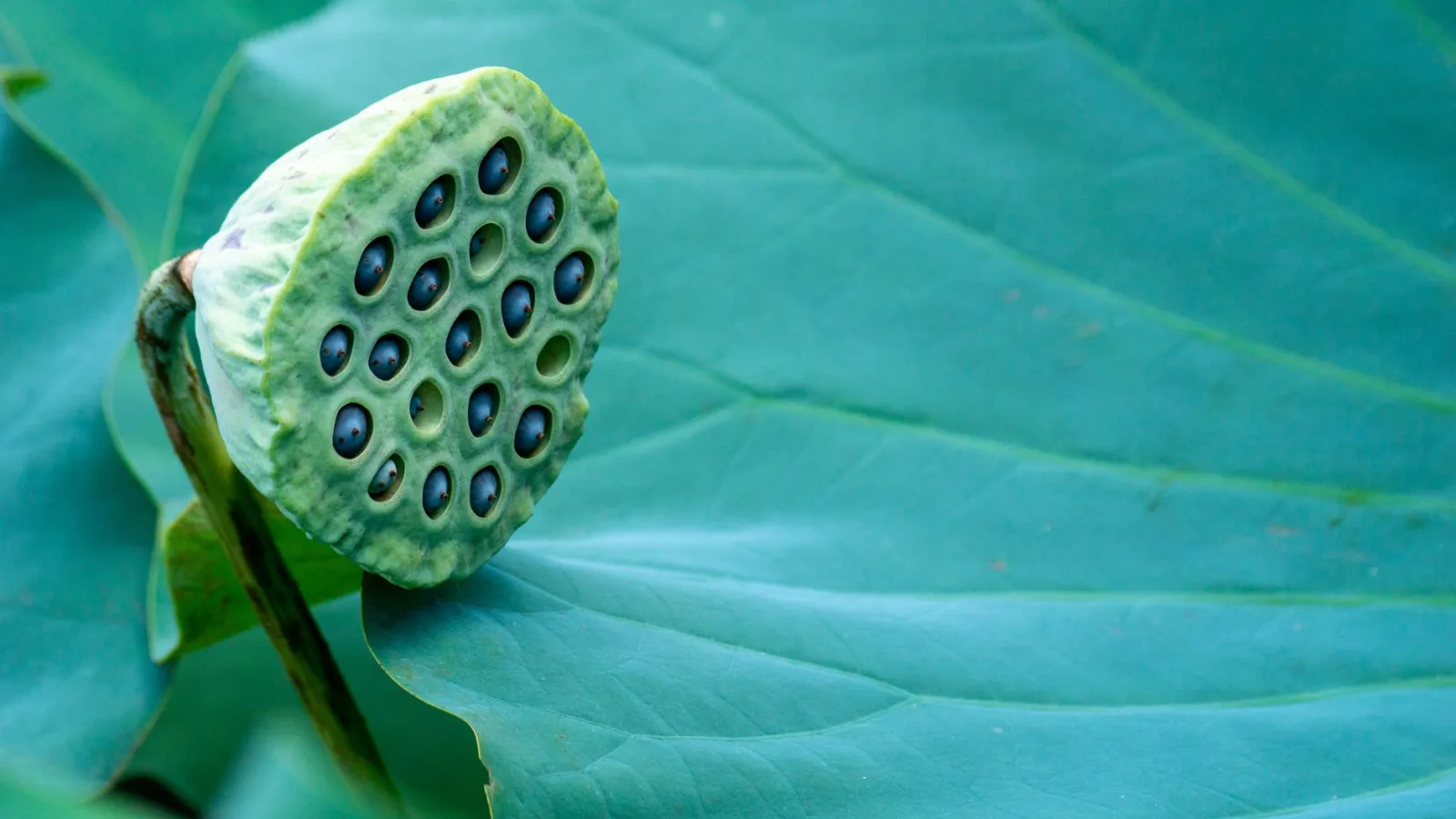
Once a lotus flower fades, its seed head dries into a honeycomb, with a single seed set into each cell. Pry a seed out and peel off the shell, and you find a white kernel. Split that kernel lengthwise and there, at the very center, sits a green core. Of all the questions people bring us when a search for lotus seeds lands them here, this green core draws the most. Do you have to take it out? Why is it so bitter? And what does it mean when a package says it holds only the cores? One tiny speck, and all the questions pile up on it.
The core is the part that would become the sprout
A lotus seed is exactly that, a seed, and the green core is its embryo. It's the same part as the little bud you find when you soak a bean and split it open. The white kernel is the seed leaves, where the plant has stored starch and protein, and the core is what will unfurl into the first young leaves once it meets water. Set a seed in a water-filled rubber tub at least 40 cm across and this core is the first thing to grow. In the Northern Hemisphere, lotus is planted in April and May and the seeds are harvested in August and September. In Korea, they come from the same areas that grow lotus root, around Muan in South Jeolla and Buyeo in South Chungcheong. Worldwide, China, Vietnam, and India are the biggest growers.
It's bitter because the alkaloids collect in the core
Touch the core to your tongue and it's fiercely bitter. The white kernel is mild, something like a chestnut, and only the core is bitter, which tells you the bitter compounds have gathered there. Those compounds are alkaloids. The most abundant one in a lotus seed core is neferine, with liensinine and isoliensinine alongside it. The white kernel, by contrast, is mostly starch, so it steams up with a texture close to chestnut, and its protein runs higher than grains, closer to that of nuts. It's fairly rich in minerals like potassium, too. At about 330 kcal per 100 g of dried seeds, the calories are on par with grains, so a bag of dry-roasted lotus seeds empties fast. You're better off setting out 20 to 30 g at a time. The core is bitter and the kernel is mild, so at the table, the core comes out and only the kernel goes in.
The old texts said take it out; the pharmacopoeia gave it a listing of its own
The Donguibogam, the Korean medical compendium published in 1613, lists lotus seeds under the name yeonsil (蓮實) in the fruits section of its chapter on medicinal substances. It advises choosing seeds from white-flowered lotus and removing the green core at the center because it is bitter. The same entry says to gather seeds in the eighth and ninth lunar months, once they have hardened and turned dark, and to steam them rather than eat them raw, since raw seeds leave you bloated. The Chinese Pharmacopoeia, meanwhile, gives that removed core its own entry under the name lianzixin (蓮子心), the lotus plumule. From a single seed, the kernel and the core each ended up with a name of their own. As for the core's alkaloids, what exists are reports at the animal-study stage, with nothing confirmed in people, and the amount you eat as food is nothing like the amount used in a lab. You take the core out because it is bitter, not because either the kernel or the core prevents or cures any illness.
Soaking, coring, and cooking times
Cover 30 g of dried lotus seeds with 300 ml of water and soak for at least two hours. Split a soaked kernel in half lengthwise and the core drops out in one piece. If you'd rather keep the seeds whole for looks, push a toothpick into the small hole at the base of the seed and nudge the core up and out. Most store-bought lotus seeds have already been cored, but split one or two first and check for a green speck. If it's still there, that seed will be bitter. Soaked seeds need at least 20 minutes of cooking to turn soft all the way through. A firm center means they're underdone. Scatter 30 g of soaked lotus seeds over 300 g of rice before you cook it and you get a texture much like chestnut. The seeds are hard, so they need to start soaking before the rice does, or the centers won't cook through. Try adding about 50 ml more water than usual. The same goes for yeongyang-bap, the mixed rice cooked with jujubes and chestnuts: the lotus seeds go in ahead of the other ingredients so everything finishes together. Braised with lotus root, the fluffy kernels and the crunch of the root meet in a single bowl. How to grow both and how they pair is written up, with a planting calendar, in our lotus seed crop guide.
What does it mean when a package sells only the core?
A package labeled yeonjasim, 蓮子心, or lotus plumule holds nothing but the cores, collected without the kernels. They're sold mainly as a tea for steeping in hot water. Ground whole, they're too bitter to get down. Check the product name so you don't come home with a bag of cores when you meant to buy seeds for your rice. And if you're after that bitterness and buying the cores on purpose, know that the white kernels carry far less of those compounds than the core does. Splitting a seed and lifting out one green speck is a step written down in a medical text from 1613, and on the packaging of today.
Sources: Donguibogam, chapter on medicinal substances (Tangaek-pyeon), fruits section, entry on yeonsil (lotus seed) · Chinese Pharmacopoeia, entry on lianzixin (蓮子心, lotus plumule)