- Type
- Grains
- Difficulty
- Moderate
- Season
- Fall
- Sowing
- From rhizome
Lotus Seed
Nelumbo nucifera
Starch, alkaloids · the seed the lotus flower leaves behind
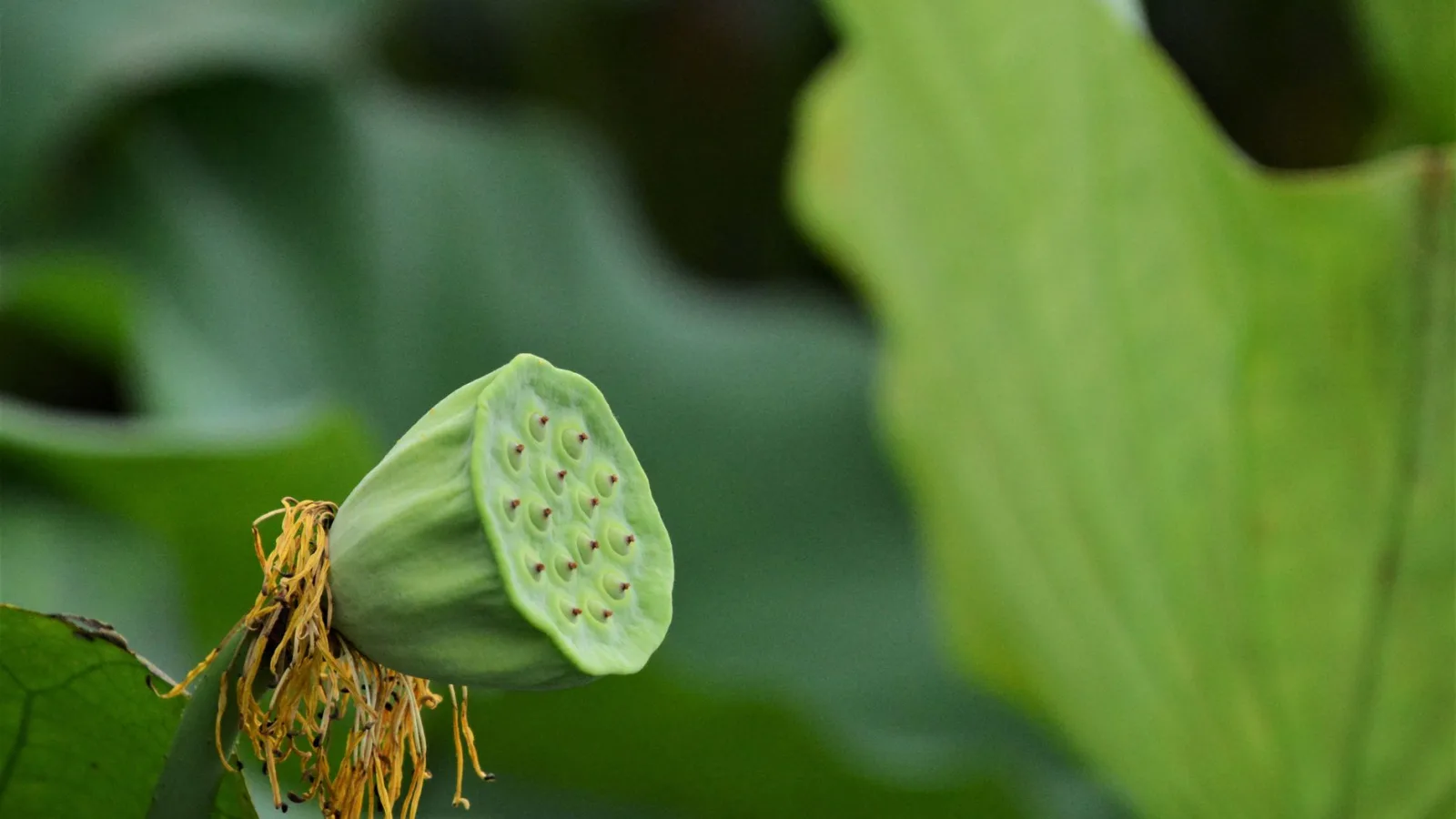
Lotus seeds sit in the honeycomb-shaped receptacle left standing after the flower drops. Peel the shell and you get a pale kernel with a green embryo at its centre, and that embryo is intensely bitter, so it is usually removed. In Korea the seeds come out of the same growing areas as lotus root, mainly Muan in South Jeolla and Buyeo in South Chungcheong. In cities, people grow a small lotus in a water-filled tub at least 40 cm across. The Donguibogam said to gather the hard, blackened seed in the eighth and ninth lunar months, and that steaming was better than eating it raw, which left the belly bloated.
Year-Round Calendar
- 1
- 2
- 3
- 4
- 5
- 6
- 7
- 8
- 9
- 10
- 11
- 12
- 4
- 5
- 8
- 9
Where It Grows
-
Main producer
In the ponds and paddies of Hunan, Hubei, Jiangxi and Fujian, seed-type varieties are grown separately. Most of the world's lotus seed comes from here. Harvest July, August, September
- 7
- 8
- 9
- Major producer It is grown in ponds in the Mekong Delta and around Hue.
- Wild population It falls within the native range and grows wild widely in ponds and reservoirs.
It is native to the ponds and marshes of temperate and subtropical Asia, from India through China and Southeast Asia, so it cannot be pinned to any single country. Commercial production is heavily concentrated in China, while in Korea and Japan the main product is the rhizome, or lotus root, with the seed taken as a side harvest. The grain sold in India as makhana is the seed of the prickly water lily (Euryale ferox), a different species from the lotus seed.
- Optimum
- 22~30℃
- Range
- 15~35℃
- Hardiness
- Hardy
An aquatic plant that grows well in summer heat. The leaves and flower stalks rise quickly only once the water is above 20℃, and in winter the rhizome overwinters — passing the cold season dormant — down in the mud. It cannot survive where the water freezes all the way to the bottom.
In Korea Nationwide
The lotus fields of Muan in South Jeolla and Buyeo in South Chungcheong are well known. Where ponds do not freeze to the bottom, the plant overwinters anywhere in the country, and the seed is harvested from late summer into autumn, when the flower receptacle dries to brown.
How to grow
- Light
- Six hours of direct sun or more. In less light you get leaves and no flowers.
- Soil and depth
- Fine clay, like paddy soil or loess. Ordinary potting mix floats and breaks apart, so it will not work.
- Spacing
- One rhizome per tub of 40 cm diameter. Crowd them and the leaves simply shade each other.
- Watering
- Keep 5 to 15 cm of water standing over the soil. Evaporation is fast in summer, so top up every other day.
- Feeding
- Bury the base fertiliser deep in the clay at planting. For top dressing, press pellets into the soil rather than dissolving anything in the water.
- Harvest
- August into September. When the receptacle dries brown and the seeds are black and hard, break the whole head off and pick the seeds out.
What makes the difference. To grow from seed, file a small patch off the hard coat with sandpaper or nail clippers before soaking. Left intact, the seed can sit in water for months without sprouting. At around 30 degrees it germinates in about a week. Over winter, bring the tub indoors or keep the water deep enough not to freeze solid.
Common problems
- Lotus leaf beetle You will see Dense small holes chewed through the leaf pads. What to do Pick them off by hand. If anything lives in the water, hand removal beats spraying.
- Aphids You will see Black clusters on the emerging leaf stalks. What to do Wash them off with water. Spraying into the tub fouls the water.
- Mosquito larvae You will see Wrigglers in the standing water. What to do Two or three loaches or killifish will usually clear them out.
This page describes how a crop is grown and used. It does not claim health effects for any food, nor is it intended to prevent or treat disease. Component and study notes are references only and do not mean the same result occurs in people. Consult a medical professional about health concerns.
Health Benefits
What the old record says. Lotus seed appears in the Donguibogam's fruit section as yeonsil. The entry favours seed taken from the white lotus and specifies removing the bitter green core. This is a record from a seventeenth-century medical text, not a modern medical judgement.
What studies have observed. Animal experiments have been reported on the alkaloids in the lotus seed embryo. Nothing has been confirmed in humans, and the amounts used in those experiments are far from what anyone eats as food.
Nutrition
- Starch (About 65 g carbohydrate per 100 g of dried seed) — Steamed, it eats much like a chestnut
- Protein (About 15 g per 100 g of dried seed) — Higher than grain, closer to nuts
- Alkaloids (Liensinine and neferine, concentrated in the green germ) — Strongly bitter, so the germ is usually removed
- Potassium (About 1,300 mg per 100 g of dried seed) — High among seeds for mineral content
Starch and protein Dried lotus seed runs about 65 g of carbohydrate and 15 g of protein per 100 g, sitting somewhere between a grain and a nut. At roughly 330 kcal per 100 g it is not a light snack, and it disappears quickly if you eat it by the handful. Cooking it into rice or porridge makes the portion easier to control.
The bitter embryo The Donguibogam called the green centre yeonui and said it was so bitter that eating it caused violent upset. That embryo is where alkaloids such as liensinine concentrate. Remove it before adding seeds to rice or porridge or the whole dish turns bitter. Dried seeds with a hole through the middle have already had it taken out.
Potassium and magnesium Dried lotus seed carries around 1,300 mg of potassium per 100 g, which is high. Drying is what concentrates it, since the water is gone but the minerals stay. Once soaked and cooked, the figure per serving weight drops considerably. If you are watching potassium, calculate from the soaked weight rather than the dry.
Pairings
○ Rice and porridge — Soak dried seeds for two hours and cook them with the rice for a chestnut-like texture. They are hard, so they need that head start or the centres stay raw. Add a little extra water to the pot.
○ Lotus root — This is the rhizome of the same plant. Cooked together, the sweetness of the seed meets the crispness of the root. The Donguibogam treated the root separately, distinguishing the raw juice from the steamed root.
○ Jujube and chestnut — A standard combination in Korean festive rice and ginseng chicken soup. The sweetness does not overlap and the textures differ enough to stay interesting. Add the lotus seed before the others so everything finishes together. Chestnut · Jujube
△ Undercooked seeds — The Donguibogam recommended steaming rather than eating raw, which it said left the belly bloated. Dried seeds stay hard and digest poorly unless cooked right through. Soak at least two hours and cook twenty minutes or more. A firm centre means it is not done.
△ The green core — It is extremely bitter and concentrates the alkaloids. Ground whole into tea it is close to undrinkable. Take it out before using the seed. Some products sell the core on its own, so check the label.
△ Snacking straight from the bag — At about 330 kcal per 100 g, dried lotus seed behaves more like a grain than a vegetable. Roasted and dry, a bag goes fast. Measure out 20 to 30 g at a time.
Varieties
- White lotus (Seed) — Bears white flowers. The old text singles out the white lotus.
- Pink lotus (Seed) — Pink flowers; the most common lotus in Korean ponds.
- Bowl lotus (Seed) — Flowers even in a 30-40 cm bowl. Suited to a balcony.
Source: Donguibogam, Fruit Section (蓮實) · Rural Development Administration (nongsaro.go.kr)