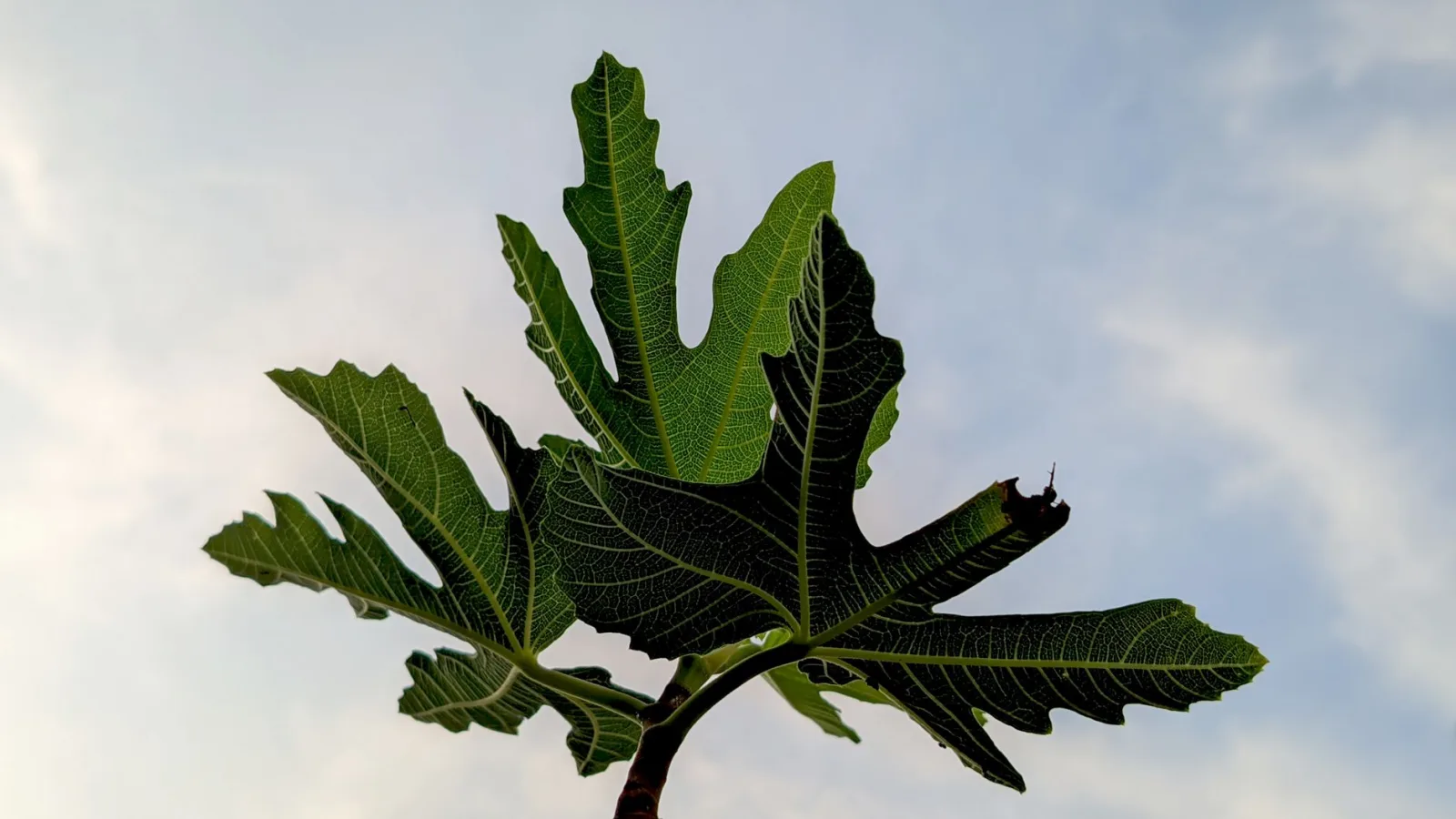
In a corner of the August garden, stand beneath a tree whose leaves split into three or four deep lobes and you'll spot the fruit hugging the branches. Some skins have begun to blush purple; others are still green. This is fig season. And yet it's hard to find a single place on this tree where a flower has opened.
The Korean name for the fig — muhwagwa — literally means "the fruit with no flower." So where are the flowers? The fig belongs to the mulberry family, and hundreds of its flowers bloom inside a hollow receptacle. Every one of the red grains you see when you halve the fruit is one of those flowers. The Donguibogam, the seventeenth-century Korean medical compendium, lists the fig in its Fruits section, citing the older Chinese text Materia Medica of Foods (Shiwu bencao). It describes a tree that sets fruit without flowering, with fruit green like a plum but a little longer, and it notes that the taste is sweet. That is a record from a historical medical text and differs from modern medical judgment.
Planting
Figs are best started from a nursery sapling. You can raise one from seed, but it takes several years to bear fruit and the variety's character can drift along the way, so a rooted sapling gets you there faster. Plant in March or April, or in November (Northern Hemisphere). Where winters are mild, plant in November and let the roots settle in over the cold months; where winters bite, plant in spring so the tree has a full season of growth before its first winter.
Two things decide the spot: sun and drainage. Figs do their best growing at 20–30°C (68–86°F), and they'll grow anywhere between 10 and 38°C (roughly 50–100°F). They like a Mediterranean climate — hot, dry summers and mild winters. Türkiye and Egypt are the major producers, with large crops in Algeria, Morocco, and Iran as well. Hold your own summer highs and winter lows up against those numbers. Difficulty: moderate.
- Plant: March–April or November (Northern Hemisphere), from a nursery sapling
- Harvest: August–October (Northern Hemisphere)
- Growing temperature: 20–30°C is ideal, with growth continuing between 10 and 38°C
- Winter: half-hardy — branches freeze below -10°C (14°F)
Getting Through Winter, and Watering
The fig is half-hardy. Below -10°C (14°F), the branches freeze. If your winter lows drop past that, the tree will struggle to overwinter in open ground. Somewhere like that, plant it in a large pot and move it indoors or into a shed before the cold arrives. If it's already in the ground, wrap the trunk thickly in straw or landscape fabric in fall and mound soil over the root zone.
Water steadily through the growing season, then taper off as the fruit begins to ripen. Frequent rain during ripening splits the fruit and turns it mushy. If August and September are rainy where you live, try covering the soil under the tree with landscape fabric to cut how much rainwater soaks in. You'll see less splitting.
Harvesting
The harvest starts in August and runs through October (Northern Hemisphere). Fruit on a single tree doesn't ripen all at once, so it's better to walk the tree every few days and take only what's ready.
A fig that's ready has skin flushed purple or brown, gives softly under your fingertips, and droops downward from the branch. Take it by the neck, tip it gently, and it comes away. Force an unripe one off and white sap runs from the cut. If your skin is sensitive, pick with gloves.
Eating, and What's Inside
Figs contain ficin, a protein-digesting enzyme. Purée a ripe fig, marinate pork or beef in it, and the ficin goes to work on the proteins at the surface of the meat, leaving it more tender. It's the same principle behind marinating meat in grated pear.
Pectin and dietary fiber hold on to water, which helps keep the gut moving. Rather than eating a lot at once, work a few into your meals over several days.
Halving a ripe fig and serving it with cured ham or aged cheese is a long tradition around the Mediterranean. The salt and the fat push back against the sweetness, and the whole thing comes into balance.
Walk the tree today and take only the fruit whose skin has colored and that yields softly to your fingertips. Leave the firm ones where they are, and check the same branches again in three days.
Sources: Donguibogam, Fruits section, "muhwagwa" (fig) · Rural Development Administration (Korea), Nongsaro · National Institute of Horticultural and Herbal Science