- Type
- Leafy Greens
- Difficulty
- Easy
- Season
- Spring·Fall
- Sowing
- From seed
Common sorrel
Rumex acetosa
Oxalic acid and vitamin C · a wild leaf with a sour bite
Sorrel is a perennial of the knotweed family, common on field edges and paddy banks, and a young leaf turns sour the moment it is chewed. That sourness comes from the oxalic acid in the leaf. Seed merchants sell it under the name sorrel, and it is grown in pots and small plots for salads. The leaf base splits into two arrow points, and that is what separates it from curly dock, a relative in the same genus. The Donguibogam lists it in the Herb section as sanmo and records the Korean name as seunga, noting that it resembles yangje (dock) but has narrower leaves and a sour taste worth eating. European kitchens blend the leaves into a sauce or drop them into soup, though the bright green browns almost at once over heat. Because the leaf carries a great deal of oxalic acid it is not eaten by the bowlful, and blanching then discarding the water draws part of it off. Sow in March or April, or in September, and once the crown is established the same spot sends up leaves every year.
Year-Round Calendar
- 1
- 2
- 3
- 4
- 5
- 6
- 7
- 8
- 9
- 10
- 11
- 12
- 3
- 4
- 9
- 4
- 5
- 6
- 9
- 10
Where It Grows
- Major producer Grown in the field as a vegetable under the name oseille. Cultivated varieties from the outskirts of Paris are well known.
- Major producer Widely grown as a kitchen-garden vegetable, and also growing wild over large areas of open country.
- Major producer Grown as a spring vegetable for soups, and wild plants are common as well.
- Wild population Comes up of its own accord in fields and on the banks of rice paddies. Seed merchants sell the seed under the name sorrel.
The plant grows wild right across temperate Eurasia, from Europe to Siberia, so its origin cannot be pinned to any one country. Field cultivation as a vegetable is concentrated in France, Eastern Europe and Russia, while in East Asia it remains a wild plant, gathered as a spring green. It is not recorded as a separate item in international production statistics, so it cannot be ranked.
- Optimum
- 15~22℃
- Range
- 3~28℃
- Hardiness
- Hardy
A cool-climate perennial, it carries a thick root through the winter and stands up well to cold. In midsummer, once temperatures pass 25℃, it throws up a flower stalk and the leaves turn coarse, leaving nothing but sourness — so spring and autumn are the seasons for picking leaves.
In Korea Nationwide
Grows wild throughout the country, in fields, on paddy banks and along roadsides. Leaves are picked twice a year, in spring and autumn, and because the root carries the plant through the winter (overwintering), once it has taken hold it lasts for several years.
How to grow
- Light
- Half a day of sun or more. In midsummer part shade keeps the leaves softer
- Soil and depth
- Free-draining soil at least 20cm deep. It tolerates ground on the acid side
- Spacing
- 25 to 30cm between plants. Being perennial, each crown thickens year on year
- Watering
- Soak it when the surface dries. Let it go dry and the leaves toughen until only the sourness is left
- Feeding
- A handful of compost around the crown as growth starts in early spring, then a weak feed after each picking
- Harvest
- Once the leaves reach the size of a palm, take the outer ones one at a time. Cut off flower stalks as they appear, since the leaves toughen once the plant bolts
What makes the difference. It is perennial, so one planting lasts several years. After about three years, when the crown has thickened, lift and divide it in early spring
Why this one is harder. It roots deeply and self-seeds freely, spreading through a plot. To fix its limits, grow it in a pot or cut the flower stalks before the seed sets
Common problems
- Aphids You will see Colonies on the underside of new leaves, which curl What to do Wash them off with a jet of water; if they keep returning use a soap or oil spray, observing the pre-harvest interval if you plan to pick
- Slugs You will see Holes in the leaves and silver trails left overnight What to do Collect them by hand in the evening and ring the pot with diatomaceous earth or coffee grounds
This page describes how a crop is grown and used. It does not claim health effects for any food, nor is it intended to prevent or treat disease. Component and study notes are references only and do not mean the same result occurs in people. Consult a medical professional about health concerns.
Health Benefits
The old record — sanmo (酸摸). The Donguibogam lists it in the Herb section as sanmo and records the Korean name as seunga. It sets down a cool nature, a sour taste and no toxicity. On appearance it says the plant resembles yangje (dock) but with narrower leaves and a sour taste worth eating, and it notes that the shoots were snapped off and eaten raw, or pressed for juice. This is a historical medical record and differs from modern judgment.
Sourness and oxalic acid. Compositional analysis confirms that the sour taste of sorrel comes from oxalic acid. It is an organic acid found widely across the knotweed family, and measurements report that part of it, being water-soluble, passes into the water during blanching. This is a record of composition and has nothing to do with preventing or treating disease.
Nutrition
- Oxalic acid (the source of the sour taste) — an organic acid in the leaf that binds calcium
- Vitamin C (present in the leaves) — one of the water-soluble vitamins
- Leaf pigments (concentrated in the veins of red-veined lines) — the pigment that colours the red veins, alongside chlorophyll and carotenoids in the green blade
Where the sourness comes from The sour taste of sorrel comes from oxalic acid in the leaf. It is the same organic acid found in curly dock and rhubarb, both relatives in the knotweed family. Oxalic acid binds calcium into a poorly soluble crystal, which is why nutrition texts discuss it alongside mineral absorption. It is water-soluble, so blanching and discarding the water draws part of it off.
Vitamin C Vitamin C is present in the leaves. Being water-soluble, it leaches out during blanching, so a raw young leaf and a blanched one do not read the same. Check whether a composition table is on a raw or a blanched basis before comparing numbers.
Colour and heat Red-veined lines carry their pigment in the veins, while the green blade holds chlorophyll and carotenoids together. Heat breaks the chlorophyll down and the bright green turns brown within moments. To keep the colour in a sauce, take the pan off the heat and add the leaves last.
How much is a normal amount Sorrel has never been a vegetable eaten by the plateful; it is the ingredient that lays a sour note over something else. A few leaves in a salad, or a handful blended into a sauce, is the long-standing use. Given how much oxalic acid the leaf carries, eating large amounts daily falls outside that use and is best avoided.
Pairings
○ Potato and egg soup — In Europe sorrel is simmered with potato and finished with beaten egg. The sourness cuts against the sweetness of the potato and keeps the broth from going flat. Add the leaves just before the heat goes off or the colour dies. Potato
○ Oily grilled fish — Chop sorrel roughly, stir it into olive oil and spoon it over grilled fish for sourness in place of lemon. The leaves go on raw, with no cooking. A few are enough.
○ Mild salad greens — A few sorrel leaves among lettuce or rocket let you cut back on dressing and still have the salad taste of something. The leaves are thin and wilt fast, so toss them in at the table rather than in advance.
△ Large raw servings — oxalic acid — Sorrel carries a great deal of oxalic acid, so it is not eaten raw in large amounts. Use a few leaves in a salad or blend a handful into a sauce; when it is cooked as a namul, blanch it briefly and throw the water away. Anyone who has had a kidney stone, or who has been advised to limit oxalate, should leave it alone.
△ Telling it from curly dock and sheep sorrel — When gathering in the field, sorrel has to be separated from curly dock, its relative in the same genus. Sorrel has a leaf base split into two sharp arrow points, a narrow blade, and an immediate sour taste. Curly dock has a far larger leaf with a rounded base and little sourness. Sheep sorrel is small and spreads in mats on dry ground. All three are knotweed-family plants carrying oxalic acid, so none of them is eaten in quantity, and if you are not certain, do not pick. Curly Dock
△ Picking on paddy banks and roadsides — The paddy banks and ditch edges where sorrel grows best are exactly where herbicide and pesticide land. Do not gather on someone else's field margin, and do not gather beside a road with traffic. If there is space to grow it, buying seed and sowing a pot is the certain route.
Varieties
- Common sorrel (seed) — The native line that comes up on its own. Arrow-split leaf base and a clear sour edge
- Sheep sorrel (wild) — A different, much smaller species. Spreads on dry ground and tastes sharper
- French sorrel (seed) — A southern European line with rounded, shield-shaped leaves. Sold as salad seed
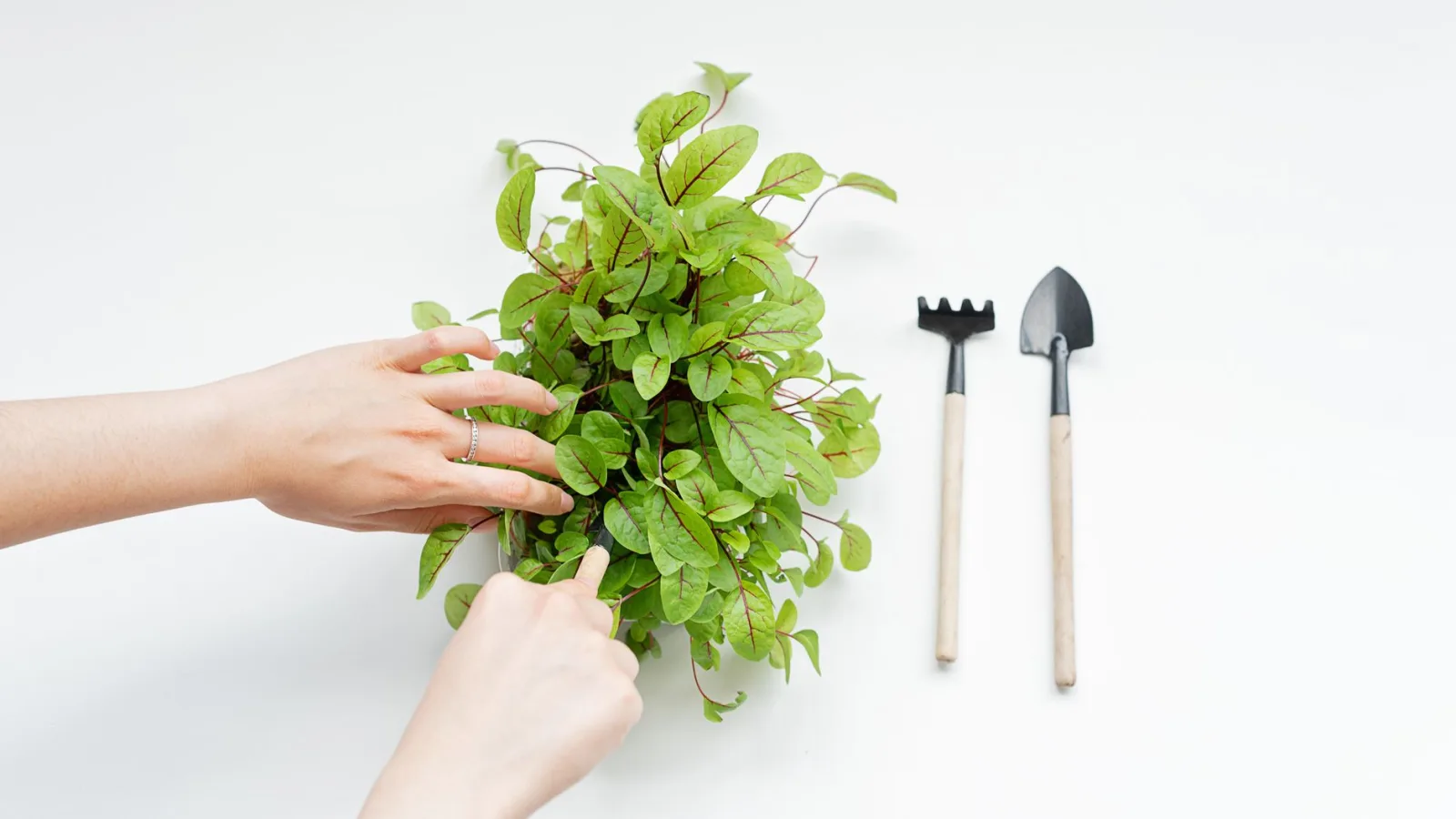
- Red-veined sorrel (seed) — An ornamental line with pronounced red veins. Milder in flavour
Source: Donguibogam, Herb Section 酸摸 · Korean Plant Names Index