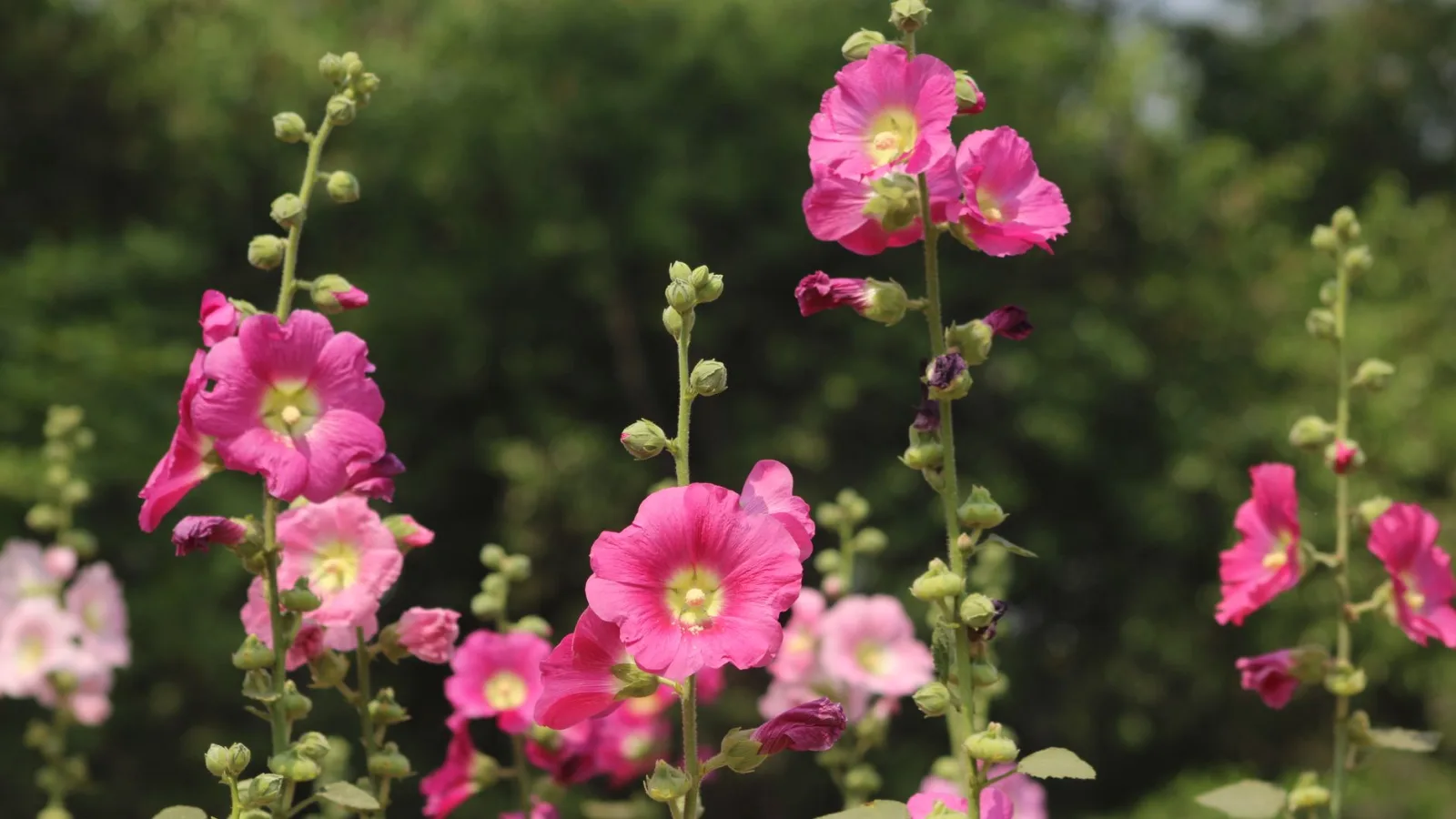
In an August garden in the Northern Hemisphere, hollyhock drops its blooms from the bottom up. The flowers that first opened in June climbed steadily up the stalk, and now the lower tier carries round seed pods. Press one between your fingers and you'll find a mix — some still soft, others already gone brown and dry. Pick out the dry ones and set them aside, and you can sow them again before the month is out.
The Dongui Bogam Called It Hongchokgyu
The Vegetables chapter (菜部) of the Dongui Bogam lists hollyhock as hongchokgyu (紅蜀葵) and records its old Korean name as "the mallow flower that blooms red." The text judged it cold in nature, sweet in taste, and free of toxicity. It even explains the name: the seed was said to have come from the lands of Yung and Chok, hence chokgyu. The plant grows everywhere, the entry notes, and looks much like curled mallow, with flowers in five colors resembling the rose of Sharon. The red single-petaled ones can be gathered year-round — the book records even the harvest season. You can read the original text and its translation in the hongchokgyu entry of the Dongui Bogam.
Keep in mind that this is a medical text from 400 years ago. Words like "cold" and "sweet" belonged to that era's way of classifying things, and they don't map onto modern chemical analysis. Read it as a historical record, not as a promise of treatment.
Where the Two Accounts Meet, and Where They Diverge
The leaves, flowers, and roots of plants in the mallow family contain mucilage polysaccharides. That's what gives them their slippery texture when blanched. But identifying a compound is one thing; confirming what it does in the body is another. The deep flower color comes from anthocyanin pigments, which have also been reported to shift with pH. Flavonoids show up in the mallow family as well.
Where the old record and the modern analysis overlap is in the plant's form. The group the old text bundled together as "mallow-like" is what we now call the Malvaceae, and the mucilage those plants share has been confirmed in the lab. Where they diverge is in use. The old medical text went as far as prescribing the plant as medicine; what we know today stops at what's inside it.
Plant It Along a Wall, and Watch for It Next Summer
Hollyhock is a biennial. The first year it spreads nothing but leaves; the following summer it sends up a flower stalk. It grows tall, so a spot beside a wall or fence — somewhere sheltered from wind — suits it well. Give it full sun, and water when the topsoil dries out.
- Sowing — April or August in the Northern Hemisphere
- Blooming — June to July in the Northern Hemisphere
- In the Southern Hemisphere, shift each by six months
Growing conditions and good companions are gathered in the hollyhock plant guide.
Dress the Young Leaves, Steep the Flowers
Blanch the young leaves, wring out the water thoroughly, and dress them with doenjang (Korean fermented soybean paste) and perilla oil. The mucilage makes seasoning cling readily, so keep it light. A little garlic takes the edge off any grassy note.
Dry the flowers thoroughly in the shade, then pour boiling water over them, cover, and let them sit about 3 minutes. The darker the petals, the deeper the color of the infusion. Steep too long, though, and astringency takes over — so watch the clock. Squeeze a few drops of lemon juice into the finished tea and the color sharpens toward red: anthocyanin shifting with pH, right in front of you.
Head out to the garden today and start with the seed pods on the lower tier. Choose only the ones whose husks have dried and begun to split, and drop them into an envelope. Sow that seed alongside the same spot before the month is out.