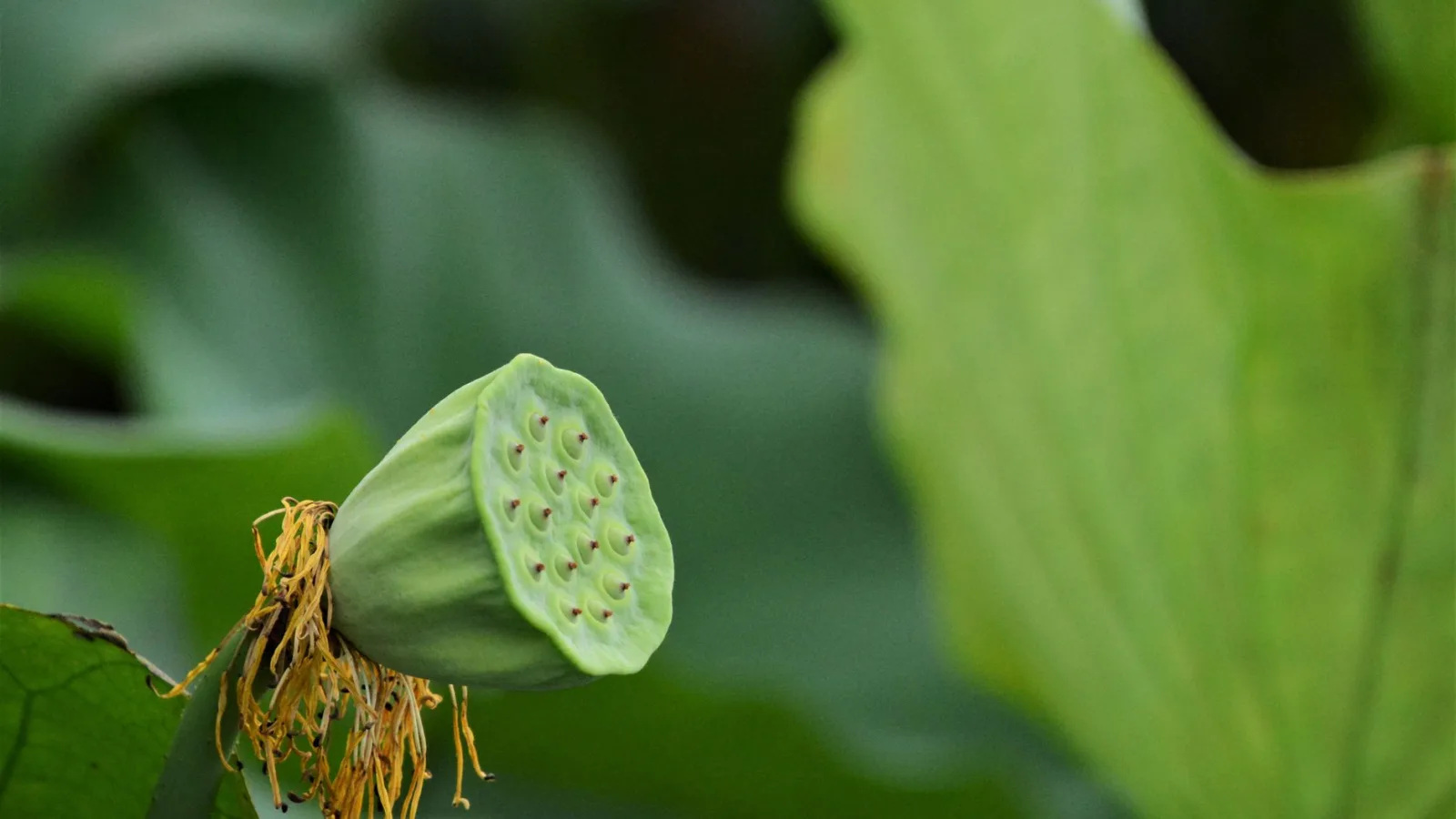
By early October in the Northern Hemisphere, the lotus seed heads in water-filled tubs have dried brown and still stand upright, their seeds already shaken out. The seeds ripened black in August and September and were gathered weeks ago. Around this time, people who don't grow lotus pick up a bag of dried lotus seeds and ask: how do you cook these rock-hard seeds so they sit well in your stomach?
Lotus seeds are the seeds set into the flat seed head that's left after the lotus flower (Nelumbo nucifera) fades. Peel away the skin and you'll find a white kernel with a green embryo at its center. China, Vietnam and India are the main growers. In the Northern Hemisphere, lotus is planted in April or May and harvested in August or September. You'll find a growing calendar and a nutrition chart in the lotus seed entry in the Homiclub Crop Guide. A medical text from more than 400 years ago and today's cooks give the same advice: cook the seeds all the way through, and take out the bitter core before you eat them.
What's inside the white kernel
The white kernel is mostly starch. That starch is also why steamed lotus seeds turn soft and mealy, much like a cooked chestnut. They have more protein than grains, which puts them closer to nuts, and they're fairly high in potassium. Their calorie count is about the same as grains.
The alkaloids are concentrated in the green embryo at the center. It tastes very bitter, so most people remove it. That means what you actually eat is mostly starch and protein, and how fully that starch is cooked decides whether your stomach feels settled afterward.
Why undercooked lotus seeds leave you bloated
The Donguibogam (東醫寶鑑, "Precious Mirror of Eastern Medicine") is a medical encyclopedia from Korea's Joseon dynasty, compiled by Heo Jun and published in 1613. Its section on fruits (gwabu) lists lotus seeds under the name yeonsil (蓮實). It says that eating them raw makes the belly swell, so they're better steamed. It also records that people removed the green core at the center of the seed because of its bitterness. Keep in mind that this comes from a historical text and is not the view of modern medicine.
Still, the passage fits what happens in the kitchen. Dried lotus seeds have lost their moisture and are very hard, so they're difficult to digest unless they're cooked all the way through. Raw starch tends to resist digestive enzymes until it has taken in enough water and heat. If you eat seeds that are cooked on the outside but still hard in the middle, you're likely to feel bloated. The old text's "belly swells" was probably describing exactly that.
Split a cooked lotus seed in half. If the center mashes easily, it's done. If the center is still firm, it needs more time.
Take out the green core before cooking
Some dried lotus seeds come with the green core still inside. Because the alkaloids are concentrated there, the core is intensely bitter, and tea made from whole ground seeds is hard to drink. Once the seeds have soaked and softened a little, split them in half and push the core out with a toothpick. You can skip this step by buying seeds that have already been cored.
Some products are made of the cores alone, so check the label to see whether you're buying kernels or cores. Animal studies have looked at the alkaloids in the lotus seed embryo, but none of the findings have been confirmed in people. The amounts used in those experiments are also far larger than what you'd eat as food. So far, the research doesn't give you a reason to eat the cores on their own.
Soak for two hours, cook for at least 20 minutes
The seeds are so hard that they need to start soaking before the rice does if they're going to cook through to the center. The rule of thumb: soak for at least two hours and cook for 20 minutes or more.
If you'd like to add some to tonight's rice, follow these steps:
- Soak the dried lotus seeds in water for two hours.
- If any green cores are left, split the seeds and remove them.
- Cook the seeds with the rice, using a little more water than usual.
- After the rice has finished steaming and rested, split one seed and check the center.
Jujubes (Chinese dates) and chestnuts are good partners. Each brings its own kind of sweetness, and their different textures make every bite more interesting. In Korea, this trio often goes into yeongyang-bap, a hearty mixed rice, and into samgyetang, a ginseng chicken soup. For soups and stews, add the lotus seeds before everything else so they finish cooking at the same time as the other ingredients. If you cook them with lotus root, the rhizome of the same plant, you get crisp slices of root with soft, mealy seeds.
Measure out just 20–30 g at a time
Even well-cooked lotus seeds are worth eating in moderation. Dried lotus seeds have about 330 kcal per 100 g. You won't eat many mixed into rice, but if you dry-roast them and snack on them, a whole bag goes quickly. Try putting only 20–30 g of roasted seeds in a bowl at a time.
If you've opened a bag of lotus seeds today, measure out 30 g, put them in water to soak, and set a timer for two hours.