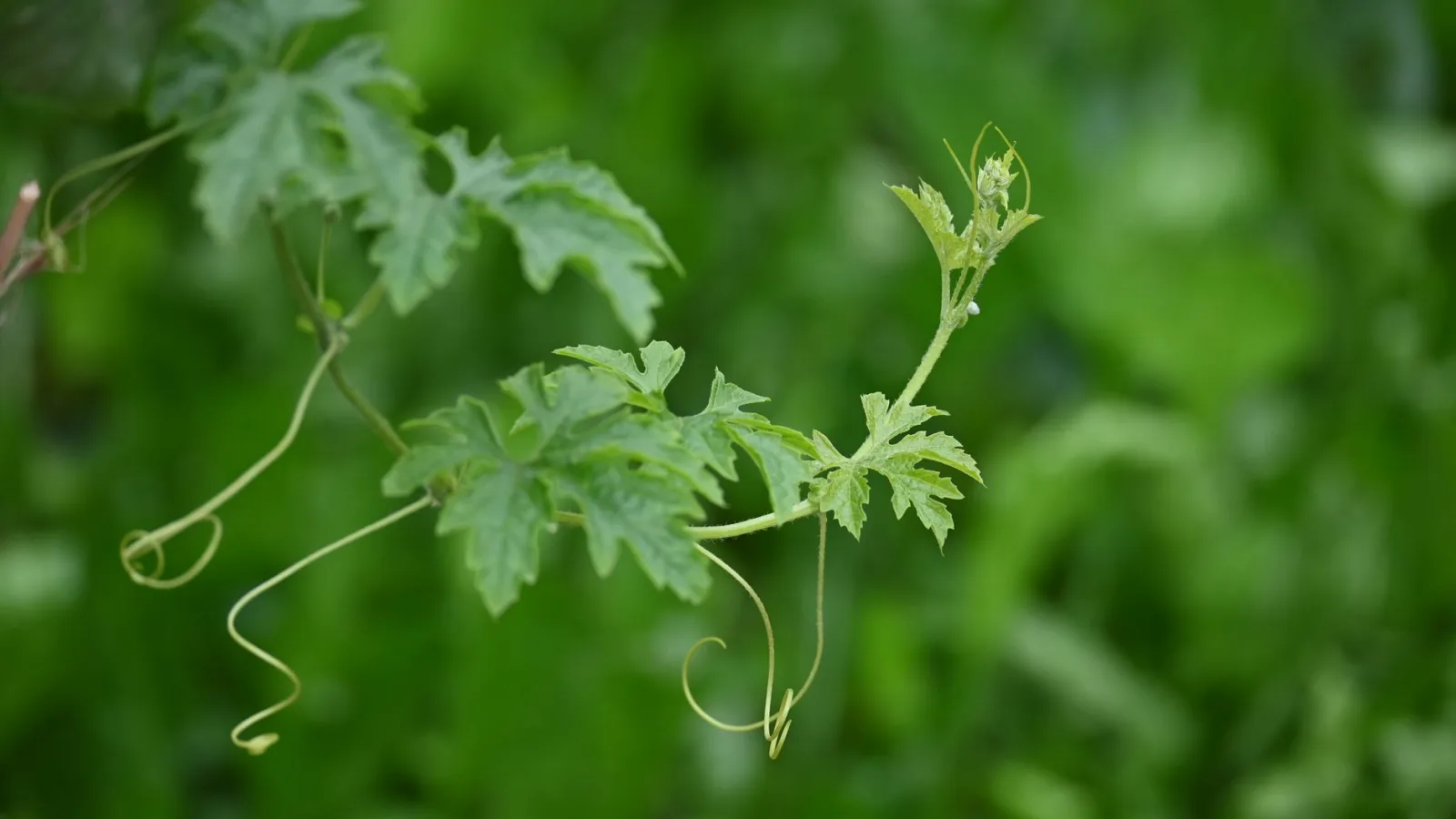
In late August, the bitter melon vines out in the garden are still setting fruit. In the Northern Hemisphere it goes in the ground in April or May and comes off the vine from July through September, so by the tail end of summer the warty fruits have swelled to about the size of your palm. It's a gourd-family crop grown widely in China, India, Bangladesh, the Philippines and Vietnam, written in Chinese characters as 苦瓜 — "bitter gourd" — and known botanically as Momordica charantia.
Nearly everyone who searches their way to this plant arrives with the same question: does it help with blood sugar? What lab analysis of its compounds has established and what studies feeding it to people have established are two different things. So the answer comes in two parts.
How far the named compounds actually take us
Bitter melon's bitterness comes from cucurbitacin-family compounds such as momordicin. The first bite can leave the back of your tongue tingling.
Charantin is a mixture of steroidal saponins isolated from the fruit; polypeptide-p is a plant protein reported to be structurally similar to insulin. Both have been studied for decades. And that is as far as the compound analysis goes. That a substance has a name and can be isolated in a lab is one story. How much it does inside a human body, at the doses you'd actually eat, is another.
What the studies fed people was mostly powder
Most of the research on bitter melon and blood sugar is supplement research: measured doses of dried powder or concentrated extract. And the results conflict from one study to the next.
Slicing an unripe fruit from your own garden thin and setting it out as a side dish is a different proposition — a different quantity, a different degree of concentration. You cannot copy the results of a supplement trial onto a single plate of vegetables. Which is why we don't write that eating bitter melon lowers your blood sugar.
For the unripe fruit eaten as a vegetable, what can be said today is what's in it and that it's high in vitamin C. Anything beyond that needs more evidence behind it. As reasons to put bitter melon on the table as one summer side dish, that's plenty.
Taming the bitterness, one plate at a time
Prep takes the edge off. Halve the fruit lengthwise, scrape out the spongy core and seeds with a spoon, and slice it about 3mm thick. Salt the slices for ten minutes or so, then rinse them under cold water. Squeeze them dry and they won't go watery in the pan.
Eggs — soft, savory — pair well with whatever bitterness is left. That's the logic behind goya champuru, the Okinawan dish that stir-fries bitter melon with tofu and egg. Cooked with fatty pork, the bitterness mellows and the protein balances the plate. If you picked a fruit today, beat two eggs and start there.
Take the seeds out, and check with your doctor if you're on medication
The seeds contain vicine, which has been reported to cause hemolysis in people with G6PD (glucose-6-phosphate dehydrogenase) deficiency. There are also case reports of vomiting and diarrhea after eating large amounts. Remove the seeds before you eat the fruit. When a fruit ripens and splits open, the red aril around the seeds is sweet and easy for a child to pick up and pop in their mouth, so if children come and go in your garden, don't leave split fruits hanging on the vine.
- If you're pregnant: some compounds in bitter melon, momorcharin among them, have been reported in connection with uterine contractions. Avoid concentrated forms — juices, powders, supplements. Don't push past the occasional side dish into eating it frequently or in quantity. If you're breastfeeding or trying to conceive, talk to your doctor.
- If you take blood-sugar medication: bitter melon may lower blood glucose, which can tip you into hypoglycemia. Anything beyond side-dish amounts — powders, supplements — should go past your care team first.
- If children are eating it too: scrape the core and seeds out completely, and start with a few thin slices.
If there's a palm-sized bitter melon on your vine today, set the health-benefit question aside, scrape it out, salt it, and stir-fry it with eggs. Sowing and harvest calendars, nutrient details and companion pairings are all laid out in the bitter melon guide — worth opening once before you put seeds in the ground next April.