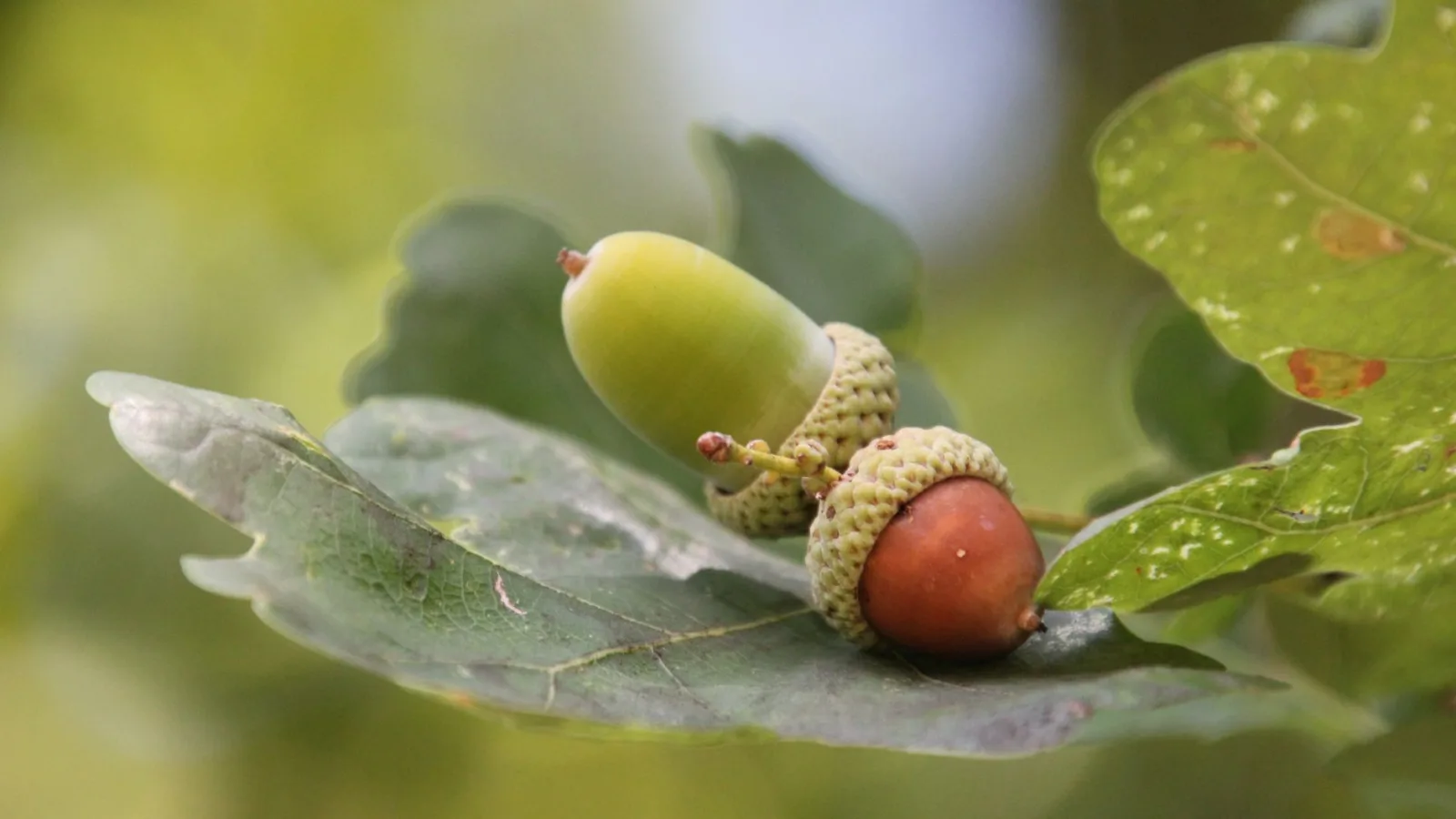
In September, acorns lie right where they've dropped beneath the oaks on the lower slopes of the hills. Every gust of wind brings down a few more. Now is the time to gather them. Bite into one straight off the ground, though, and it's so astringent your tongue will curl. Acorns only become food once they've been prepared to draw that harshness out.
A nut that can take two years to ripen
Acorns are the nuts of oak trees, a large family that includes the sawtooth oak. Sawtooth oaks and Oriental cork oaks take two years: their acorns ripen in the autumn after the trees flower. Mongolian oaks and konara oaks ripen theirs the same autumn. Oaks need a full season of winter cold, and they flower once spring temperatures climb. They grow on open, sunny slopes and can't survive in shade. They do best between 15 and 25°C and can tolerate anything from 5 to 32°C. In the Northern Hemisphere, September and October are the months for gathering acorns. If you're planting seedlings, plant them in March or April. Oaks grow wild in the mountains of Korea, China, and Japan, and Spain and Portugal also produce acorns in abundance.
The pucker comes from tannins
An acorn's astringency comes from tannins, which belong to a group of compounds called polyphenols. Beyond that, there's little we can say with confidence about the chemistry. What matters in the kitchen is that tannins dissolve readily in water. So the acorns are shelled, dried, and ground. Then the meal is covered with water, and the water is changed again and again until the bitterness washes away. This is also why the process takes several days. The tannins don't all come out at once, so you pour off the water, add fresh, and wait, over and over.
What settles out sets into jelly
After all those water changes, a white sediment settles at the bottom of the bowl. This is the raw material for dotorimuk, Korean acorn jelly. It's made up mostly of starch. When starch simmers in water, it absorbs the water and loosens. As it cools, it knits back together and firms up. That's why the finished jelly is soft enough to scoop with a spoon yet holds its shape when you slice it. The acorn starch powder sold in Korean markets is simply this sediment, dried. Even if you start from the powder at home, you still cook it and let it cool the same way. Aside from the starch, the finished jelly is mostly water, which is why it tastes mild and feels so tender.
Three ways to serve it
Because the jelly tastes so mild, whatever you serve with it sets the flavor. If you're putting it on the table tonight, start with one of these three.
- With seasoned soy sauce — Cut the jelly into thick slices and spoon over a sauce of soy sauce, sesame oil, gochugaru (Korean chili flakes), and chopped scallions. Once it's cut, the jelly starts to weep water, so slice it just before serving.
- Dotorimuk muchim (dressed acorn jelly salad) — Finely chop well-fermented kimchi that has turned sour, tear lettuce or perilla leaves by hand, and toss everything with the jelly. Mix gently in a large bowl so the jelly doesn't break apart. Drizzle in the sesame oil at the very end, then scatter sesame seeds over the top.
- Mukbap (acorn jelly and rice in broth) — Put julienned jelly and rice in a bowl of anchovy-kelp broth, then top with crumbled roasted seaweed and kimchi. Serve it chilled in summer and piping hot in winter. The jelly falls apart if it simmers too long, so add it to the broth and serve right away.
A name in an old book, and a line to hold today
The Donguibogam, the 17th-century Korean medical classic, lists the acorn in its section on trees (木部) under the name sangsil (橡實). It records the Korean name as "gulgeun dotori," or plump acorns. According to the text, acorns are warm in nature, bitter and astringent in taste, and nontoxic. It calls the little cup that holds the nut jodu (皂斗). There are also passages saying that the shell and nut were used together after roasting, and that acorns helped people get through famine years. These are simply the descriptions of an old medical text, and they don't reflect how we'd judge acorns today.
Acorns are also winter food for squirrels, wild boar, and other mountain wildlife. In Korea, gathering them in national parks and other designated nature parks is against the law. When you forage, don't strike or shake the trees. Take only what has already fallen to the ground.
If you stop by a wooded hillside today, pick up just a handful of fallen acorns. Once you're home, all that's left to do is spread them out somewhere breezy to dry. Shelling, grinding, and soaking can wait until they're dry.
Sources: Donguibogam, Section on Trees (木部), Sangsil (橡實) · Korea National Arboretum, Korea Biodiversity Information System