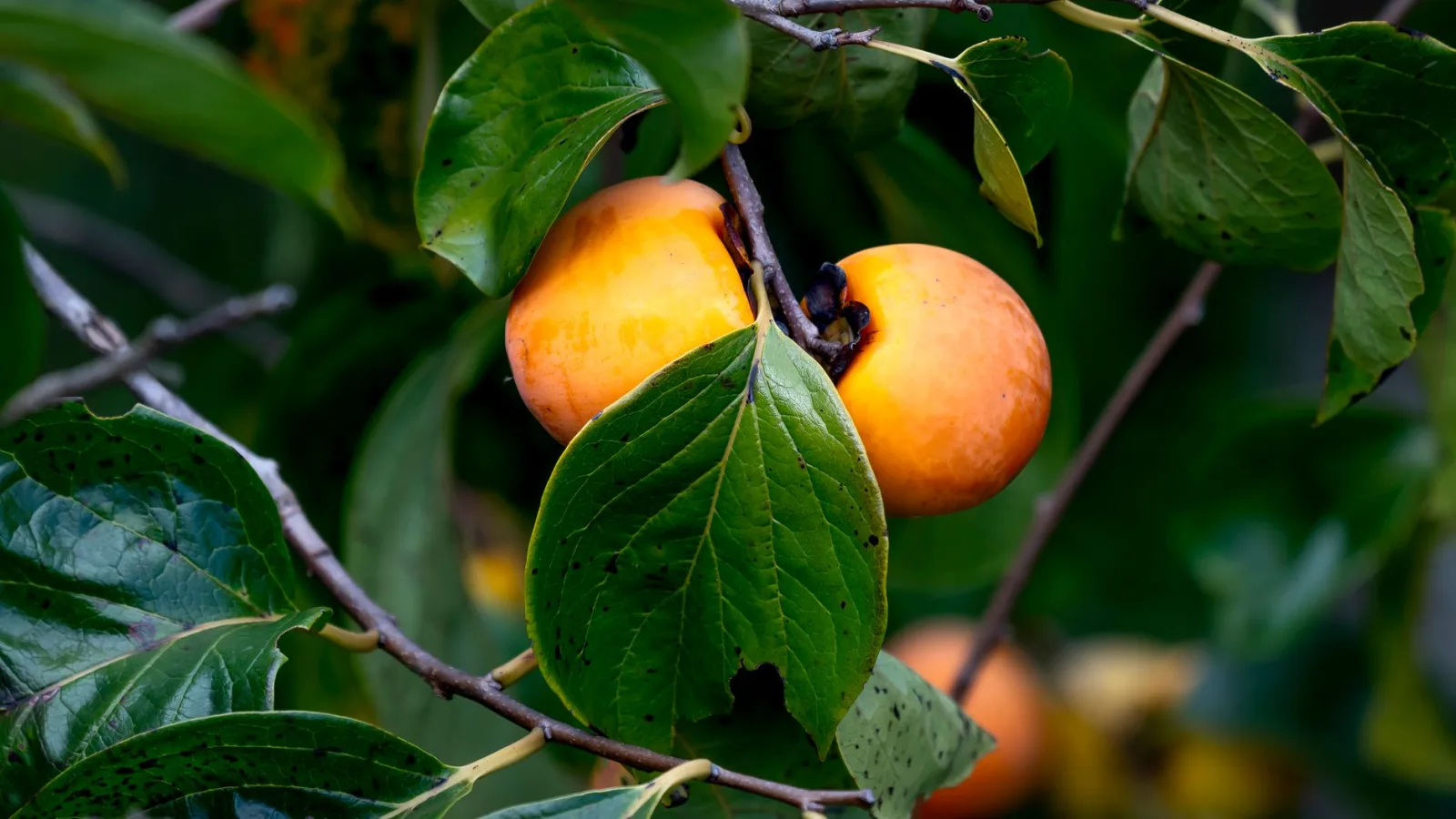
A dwarf persimmon tree planted in a large pot has set fruit for the first time in its fourth year. Someone picks one blushing red fruit, bites into it, and spits it out as their tongue goes dry and their whole mouth clamps shut, then comes looking for the persimmon entry in the crop guide. The story is the same when a box from a neighbor, or fruit bought at the market as sweet persimmons, turns out to pucker. You don't throw astringent persimmons away. Left alone, they soften into hongsi (soft-ripe persimmon). Peeled and hung to dry, they become gotgam (dried persimmon). And with a dab of soju on the stem and a sealed bag, they can be peeled and eaten like sweet persimmons within a week. All three set off the same reaction inside the fruit, but which one you choose changes how much sugar and vitamin C ends up in your mouth. Persimmons are grown widely in China, Korea, Spain, Japan, and Azerbaijan, and in the Northern Hemisphere they are harvested in October and November.
Astringency Happens When Tannins Touch Your Tongue
The pucker of a persimmon is the feeling of tannins binding with the proteins in your saliva and tightening the lining of your mouth. In an astringent persimmon, the tannins sit in the flesh in a water-soluble state, so they reach your tongue the moment you bite. In a sweet persimmon (the Fuyu type), the tannins convert to an insoluble form while the fruit is still on the tree, so there is no pucker. In an astringent variety that conversion never finishes on the tree, and the fruit stays astringent even after it turns red. The persimmon (Diospyros kaki) entry in the Homiclub crop guide notes the same thing: these tannins "change into an insoluble form once the fruit ripens or has its astringency removed."
Food science explains the change this way: when the fruit respires without oxygen, it produces acetaldehyde, which bonds with the tannins into large clumps that no longer dissolve in saliva. The amount of tannin stays the same. Only the form that reaches your tongue changes. Soft-ripening, drying, and deliberate de-astringing are simply different ways of waiting for that reaction or hurrying it along. What happens when those converted tannins clump up again in an empty stomach is covered in "How Many Persimmons Can You Eat?"
Wait and You Get Hongsi, and One Apple Shortens the Wait
Keep astringent persimmons indoors at 15 to 20°C (59 to 68°F) and within two to three weeks they usually soften and lose their pucker. As the fruit ripens it gives off its own ethylene, and the reaction described above works its way through the flesh from the inside out. Put one apple in a paper bag with five or six persimmons and the apple's ethylene speeds things up to roughly a week. Set them stem-side up in a single layer and press each one gently with a finger once a day. When the whole fruit gives evenly and the skin is on the verge of splitting, that's the day to take it out.
Because hongsi loses no water, its sugar is less concentrated than in dried fruit, and it keeps the most vitamin C, which breaks down with heat. Persimmons carry more pectin than most fruits, and as it loosens the flesh turns custardy, giving hongsi its signature texture. Mash a fully ripe one into plain yogurt and it's sweet enough without any added sugar, and the fat in the dairy helps your body absorb fat-soluble pigments like beta-carotene and cryptoxanthin.
Drying Concentrates the Sugar and Loses the Vitamin C
Gotgam is made by peeling persimmons, hanging them by the stem on a string, and leaving them in a breezy, shaded spot for three to four weeks. Start on a day when daytime highs have dropped below 10°C (50°F) and no rain is in the forecast, so the surface dries before mold can take hold. After about ten days, when the outside has turned leathery, knead each one gently once a day so the sugar inside spreads evenly. The white powder that settles on a fully dried gotgam is sugar that has migrated to the surface and crystallized. Mold, by contrast, is blue-green or black and fuzzy like cotton.
The fruit chapter of the Donguibogam, Korea's 17th-century medical encyclopedia, sorts persimmons into four kinds: hongsi for the soft-ripened fruit, baeksi for fruit dried in the sun, osi for fruit dried over fire, and sisang, or "persimmon frost," for the thick powder that collects on the skin of baeksi. It is an old medical text, so its categories don't map onto modern medicine, but its authors clearly noticed how much sugar gathers on the surface, enough to give the white powder a name of its own.
As the water leaves a dried persimmon, all the sugar of the whole fruit stays behind in the space it left, so weight for weight gotgam is far sweeter than hongsi and most of its vitamin C is gone. Gotgam-mari, dried persimmon rolled around walnuts, pairs the sugar with the walnuts' fat and protein, which slows its absorption a little. Sujeonggwa, a drink made by floating gotgam in water simmered with cinnamon and ginger, balances the persimmon, considered "cooling" in traditional terms, with warming spices, and is gentler on slow digestion than persimmon eaten on its own.
To Eat Them Firm, Dab Soju on the Stem
To take out the astringency while keeping the flesh firm, you cut off the oxygen and let the fruit make its own acetaldehyde. Soak a cotton ball or brush with soju (Korean distilled spirit, 17 to 25% alcohol), dab it on the stem end, put the persimmons in a plastic bag, press out the air, tie it shut, and leave it indoors at around 20°C (68°F) for five to seven days. The alcohol that seeps into the flesh converts to acetaldehyde and locks up the tannins. Leaving them longer won't make them sweeter, only softer, so from the fifth day on, peel one and taste it. Soaking them in water at around 40°C (104°F) for 15 to 24 hours also works, but it does nothing once the water cools, and above 50°C (122°F) the flesh cooks. If you have no way to hold the temperature steady, soju is the safer bet.
Persimmons treated this way keep the same water and vitamin C as the raw fruit, and with only the sweetness left in their crisp flesh they're hard to tell from sweet persimmons. The tannins haven't gone anywhere, they've only changed form, so eating several at once on an empty stomach is something to avoid, exactly as with hongsi and gotgam. If you've had part of your stomach removed, or food empties slowly from your stomach, skip astringent persimmons and gotgam altogether, and eat even sweet persimmons and hongsi only after a meal, a little at a time.
The Donguibogam writes that an unripe persimmon is green and astringent, and that as it ripens and reddens the astringency disappears on its own. That "on its own" is two or three weeks of the fruit respiring without oxygen and converting its tannins. An apple in a paper bag or a dab of soju on the stem shrinks that time to a few days, and sun and wind stretch the result out to last through winter. However you go about it, what remains once the pucker is gone is the same amount of tannin, along with sugar and vitamin C that differ as much as the methods do.
Sources: Donguibogam, Tangaek (materia medica) volume, fruit chapter, entries on persimmon and small persimmon · Homiclub crop guide, persimmon entry.