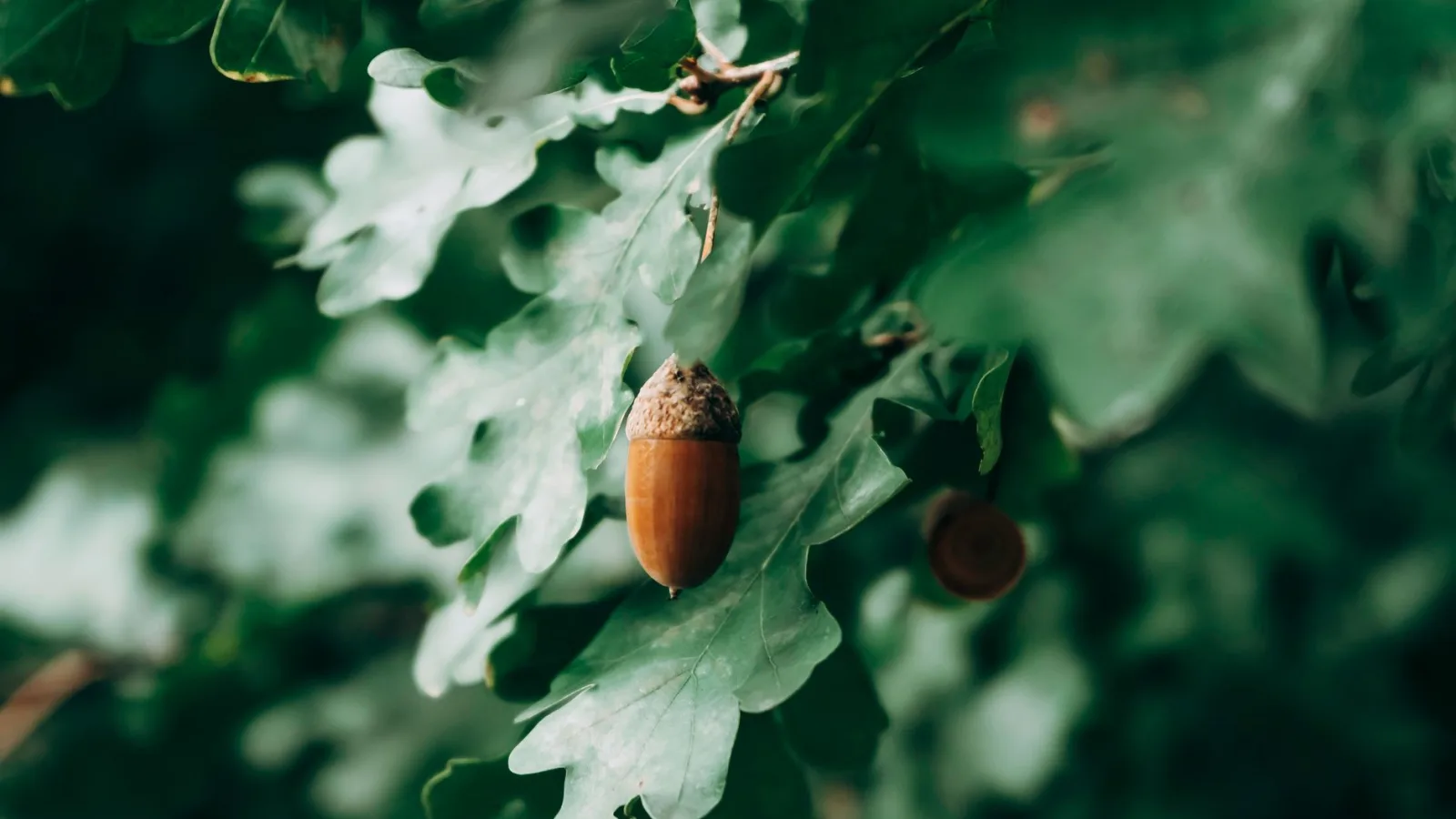
Walk beneath an oak in autumn and something rolls underfoot: an acorn, slipped free of its cap. Across the Northern Hemisphere in September and October, hillsides and the wooded slopes behind villages are carpeted with them before anyone arrives to gather. And on the evening after tucking a few into a pocket and carrying them home, people type the same words into a search bar: "acorn benefits." There isn't much on record that qualifies as an answer. There is one entry in the Donguibogam, the 17th-century Korean medical compendium, and there is the composition that modern analysis has revealed. Those two sources cover a certain range, and beyond it, even our crop guide won't vouch for anything.
What the Donguibogam Says About Sangsil (橡實)
In the Donguibogam, compiled by the court physician Heo Jun and published in 1613, the acorn appears in the section on trees (木部) under the name sangsil (橡實). Its Korean name is given as gulgeun dotori, roughly "the large acorn." The entry describes it as warm in nature, bitter and astringent in taste, and free of toxins, and notes that it is the fruit of the sawtooth oak and found everywhere. The cup that holds the nut had its own name, jodu (皂斗). The text says acorns were gathered in any season and roasted shell and nut together before use, and adds that the characters 柞, 櫟, 杼, and 栩 were all names used broadly for the sawtooth oak. It closes by noting that acorns carried people through hunger in years of famine. This is a medical text more than 400 years old, so its judgments don't match ours today, and nothing in it can be read as a claim that acorns prevent or cure disease. Still, two phrases, "bitter and astringent" and "carries people through hunger," overlap with what modern compositional analysis has found.
The Bitter, Astringent Taste: Tannins
If you've ever bitten into a freshly gathered acorn, you remember the astringency. That taste comes from tannins, a group of polyphenols, and this much has been confirmed by analysis. Heo Jun's "bitter and astringent" was known by the tongue; tannins were identified in the lab. But they point to the same thing. Tannins leach readily into water. Shell and dry the acorns, grind them, and soak the meal in water, and the water turns a dark reddish-brown. That color is the tannin coming out. This is why the traditional method for removing the astringency has always been to change the water, again and again. Each time, the dark water floating on top is poured off and only the sediment that settles at the bottom is kept. Chew an unleached acorn as is, or grind it and cook it straight away, and your mouth will pucker hard and your stomach may protest. What tannins do inside the body is something our crop guide doesn't address. The confirmed range ends here: the astringency comes from tannins.
Inside a Block of Acorn Jelly: Starch and Water
The white sediment left after repeated soaking and rinsing is the raw material for dotorimuk, Korean acorn jelly, and the acorn starch sold in stores is simply this sediment, dried. Its main component is starch. Boil starch with water and the granules swell, take up the liquid, and loosen; as the mixture cools, they bind together again and set. Acorn jelly is a food that uses this property and nothing more, so a set block is mostly water, with starch making up the rest. That's also why its flavor is so mild. When Heo Jun wrote that acorns carried people through famine, this starch is almost certainly what he meant. In years when the grain failed, people harvested starch from the hills. The components our acorn crop guide lists are tannins, starch, and water, responsible respectively for the astringency, the firmness, and the soft, yielding texture. Claims about weight loss or benefits to a particular organ fall outside that range. What has been confirmed is this: remove the astringency, and what remains is starch and water.
How to Eat It: The Seasoning Does the Work
Acorn jelly on its own tastes of very little, so the seasoning decides the dish. Cut one block (about 400 g) into thick slices and spoon over a sauce of 30 ml soy sauce, 5 ml sesame oil, 3 g gochugaru (Korean red chili flakes), and 10 g minced scallion. The jelly weeps once cut, so slice it just before serving. Chop some well-soured kimchi, tear lettuce or perilla leaves by hand, and toss everything with the jelly for dotorimuk-muchim, a dressed acorn jelly salad. Fold gently in a large bowl so the jelly doesn't break apart, and add the sesame oil and sesame seeds last. For mukbap, acorn jelly in broth with rice, simmer 10 g dried anchovies and 5 g dried kelp in 600 ml water for 10 minutes, then ladle the broth over julienned jelly and rice. Serve it cold in summer and hot in winter. The jelly dissolves if it simmers too long, so add it to the broth and serve right away.
The Old Rules of the Gathering Ground
How long an acorn takes to ripen depends on the tree. Sawtooth oak (Quercus acutissima) and Oriental cork oak ripen in the autumn of the year after flowering, a two-year cycle, while Mongolian oak and konara oak ripen the same autumn they flower. That's why, even on the same hillside, the quantity that falls each year varies from tree to tree. The countries that gather acorns in volume are Korea, China, Japan, Spain, and Portugal. In Korea, collecting acorns and other forest products inside national and nature parks is prohibited by law, and you can't simply walk into privately owned woodland and help yourself either. Rules vary from park to park in other countries too, so check the sign at the entrance first. And at the gathering spot, take only what has already fallen to the ground. Don't knock or shake the tree.
Heo Jun's line about carrying people through famine describes the human side of things. The forest has its own residents who get through winter on the same nut. Acorns are the winter store of squirrels and wild boar. The rule against sweeping one spot clean, the rule that says leave some behind, comes from there. A single pocketful is enough to make a block of jelly.
Source: Donguibogam, section on trees (木部), entry on sangsil (橡實).