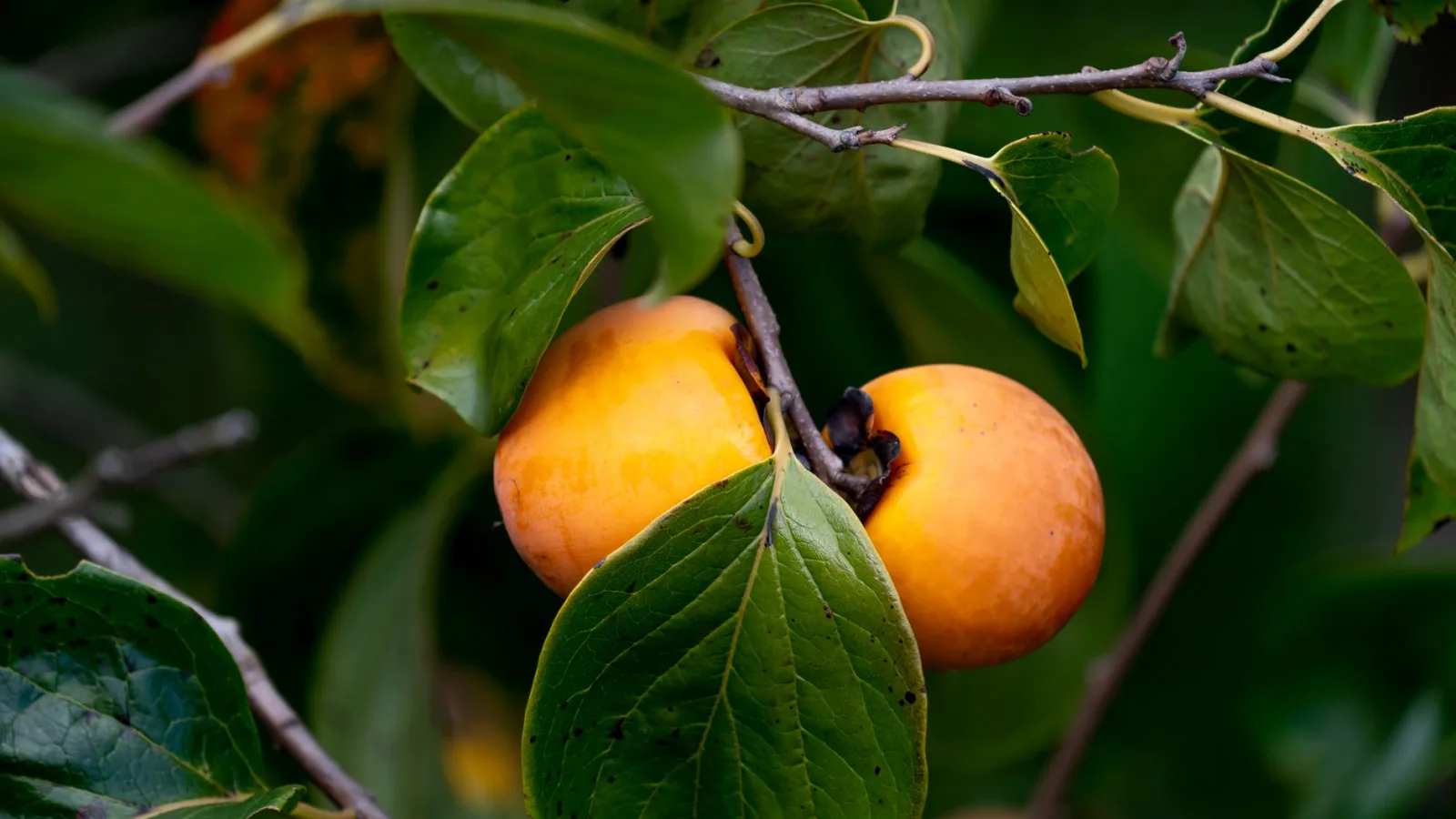
In the Northern Hemisphere, persimmon trees are planted in March and April and harvested in October and November. Plant a sapling on dwarf rootstock in a large container, and you can watch a few fruits ripen to orange right on your balcony. Persimmons are grown widely in China, Korea, Spain, Japan, and Azerbaijan, and people eat them both fresh and dried. Have you ever eaten several gotgam (peeled, dried persimmons) in one sitting and felt bloated afterward? Tannins, the compounds that give the fruit its astringent taste, may be to blame.
The Astringency Fades, but the Tannins Stay
Persimmons (Diospyros kaki) fall into two groups, depending on when they lose their astringency. Non-astringent, or sweet, persimmons lose it while still on the tree, so you can eat them as soon as they're picked. Astringent persimmons stay astringent even when ripe. Before eating, they're treated to remove the astringency, left to soften, or dried. A fully ripe astringent persimmon that has gone soft is called hongsi.
Losing the astringent taste doesn't mean the tannins are gone, though. As a persimmon ripens or goes through astringency removal, its tannins change into a form that doesn't dissolve in water. Because they no longer dissolve into saliva, they apparently stop tasting astringent. The tannins are still in the flesh, just in a different form. The Donguibogam, a 17th-century Korean medical classic, also records that unripe persimmons are green and astringent, and that the astringency disappears on its own as the fruit ripens and turns red.
Besides tannins, persimmons contain fat-soluble antioxidant pigments such as beta-carotene and cryptoxanthin. They're also high in dietary fiber and pectin compared with most fruits. Vitamin C breaks down with heat and is mostly lost during drying, so little of it is left in gotgam. Lab experiments measuring the antioxidant activity of persimmon tannins and carotenoids have been reported many times, and so have animal studies. Whether people get the same results is still an open question.
What Happens When You Eat a Pile of Gotgam on an Empty Stomach
In their changed form, tannins can cause trouble in the stomach. If you eat a lot of astringent persimmons or gotgam at once on an empty stomach, the tannins can bind with what's in your stomach and harden into a mass. Such a mass is called a bezoar, and one formed from persimmons has its own name: a diospyrobezoar.
There's a reason to name gotgam along with astringent persimmons. As gotgam dries, it loses water and shrinks. Gram for gram, its nutrient content also differs from that of a fresh sweet persimmon. With fresh persimmons you'd likely stop at one or two, but with gotgam it's easy to eat more without noticing. They're small and sweet, so you keep reaching for another, and the amount of tannin reaching your stomach at once probably goes up too.
If you have stomach pain and vomiting that don't let up after eating persimmons, don't wait. See a doctor.
Take Extra Care If Your Stomach Empties Slowly
These masses form more easily in people who've had part of their stomach removed or whose stomachs are slow to empty. Cases of bowel obstruction caused by diospyrobezoars have also been reported. If this describes you, avoid astringent persimmons and gotgam, and eat sweet persimmons and hongsi only in small amounts at a time.
Traditional medical texts didn't recommend eating persimmons in large amounts either. The Donguibogam lists the persimmon in its section on fruits, and the same entry warns against eating it with crab. Goyom, or date plum, belongs to the same genus as the persimmon but is a different tree. The text adds that goyom is extremely cold in nature and shouldn't be eaten in large amounts. These are historical records, not modern medical advice. Still, the warning against eating too much at once matches the bezoar cases being reported today.
Source: Donguibogam, Fruit section (果部), entries on hongsi (紅柿, ripe persimmon) and goyom (小柿, date plum).
When to Eat Them, and What to Pair Them With
To keep your stomach comfortable, start with timing. Limit astringent persimmons and gotgam to one or two after a meal. Chew gotgam slowly, with water or alongside other food. It also helps to choose what you eat with them.
- Hongsi and plain yogurt: Mash a ripe hongsi into yogurt and it's sweet enough without added sugar. The fat in dairy helps your body absorb carotenoids such as beta-carotene. Freeze the mixture and blend it for a quick sherbet.
- Gotgam and walnuts: Gotgam rolled around walnuts, called gotgam-mari, has been eaten in Korea for generations. Eaten together, the fat and protein in the walnuts slightly slow the absorption of the persimmon's sugars. The chewy fruit and crunchy nut also make a good contrast.
- Cinnamon-ginger drink: Sujeonggwa is a traditional Korean drink made by simmering cinnamon and ginger in water and floating gotgam in it. The warming spices balance the persimmon, which traditional medicine considers cold in nature. If you've had stomach surgery or your stomach empties slowly, though, skip the gotgam in sujeonggwa too.
For more on persimmon nutrients, food pairings, and a planting and harvest calendar, see the persimmon entry in Homiclub's Crop Guide.
If you're having gotgam today, wait until after your meal, then eat just one slowly, with a glass of water.