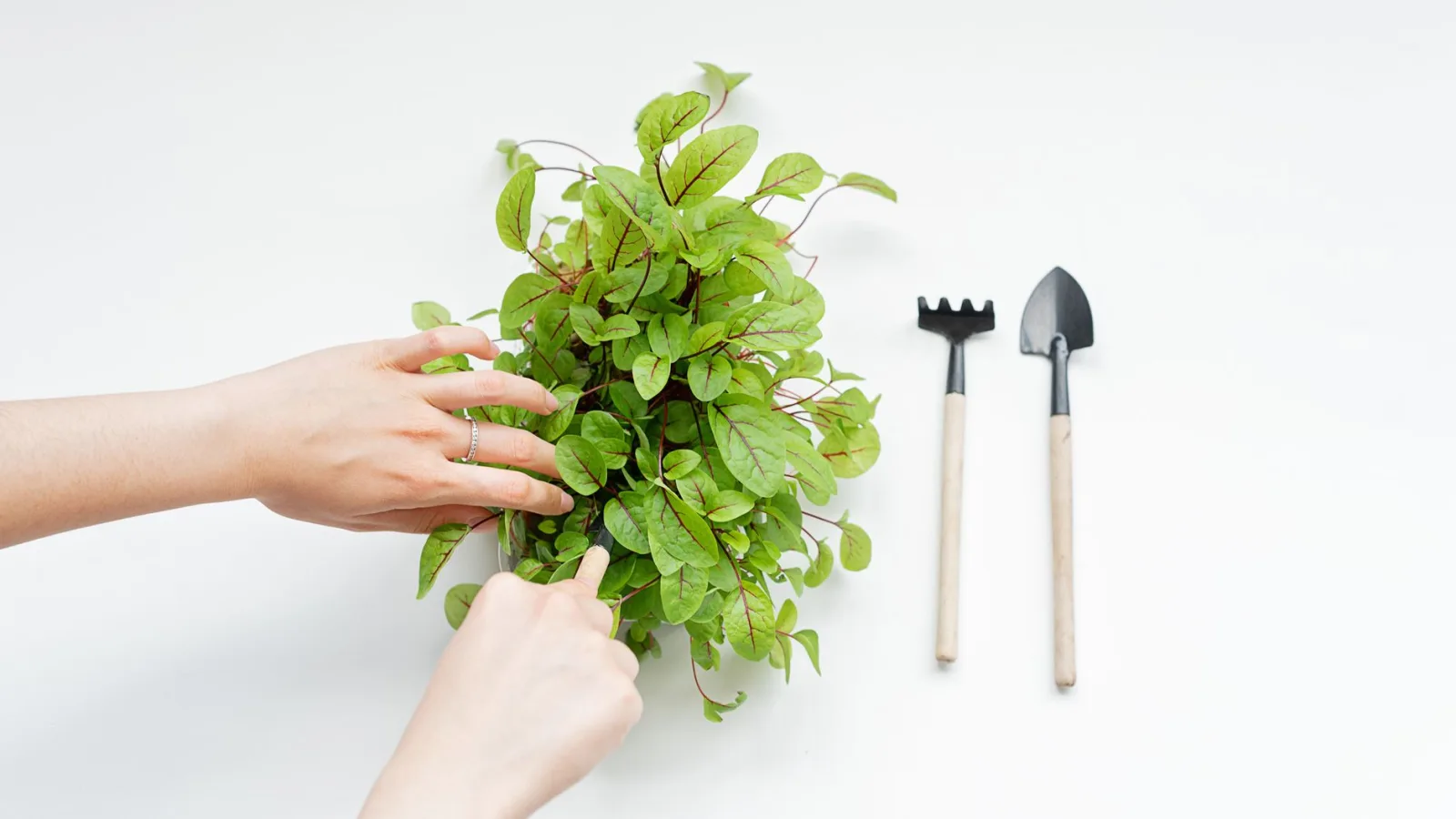
When September mornings turn cool, one corner of the garden starts to empty out. It's the spot where the summer greens held their ground all season before bolting and giving way. Sorrel is a good seed to slip into that bare soil right now. It's a perennial in the knotweed family that grows freely in open fields and along the banks of rice paddies, and seed catalogs list it as garden sorrel. Plenty of people walk right past it, filing it away as just another weed.
Sow It When the Air Turns Cool
Sorrel fills out best in cool weather. Its ideal range is 15–22°C (59–72°F), and it will keep growing anywhere between 3 and 28°C (37–82°F). The sowing windows are March through April and again in September, so watch the thermometer rather than the calendar and you won't go wrong. The seed is tiny and can't push up through a deep covering, so rake the bed fine, set the seed shallow, and cover it with barely a dusting of soil. If the seedlings come up thick, thin them to roughly 20cm (8 inches) apart. Sorrel does well in containers too — just pick a deep pot, since the root drives straight down and thickens as it goes.
- Sowing — March–April, September
- Harvest — April–June, September–October
- Ideal range 15–22°C, viable range 3–28°C
Tending It, and Getting It Through Winter
Once it settles in, sorrel asks very little of you. Water it so the soil never goes bone-dry, and once the outer leaves reach about the size of your palm, start picking. The moment to pay attention is when the temperature climbs. Above 25°C (77°F), the plant throws up a flower stalk, the leaves turn tough, and nothing is left but the sourness. Cut any flower stalk at the base the moment you spot it. Plants sown in fall overwinter on a thick taproot. Sorrel is genuinely cold-hardy: even after the leaves die back, the root stays alive and pushes out fresh growth the following spring. Because it's a perennial, one good planting will feed you for several years.
When Is the Sourness Cleanest?
Pick from April through June, and again in September and October. The younger the leaf, the cleaner the sourness and the more tender the bite. Leave the crown intact and take only the outer leaves, and new ones will keep rising from the center. If you're foraging, sorrel is easy to confuse with curly dock, a relative in the same genus. Look at the base of the leaf: on sorrel it splits into two sharp lobes that sweep backward, and one bite settles the question — the sourness is right there.
Cooking Around the Sourness
That sour edge comes from oxalic acid in the leaves. It's an organic acid common throughout the knotweed family, and because it dissolves in water, some of it leaches out during blanching. When you're dressing sorrel as namul — a seasoned vegetable side dish — throw the blanching water out. Oxalic acid binds with calcium, so this isn't a green to eat in quantity at one sitting. The leaves also carry vitamin C, plus the pigment behind those red veins and the chlorophyll and carotenoids of the green blade.
There are places where raw sorrel earns its keep. Chop a few leaves coarsely, stir them into olive oil, and spoon that over a rich grilled fish: you get the lift of lemon without the lemon. Tuck a few leaves in among lettuce or arugula and the salad holds its own with less dressing. The leaves are thin and wilt in moments, so fold them in just as the dish goes to the table. Sorrel is grown widely in France, Russia, and Ukraine, where it's simmered with potatoes into a soup finished with beaten egg. Heat turns the green to a dull brown, so add the leaves right before you cut the flame.
The Name in the Old Records
In the herb section of the Dongui Bogam, the seventeenth-century Korean medical compendium, sorrel appears as sanmo (酸摸), with the vernacular name written as seung-a. The text describes it as cooling in nature, sour in taste, and free of toxicity, and notes that it resembles yangje (dock) but with narrower leaves and a sourness that makes it worth eating. Another passage mentions snapping off the young shoots to eat raw, or pressing them for juice. These are notes from an old medical text, and they don't line up with what we'd conclude today.
If there's even a hand's width of bare soil left in your garden, scatter a little sorrel seed there today, shallow. What goes in this month will leaf out before fall is over, and the root will hold through winter and rise again in spring.
Sources: Dongui Bogam, Herb Section, "Sanmo" (酸摸) · National Standard Plant List of Korea