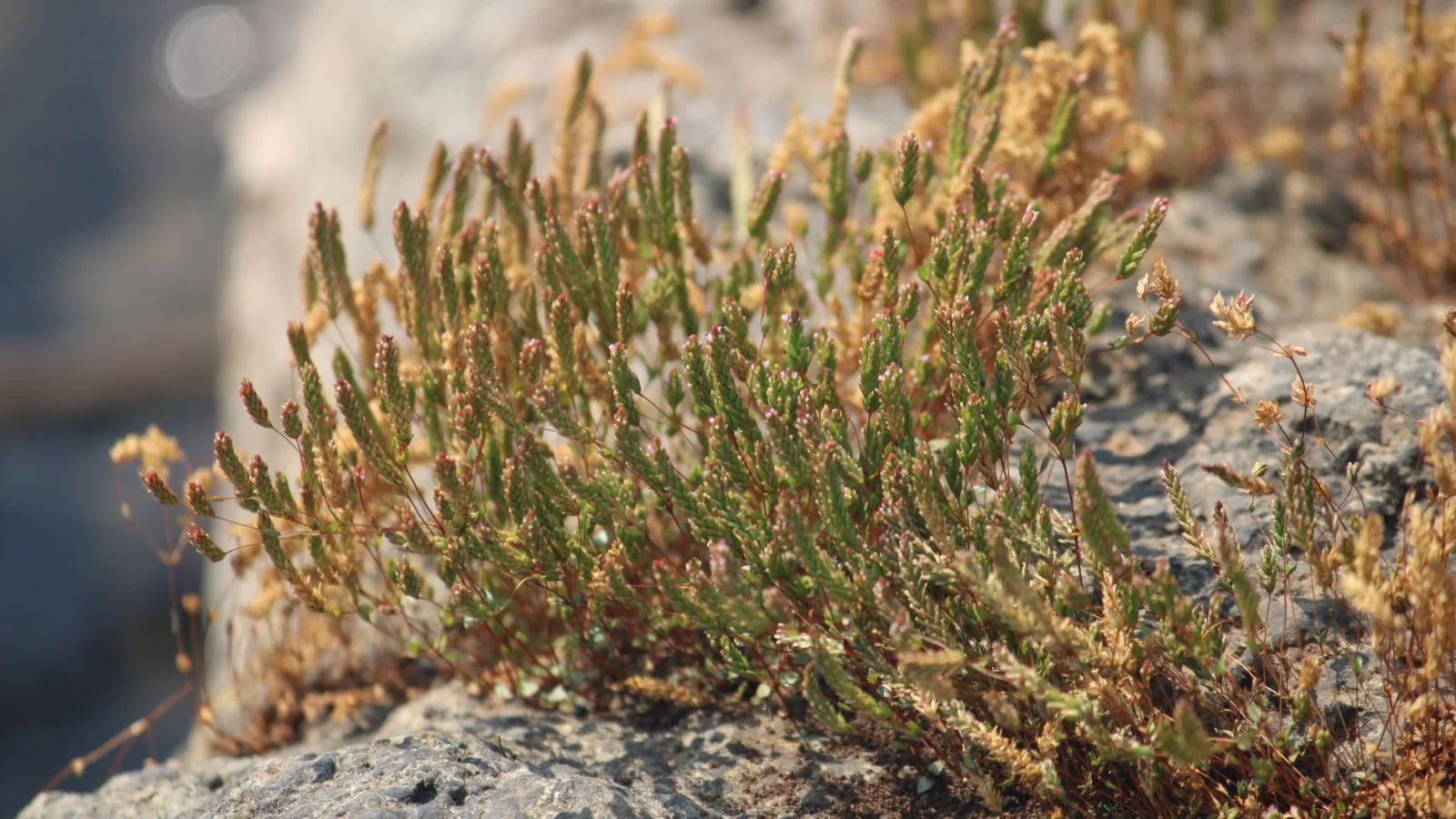
In September the field banks are still buried under summer growth. Somewhere in there, pick out a dry margin — a spot that gets long hours of sun and drains well — and set aside a hand's span of it. That's where the tteoksuk seed goes. It's a biennial in the aster family, so seed sown in September or October germinates in fall, spends the winter as a flat rosette pressed against the ground, and sends up young shoots the following April or May.
Sown in Fall, Wintered Over
Jersey cudweed does best between 12 and 22°C (54–72°F) and holds on anywhere from 0 to 30°C (32–86°F). It takes cold well and overwinters as a small rosette. Scatter the seed across a bed you've just cleared of summer crops and cover it with the thinnest layer of soil. The seed is tiny; bury it deep and it will never make it to the surface. In damp shade the plants sprawl and the white wool on the leaves thins out, so avoid anywhere water pools. It grows wild across Korea, China, and Japan, and turns up most often on dry ground people leave alone — field banks, roadsides, edges.
- When to sow: September–October
- Where to plant: dry soil with long sun and good drainage
- How deep to cover: just enough to hide the seed
- When to harvest: the following April–May, before the flower stalk rises
Tell It Apart by the White Wool
Leaves and stems are covered in white woolly hairs, so from a distance the plant reads gray-white, and under your fingertips it feels soft. Its Korean name sits close to ssuk (mugwort), which is where the confusion starts. Mugwort is white only on the underside of the leaf; the top stays green. Jersey cudweed is pale on both sides. Before you dig, turn one leaf over. In late spring, small yellow disc flowers open in clusters at the stem tips. Once the flower stalk goes up the leaves turn tough and are no longer used as a green — which is why the harvest bunches into April and May.
Inside the Leaf, and an Old Name
Young shoots are tender and post-bloom leaves are tough for one reason: fiber. As the flower stalk rises, the tissue firms up and the bite turns coarse. Harvest on time and you skip the whole change. The compounds usually mentioned for aster-family leaves are flavonoids, luteolin glycosides in particular. That said, no measured levels for this plant appear in the standard field guides, so there's no honest way to say that eating a given amount does a given thing for you.
In the herb section (草部) of the Donguibogam, it appears under the name buri-cho (佛耳草), "Buddha's-ear herb," recorded as hot in nature and sour in taste. It's a short entry quoting the Introduction to Medicine (Uihak Immun), so nothing is said about the plant's appearance or where it grows. Buri-cho has long been passed down as another name for seogukcho (鼠麴草), identified today as Jersey cudweed. This is a record from an old medical text, not a judgment of modern medicine. Read it as a green eaten briefly in spring. There is nothing in the record to justify expecting a cure.
Blanched and Dressed, or Folded Into Rice Cake
Blanch the young shoots briefly in boiling water and rinse them in cold. Blanching lays the wool flat, so you don't feel it when you chew. Wring out the water, then dress them with doenjang (fermented soybean paste) and sesame oil. The flavor is mild — easier eating than mugwort.
For tteok (steamed rice cake), mince the blanched shoots fine and work them into non-glutinous rice flour, then steam. Squeeze them dry first; wet greens make a slack dough. The result is gentler in aroma and paler in color than mugwort tteok. That's where the tteok in the Korean name comes from.
In Japan the plant is counted among the seven herbs of spring, and the young leaves go into rice porridge. Simmer a plain white porridge and stir the chopped leaves in at the very end so the color holds. Worth keeping in mind on a morning when you want something light in your stomach.
Just do this much today. At the end of a bed you've cleared of summer crops, open up the sunniest 1 m (about a yard) and leave it bare, scatter tteoksuk seed, and cover it with a thin layer of soil. Next spring, harvest the young shoots — only until the flower stalk rises.
Sources: Donguibogam, Herb Section, buri-cho (佛耳草) · Korean Plant Names Index, Korea National Arboretum