- Type
- Herbs & Aromatics
- Difficulty
- Easy
- Season
- Spring
- Sowing
- From seed
Cudweed
Pseudognaphalium affine
White woolly hairs · the field herb that once went into rice cakes
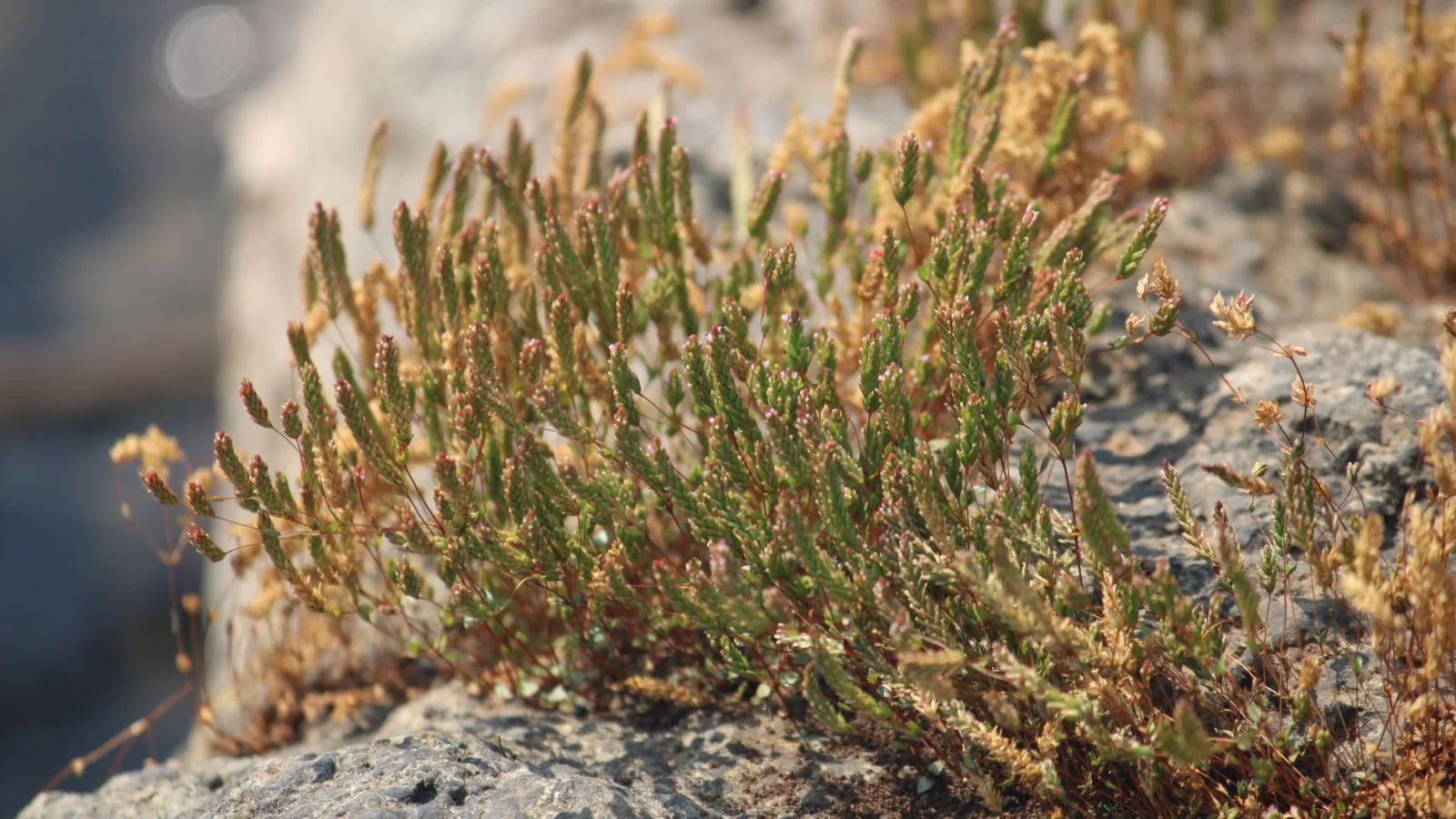
Cudweed is a common daisy-family herb of field banks and roadsides. Its leaves and stems are covered in white woolly hairs, so from a distance the plant reads grey-white, and it feels soft under the hand. The young shoots of spring are blanched and dressed, or worked into rice cakes in place of mugwort, which is where the Korean names tteok-ssuk and som-ssuk come from. In neighbouring Japan it is counted among the seven spring herbs and the young leaves go into rice porridge. In late spring yellow disc flowers cluster at the stem tips, and once the flower stalk stands the leaves coarsen and are no longer picked. The Donguibogam lists it in the Herb section as Buricho (佛耳草) and records a hot nature and a sour taste. It is a very short entry quoting the Uihak Ipmun. The Korean name suggests mugwort, but they are different plants: check whether both leaf surfaces are white or only the underside.
Year-Round Calendar
- 1
- 2
- 3
- 4
- 5
- 6
- 7
- 8
- 9
- 10
- 11
- 12
- 9
- 10
- 4
- 5
Where It Grows
-
Wild population
Common nationwide on field banks, roadsides, and abandoned fields. Harvest April, May
- 4
- 5
- Wild population It grows widely across central and southern China, where the young shoots are added to rice cakes in spring.
- Wild population Common from Honshu southward, and counted as one of the seven greens eaten in spring.
It is a wild plant native from East Asia across South and Southeast Asia, with no commercial cultivation and no production statistics. Rather than a production ranking, therefore, the list is cut off at the three countries in its native range where it is actually gathered as a spring green. Because it spreads readily on land people have disturbed, such as field banks and roadsides, its distribution follows farmland.
- Optimum
- 12~22℃
- Range
- 0~30℃
- Hardiness
- Hardy
It is a biennial wild plant that grows on sunny, well-drained dry field banks and roadsides. It sprouts in autumn, overwinters flat against the ground in a cushion-shaped rosette, and sends up a flower stalk the following spring. In damp shade the plants sprawl and the white down covering the leaves fades.
Harvested 1–1 years after planting. Seed shed in September to October sprouts that same autumn, overwinters, and by April to May of the following year has grown large enough to pick. The month the seed falls and the month the shoots are picked are not in the same year.
In Korea Nationwide
It is gathered from the wild rather than planted and grown. The young shoots, spread in a cushion-shaped rosette, are picked in April to May, before the flower stalk rises. The shoots come up from late March in the southern regions and from mid-April in the central regions.
How to grow
- Light
- A sunny position. In shade the wool thins and the plant sprawls
- Soil and depth
- Not particular. It does better on dry, free-draining ground than on rich soil
- Spacing
- 20cm between plants. It spreads as a flat rosette, so crowding presses them together
- Watering
- No watering needed. Water only through a long drought
- Feeding
- No feeding. Rich ground draws it up soft and thins the wool
- Harvest
- April and May. Pick the young rosette growth before the flower stalk stands. Take only the leaves and leave the crown, and one plant gives another picking or two
What makes the difference. Rinse what you pick several times in running water, shaking it as you go. Dust clings readily in the wool
Why this one is harder. It sets a great deal of very fine seed, so a single season leaves it scattered along the whole bank. Keep only as much as you will pick, and cut the flower stalks before the seed ripens
Common problems
- Aphids You will see Colonies on flower stalk tips and young leaves What to do Wash them off with a jet of water. Do not spray a plant you intend to pick from
- Waterlogging You will see After the rainy season the crown softens and the leaves darken and collapse What to do Raise the bed so water does not sit, and open the spacing
- Smothering by taller weeds You will see Taller spring weeds come up first and bury the rosette What to do Weed around the overwintered rosette early to let the light in
This page describes how a crop is grown and used. It does not claim health effects for any food, nor is it intended to prevent or treat disease. Component and study notes are references only and do not mean the same result occurs in people. Consult a medical professional about health concerns.
Health Benefits
What the Donguibogam records — Buricho (佛耳草). The Donguibogam lists the plant in its Herb section as Buricho (佛耳草). It records a hot nature and a sour taste. It is a short entry quoting the Uihak Ipmun, so beyond nature and taste no description of form or country is attached here. This is a historical medical record and differs from modern medical judgment.
The name and the identification. Buricho is handed down as another name for seogukcho (鼠麴草), taken today to be cudweed. The white wool covering leaves and stems is the mark that identifies the group. This is a note on the history of a name and has nothing to do with preventing or treating disease.
Nutrition
- White woolly hairs (cover the leaves and stems) — the character that separates cudweed from other spring greens
- Flavonoids (luteolin glycoside type) (identified in the leaves in analyses) — compounds widely addressed in daisy-family foliage
- Dietary fibre (rises once the flower stalk stands) — the tissue that coarsens after flowering
Not a mugwort The Korean name carries the word for mugwort, but this is a different group from Artemisia. Cudweed is woolly white on both leaf surfaces; mugwort is white only underneath and green on top. Rubbed between the fingers, mugwort is far more strongly scented.
Blanched before use Blanch the young shoots in boiling water, rinse cold, and dress them. Throw the blanching water away. For rice cakes, chop the blanched shoots fine and work them into the dough.
Flavonoids Analyses identify luteolin-type flavonoids in cudweed leaves. This entry stays with the compositional record.
Pairings
○ Rice flour — cudweed tteok — Chop the blanched shoots fine, mix them into non-glutinous rice flour, and steam. Milder in scent and paler in colour than mugwort cake. Squeeze the water out first or the dough goes slack.
○ Dressed with doenjang — Dress the blanched shoots with soybean paste and sesame oil. Blanching lays the wool flat, so nothing of it remains in the bite.
○ Rice porridge — Chop the young leaves and stir them into plain rice porridge. That is the spring herb porridge eaten in Japan. Add them at the end to keep the colour.
△ Picking it as mugwort — Cudweed and mugwort are different plants. Woolly white on both leaf surfaces means cudweed; white underneath and green on top means mugwort. If you cannot tell which you are looking at, do not pick.
△ After the flower stalk stands — Once yellow flowers begin to cluster at the stem tips, the leaves have coarsened and the plant is no longer picked as a green. The picking season runs from the flat winter rosette until the stalk rises.
△ Roadsides and sprayed banks — Do not pick along roads carrying traffic or on banks that have been sprayed. The plant spreads low enough for its leaves to touch the soil, and dust clings in the wool where rinsing does not reach it.
Varieties
- Cudweed (wild) — The commonest kind on field banks. Both leaf surfaces covered in white wool
- Gnaphalium hypoleucum (wild) — A relative in the same group. Taller, and it flowers in late summer
Source: Donguibogam, Herb Section 佛耳草 · Korea National Arboretum, Korean Plant Names Index