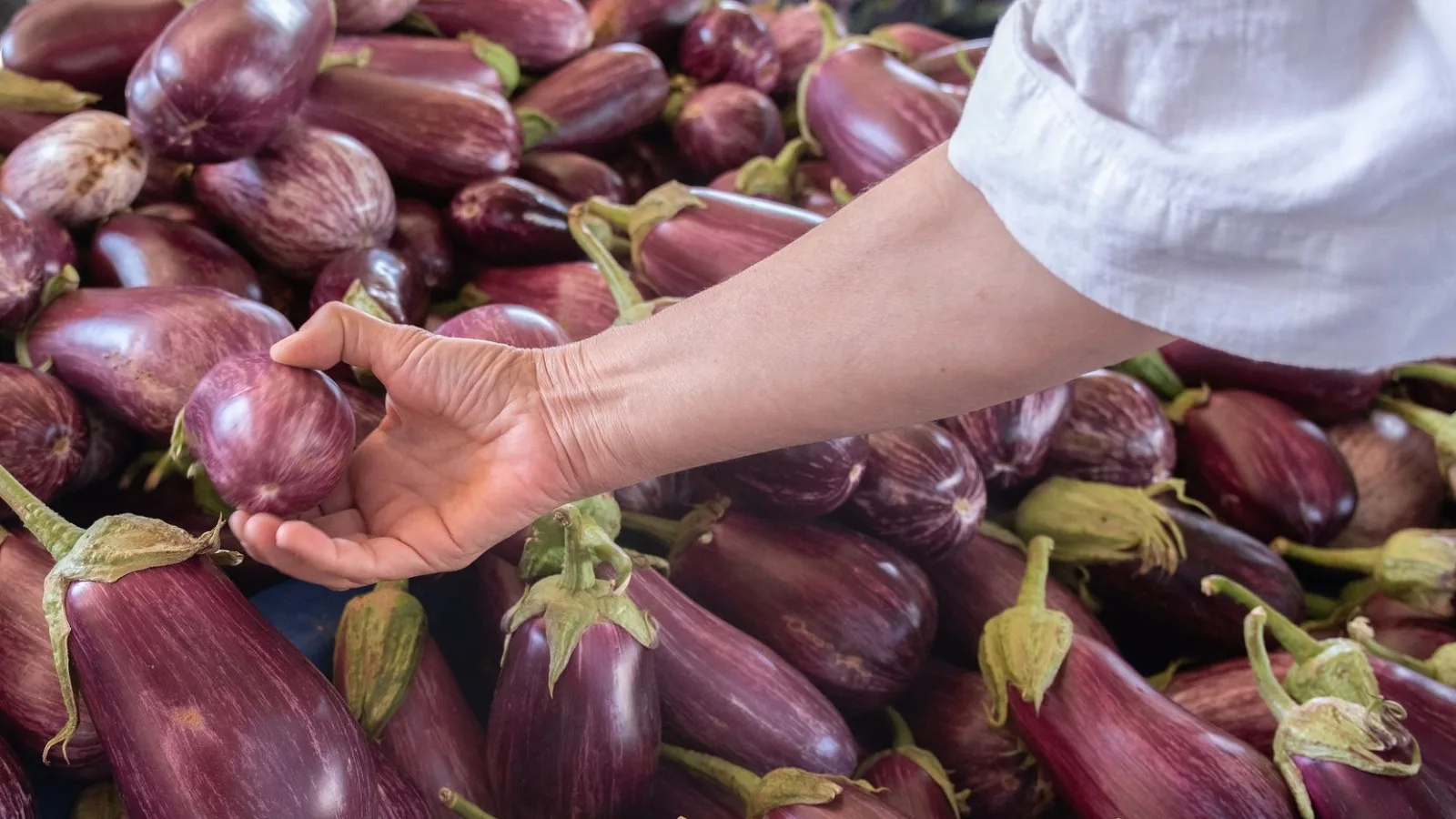
Picking Purple in the Summer Garden
Step out into the garden in midsummer and you'll find them: deep purple eggplants hanging heavy, glossy in the sun. The skin is cool and smooth against your palm, and there's a particular satisfaction in that little snap when you tug one free. A single plant keeps producing all season, enough to land on the table meal after meal, which makes eggplant one of the most dependable companions a summer garden can offer.
Steamed until silky, grilled until nutty and sweet — this everyday vegetable turns up in a hundred forms at dinner. But how did the old medical texts treat it? Open the Dongui Bogam, the seventeenth-century Korean medical compendium, and eggplant appears as something well beyond a summer side dish. Let's walk through what it has to say.
What the Dongui Bogam Says
The Dongui Bogam describes eggplant (gaji, 茄子) as cold in nature, sweet in flavor, and free of toxicity. Being cold, it was used to draw heat out of the body. The original text says it governs alternating chills and fever (寒熱), the taxation heat of the five viscera (五藏勞), and long-settled consumptive conditions (傳尸勞氣). The Korean commentary reads this as a cooling approach to chronic exhaustion and low-grade fever.
Another line worth noting is that eggplant disperses stagnant blood (散瘀). Stagnant blood is an old term for blood that has settled in one place and stopped moving, and the Dongui Bogam reached for eggplant in cases of bruising, blunt injury, and bleeding in the lower body. Its medicinal action was said to travel to the stomach, large intestine, liver, and bladder. That the text bothered to specify which organs a single vegetable's influence reached says something about the care these old physicians took.
Beyond the fruit we eat, the Dongui Bogam lists the roots, dried stems, and leaves as separate medicinal materials. One passage instructs the reader to boil eggplant root and stem and soak and wash frostbitten skin in the resulting water (主凍瘡, 煎湯浸洗). Korean folk practice extended the same method to scabies and skin sores, and for bleeding gums, the commentary notes that the burned, powdered calyx was applied directly to the affected area. There's something fascinating about a way of seeing that divided one plant into fruit, root, stem, and calyx, each with its own use.
The text does attach a caution, though: do not eat too much of it (不可多食). Its cold nature is strong, and eating large amounts over a long stretch was believed to obstruct the flow of qi (動氣).
Read Against Modern Nutrition
The dispersing-stagnant-blood property the Dongui Bogam described is worth reading alongside a pigment we now call anthocyanin. That deep purple in eggplant skin is anthocyanin, and modern pharmacology studies it largely for its effects on blood vessels. Where the old physicians thought of bruises and bleeding, we now put the word vascular.
Eggplant is high in water, low in calories, and rich in dietary fiber. The Dongui Bogam's view of it as a food that gently soothes the digestive system doesn't stray far from how we classify it today: a light vegetable, easy on the body. The impression of a soft, settling meal seems to have held steady across four centuries. That said, this kind of overlap is a general-interest comparison, not a claim — eating eggplant won't reliably produce any specific effect. The Dongui Bogam's records are best read as a record of their own era.
The old note about its cold nature is worth keeping in mind too. If you have a delicate stomach, tend to run cold, or are prone to loose stools, the Dongui Bogam's advice to moderate your portion still holds up.
From Garden to Table
Your harvest will take beautifully to steaming, grilling, braising, or frying. If the cooling quality gives you pause, cooking it warm — grilled or stir-fried in oil — is a sensible way to go. The Dongui Bogam itself notes that yellow eggplant (黃茄) was what physicians mainly used medicinally, while the rest was simply eaten as a vegetable dish. So for everyday purposes, enjoy it as a side dish and don't overthink it.
The cautions come straight from the old record. Avoid eating a great deal at once or over long stretches, and if your stomach runs cold or delicate, cut back on the portion. Nightshade allergies are uncommon but real, so pay attention the first time you eat a large serving. May the purple eggplants from your garden bring a welcome coolness to your summer table.