
Tangaek — Decoctions · Trees
桑上寄生 Mistletoe
 Related Crop · Mistletoe →
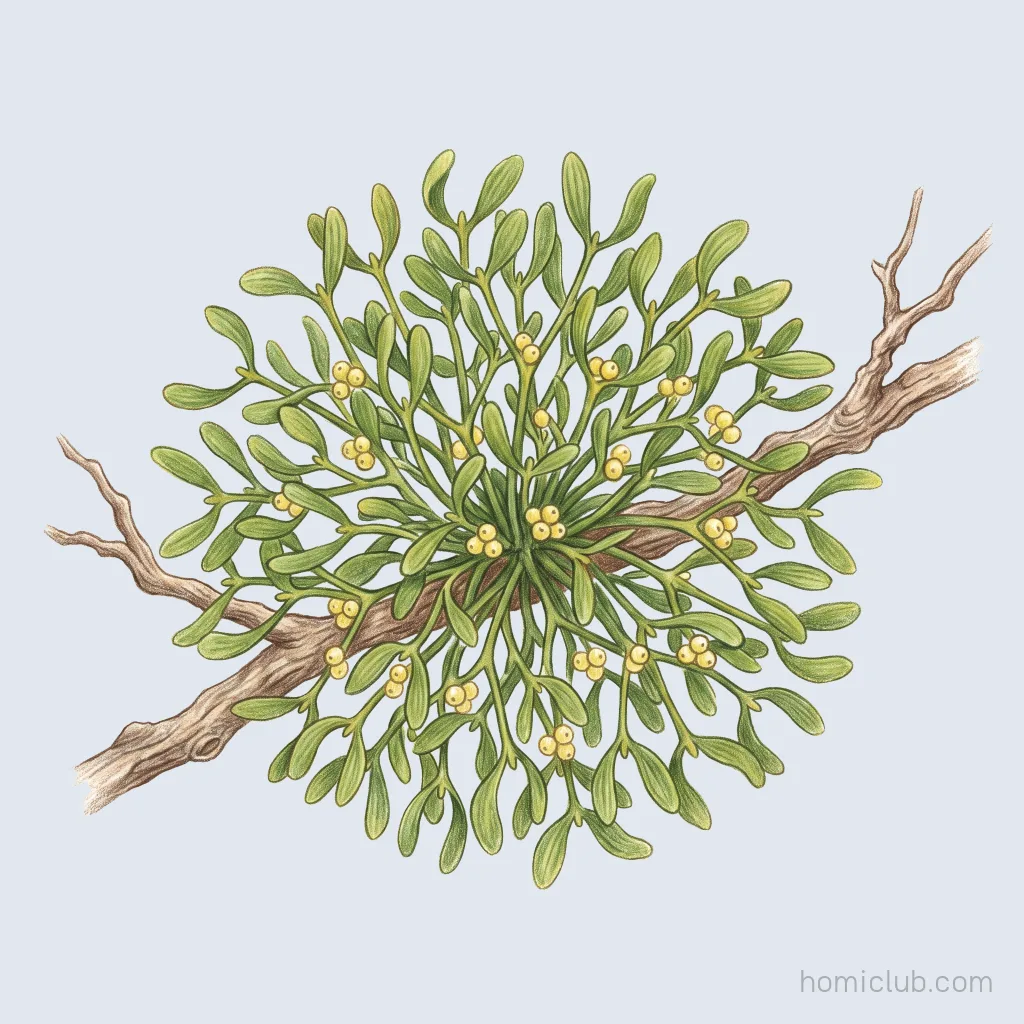
Sangsanggisaeng is mistletoe growing on an old mulberry branch. Mistletoe shows itself as a green nest-like clump on bare winter branches, most often on oaks, but the Dongui Bogam accepted only the mulberry-borne kind and noted how hard the genuine article was to come by.
Original, read line by line 東醫寶鑑 · Tangaek — Decoctions vol. 3
-
性平, 味苦甘, 無毒.
Its nature is neutral, its taste bitter and sweet, and it has no toxicity.
-
助筋骨, 益血脉, 充肌膚, 長鬚眉.
It aids the sinews and bones, boosts the blood vessels, fills out the flesh and skin, and makes the beard and eyebrows grow.
-
主腰痛.
It governs lower back pain.
-
治癰腫及金瘡,
It treats abscesses and swellings (癰腫) and metal wounds (金瘡).
-
療女子懷胎漏血, 能令胎牢固,
It cures leaking of blood (漏血) in a woman carrying a child, and can make the fetus firm and secure.
-
除産後餘疾及崩漏.
It removes lingering illness after childbirth and flooding and spotting (崩漏).
-
生老桑樹上,
It grows on old mulberry trees.
-
葉似橘而厚軟,
Its leaves resemble those of the tangerine but are thick and soft.
-
莖似槐枝而肥脆.
Its stems resemble pagoda-tree (槐) branches but are plump and brittle.
-
三四月開花黃白色,
In the third and fourth months it opens yellowish-white flowers.
-
六七月結實, 黃色如小豆大.
In the sixth and seventh months it bears fruit, yellow and the size of a red bean.
-
他木上皆有寄生, 惟桑上者入藥.
Parasitic mistletoe grows on many trees, yet only the one rooted on mulberry is taken as medicine.
HomiclubWhat is used as sanggisaeng in China today is Taxillus chinensis of the showy mistletoe family (Loranthaceae), which grows on more than seventy kinds of host tree, mulberry among them. Plants growing on masang (馬桑, Coriaria nepalensis) are poisonous and are not used.
-
三月三日採莖葉, 陰乾.
On the third day of the third month gather the stems and leaves and dry them in the shade.
-
此物極難得眞,
It is extremely hard to obtain the genuine article.
HomiclubThe mistletoe commonly seen in Korean mountains (Viscum coloratum) is a different plant, placed in the sandalwood family (Santalaceae) under APG, and is used separately in China as gokgisaeng (槲寄生). Prescriptions often shorten both to gisaeng (寄生), so the two have to be told apart.
-
或云, 斷其莖而視之, 其色深黃,
Some say that when the stem is cut and examined, its colour is deep yellow.
-
幷實中有汁稠粘者, 爲眞. 《本草》
Also, one whose fruit holds thick, sticky juice is said to be genuine. 《Boncho (本草)》
Related Crop
Mistletoe →
Reading on Mistletoe
Trees — more entries
This is a cultural and historical record from a classical text, not a claim about any food’s effects. Nothing here is a health supplement or intended to prevent or treat disease. Consult a medical professional about health concerns. · Text: Korean Medicine Classics DB, collated with the Jangseogak copy of the 1613 wooden movable-type edition · Reading: Homiclub