

- Type
- Trees & Vines
- Difficulty
- Hard
- Season
- Fall·Winter
- Sowing
- Plant a sapling
Sweet mandarin
Citrus reticulata
Hesperidin and vitamin C in a citrus that sweetens after frost
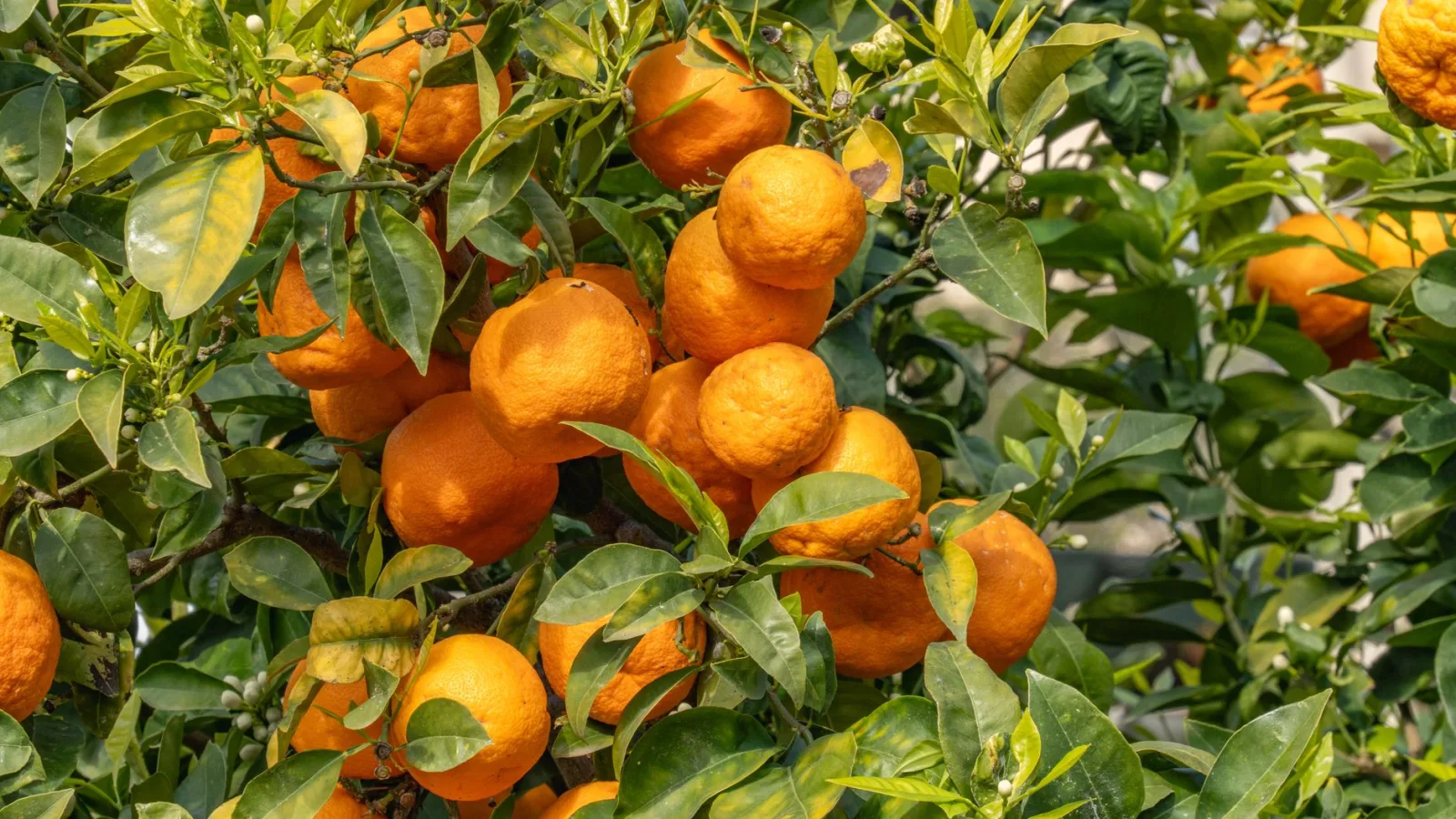
Despite the Korean name gam, which most people read as persimmon, this entry is a citrus. The Donguibogam described it as a tree resembling the tangerine, bearing fruit rounder and larger than a tangerine, with skin that starts green and turns yellow-red as it ripens. The same passage notes that it grows markedly sweeter after the first frost, which is where its Chinese name comes from. Today that place is held by satsuma mandarins and the larger late-season hybrids, nearly all of them grown on Jeju Island. It is the fruit that arrives by the box in winter, which is how most city households meet it.
Year-Round Calendar
- 1
- 2
- 3
- 4
- 5
- 6
- 7
- 8
- 9
- 10
- 11
- 12
- 3
- 4
- 11
- 12
Where It Grows
-
Main producer
The world's largest producer of citrus. Hunan, Guangxi, Hubei and Zhejiang are the main areas. Harvest October, November, December, January
- 1
- 10
- 11
- 12
-
Main producer
The largest source of the small mandarins sold into the European market. Valencia and Andalusia are the main areas. Harvest October, November, December, January, February
- 1
- 2
- 10
- 11
- 12
-
Major producer
Grown around Adana and Mersin on the Mediterranean coast. Harvest October, November, December, January
- 1
- 10
- 11
- 12
- Major producer Grown on irrigated land in the Nile Delta, with a large share going to export.
-
Major producer
The Souss and Gharb plains are the growing areas, and the clementine came out of this region. Harvest November, December, January, February
- 1
- 2
- 11
- 12
-
Major producer
Where the satsuma mandarin (Citrus unshiu) originated. Wakayama, Ehime and Shizuoka are the growing areas. Harvest October, November, December
- 10
- 11
- 12
-
Major producer
Being in the Southern Hemisphere, its harvest runs opposite to the Northern Hemisphere's, so it supplies the northern summer market. Harvest May, June, July, August
- 5
- 6
- 7
- 8
The citrus group is native to southeastern Asia, from southern China to northeastern India, and cannot be pinned to any single country. The satsuma mandarin sold in Korea is a variety that came out of Japan, while the clementine of the European market came out of North Africa. Growing regions are split between the Northern and Southern Hemispheres, so their harvest seasons fall opposite each other, and mandarins are on the market year-round as a result. The FAO counts mandarins, clementines and tangerines under a single heading, so the rankings mix several kinds of citrus together.
- Optimum
- 23~30℃
- Range
- 13~37℃
- Hardiness
- Not hardy
- Day length
- Not applicable
Outdoor overwintering — surviving the winter in open ground — is possible only where the soil does not freeze deeply even in midwinter. The satsuma mandarin sits at the cold-hardy end of the citrus group, but a sustained spell of -5 to -7℃ freezes its leaves and branches. It needs generous summer sun, and a wide gap between day and night temperatures through the ripening season, for the fruit to take on colour and lose its acidity. Flower buds break not on day length but on spring warmth, after a rest period imposed by the low temperatures and dryness of winter.
Harvested 3–4 years after planting. It takes three or four years from planting a sapling to the first fruit. Flowers open in May–June and ripen in November–December of the same year, closing the cycle within one year; but in the year following a heavy crop, flowering thins out and the tree falls into alternate bearing.
In Korea Jeju and the south coast
Jeju is the main growing region, and open-field cultivation also works in parts of Goheung and Wando in South Jeolla and Geoje in South Gyeongsang. In the central part of the country the tree cannot overwinter outdoors, so it has to be carried inside, pot and all, every winter.
How to grow
- Light
- A south-facing spot with six or more hours of direct sun. Too little and the fruit stays sour and colors up late.
- Soil and depth
- Free-draining, slightly acidic soil at pH 5.5-6.5. In a pot, mix in about 30% coarse grit.
- Spacing
- Three to four meters apart in the ground. In a pot, use one at least 45 cm across and choose a tree grafted on dwarfing rootstock.
- Watering
- Water until it runs from the drainage holes whenever the surface dries. A dry spell in August or September, when the fruit is sizing, splits the skins.
- Feeding
- Feed with organic fertilizer three times a year, in March, June, and October. Too much nitrogen gives you leaves and sour fruit.
- Harvest
- Pick in November or December once 80% of the skin has colored, cutting the stem flush with shears. Twisting fruit off by hand tears the rind and mold follows quickly.
What makes the difference. Leaving every flower to set gives you small fruit and a poor bloom the following year. Thin in June to roughly one fruit per 25 leaves.
Why this one is harder. It only overwinters outdoors on Jeju and the far south coast. Anywhere further north the pot has to come inside each winter, and it takes three to four years to see the first fruit.
Common problems
- Citrus red mite You will see Leaves go pale and bleached, with red specks moving on the undersides What to do Spray the leaf undersides hard with water to knock the population down and avoid letting the plant run dry
- Scale insects You will see White shells stuck along the branches and sticky leaves below What to do Scrub them off with an old toothbrush and apply horticultural oil in winter
- Melanose You will see Scattered black speckling across the rind What to do Cut out and burn dead wood, and open up the canopy so it dries after rain
This page describes how a crop is grown and used. It does not claim health effects for any food, nor is it intended to prevent or treat disease. Component and study notes are references only and do not mean the same result occurs in people. Consult a medical professional about health concerns.
Health Benefits
What the old text says. This citrus appears in the Donguibogam's fruit section as yugamja (乳柑子). The entry records it as strongly cooling in nature — cooling, by another account — sweet in taste and free of toxicity. It describes a tree resembling the tangerine tree, bearing fruit rounder and larger than a tangerine, with skin that is green while unripe and turns yellow and red as it ripens. It also gives the origin of the name: the fruit turns markedly sweet after frost, and so it is called gamja. This is a record from an old medical text, not a modern medical judgement.
Hesperidin research. Several studies have reported on antioxidant markers using hesperidin from citrus. The doses used in those studies are often far larger than what eating the fruit provides. This is a note on research into a compound, and it has nothing to do with preventing or treating disease.
Nutrition
- Hesperidin (Concentrated in the pith and the white strands) — A citrus flavonoid
- Vitamin C (About 40 mg per 100 g) — A water-soluble vitamin
- Citric acid (About 1 %) — The sourness
- Beta-cryptoxanthin (The orange pigment of the flesh) — One of the carotenoids
Vitamin C The flesh carries around 40 mg of vitamin C per 100 g. Two medium fruit still fall short of an adult's daily requirement. It degrades with heat, so you get the most from eating them fresh rather than cooked. Peeled segments left sitting out lose some of it too.
Hesperidin The white pith and the stringy threads clinging to each segment concentrate a flavonoid called hesperidin. Picking all of that away throws the compound out with it. A number of studies have reported on antioxidant markers using hesperidin, but the amounts used in them are often far larger than what eating the fruit provides. This is a note on research into a compound, and it has nothing to do with preventing or treating disease.
Beta-cryptoxanthin The orange of mandarin flesh comes from a carotenoid called beta-cryptoxanthin. Observational studies have reported higher blood levels of it in people who eat citrus regularly. It is fat-soluble, so a little fat in the same meal helps absorption.
Fiber and potassium Juicing strains out most of the fiber that sits between the segments. Eat the fruit whole and you get roughly 1 g of fiber per 100 g along with its potassium. Gram for gram, whole fruit is far more filling than juice.
Pairings
○ Nuts — Vitamin C is known to improve absorption of the iron in plant foods. A handful of almonds or hazelnuts alongside puts fat and vitamins together in one snack. It also happens to be a sensible winter habit. Hazelnut (Korean hazel)
○ Leafy greens and namul — Following a side dish of spinach or seasoned greens with a mandarin puts iron and vitamin C in the same window. One or two right after the meal is enough. Coffee and strong tea work the other way, so it is worth leaving a gap.
○ Dried peel — Wash and dry the peel you would otherwise throw away and it becomes tea or a braising ingredient. Using flesh and peel together leaves almost nothing wasted. If you plan to use the peel, choose fruit grown with minimal spraying. Tangerine peel
△ Several on an empty stomach — The citric and other organic acids can bring on heartburn if you eat several with nothing else in your stomach. If reflux is a regular problem, one or two after a meal is the better pattern. The tarter late-season hybrids are more likely to do it.
△ Carotenemia — Eating ten a day for weeks on end can turn the palms and soles yellow, a harmless condition called carotenemia. It fades on its own once intake drops. Still, two or three a day is a reasonable ceiling.
△ Medications — Grapefruit and pomelo have been reported repeatedly to interfere with how certain drugs are metabolized. Satsuma mandarins have almost no such reports, but if you drink several glasses of citrus juice a day it is safer to space that away from your medication. Ask a pharmacist if you are on a regular prescription.
Varieties
- Satsuma mandarin (Sapling) — Most of Korea's citrus crop. The peel comes away easily.
- Hallabong (Sapling) — A late-maturing hybrid with a raised neck. Shipped December to February.
- Cheonhyehyang (Sapling) — A juicy, strongly fragrant late hybrid.
- Byeonggyul (Sapling) — A Jeju landrace citrus. The closest to the 柑子 of the old record.
Source: Donguibogam, Fruit Section (乳柑子) · Rural Development Administration (nongsaro.go.kr)
Stories about Sweet mandarin
Bitter Orange Peel (Deungjapi): What the Donguibogam Recorded and What Modern Analysis Shows
Korea's 17th-century medical classic, the Donguibogam, listed bitter orange peel among its fruits as a source of aroma and bitterness. Here's where that old record agrees with modern chemistry, where it doesn't, and three ways to use the peel in your kitchen.
Can Rosemary Ease Full-Body Pain? What a Rat Study Shows
A 2026 animal study found that rosemary extracts made rats with a fibromyalgia-like condition less sensitive to pain. Nobody has tested this in people yet, but rosemary is still a fine herb to grow and cook with.