- Type
- Berries
- Difficulty
- Moderate
- Season
- Spring·Fall
- Sowing
- Plant a sapling
Goji Berry
Lycium chinense
Zeaxanthin, betaine · a red berry that fruits in a pot
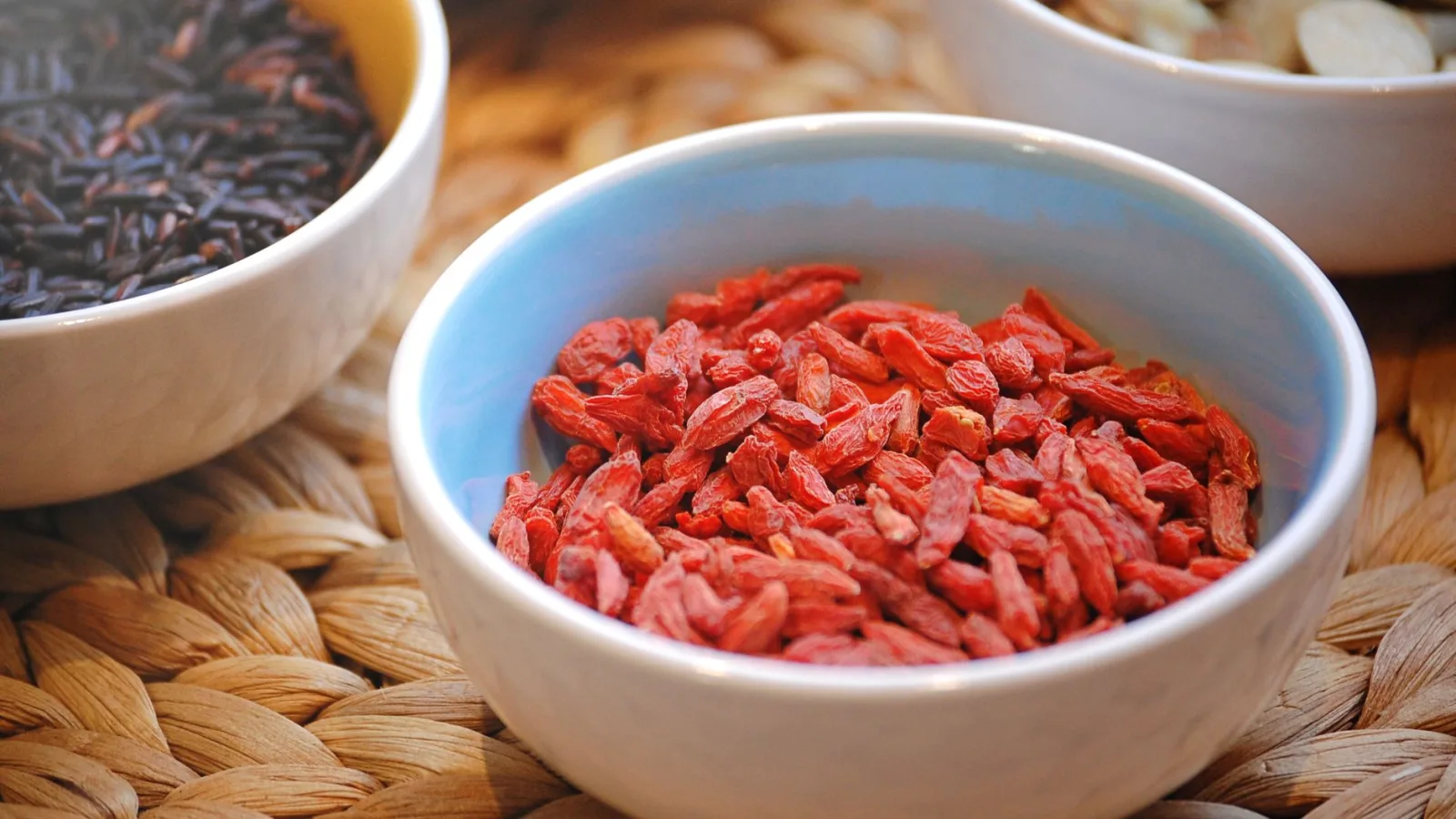
Goji is the red fruit of a deciduous shrub in the nightshade family. Its branches arch and trail, so it grows in a corner of a yard or in a pot 30cm across, and the young spring shoots are eaten as a seasoned green in Korea. The Donguibogam lists it in the Wood section as 枸杞子, calling its nature cold — some say neutral — and its taste bitter, some say sweet, with no toxicity. The same entry names the stem 枸杞 and the root 地骨, separating stem bark, root bark and red fruit as three distinct uses of one plant, and grades their nature in three steps: stem bark cold, root bark very cold, fruit slightly cold. This is a historical medical record and differs from modern medical judgment.
Year-Round Calendar
- 1
- 2
- 3
- 4
- 5
- 6
- 7
- 8
- 9
- 10
- 11
- 12
- 3
- 4
- 11
- 8
- 9
- 10
Where It Grows
- Main producer The dry irrigated land of Zhongning in Ningxia, along with Qinghai, Gansu and Xinjiang, is the largest producing area in the world. What is grown there, however, is mostly the Ningxia wolfberry (Lycium barbarum), a different species from gugija (L. chinense).
-
Major producer
Cheongyang in South Chungcheong and Jindo in South Jeolla are the home of the native varieties. What is grown there is Lycium chinense. Harvest August, September, October
- 8
- 9
- 10
- Wild population It is found along the coast and in open country from Honshu southward.
Native to East Asia, it grows wild in Korea, China and Japan. Most of what sells as goji berry on the world market is the Ningxia wolfberry (Lycium barbarum) from Ningxia in China, whereas the gugija grown in Korea is L. chinense — a different species. When both are coloured in on a single map, the species have to be kept apart.
- Optimum
- 20~25℃
- Range
- 0~35℃
- Hardiness
- Hardy
A deciduous shrub, it endures winter cold and stands up well to summer heat and dry ground. Where water pools, the roots are the first thing to go, so drainage is what decides a site.
Harvested 2–3 years after planting. In the year the seedling goes in, it sets almost no fruit; the crop builds from the following year, and by the third or fourth year you pick in earnest. Planted once, it yields for years on end.
In Korea Nationwide
Cheongyang in South Chungcheong is the leading growing area, and native varieties still survive on Jindo in South Jeolla. It will also grow in a yard or along the edge of a field.
How to grow
- Light
- Six hours of direct sun or more. In weak light the berries stay small
- Soil and depth
- Drainage first. Field soil with 30 percent coarse sand; pots at least 30cm across and 30cm deep
- Spacing
- 1.5 to 2m in the ground, one plant per pot. The branches trail a long way sideways
- Watering
- Water thoroughly once the surface dries. Standing water damages the roots first
- Feeding
- One base dressing in March before bud break, then one potassium-leaning feed as fruit sets
- Harvest
- From August, pick the berries that have turned red. They do not ripen together, so expect several passes about ten days apart
What makes the difference. Fresh berries soften quickly, so spread them to dry the day they are picked. Sun or a low-temperature dryer keeps the colour best
Why this one is harder. Gall mite is the real hurdle. Once it spreads it costs that year's crop and carries into the next, so do not skip the winter prune that clears out old wood
Common problems
- Goji gall mite You will see Bumpy galls form on leaf undersides and the leaves buckle What to do Pick off affected leaves as they appear, and prune old wood hard in winter to cut down overwintering sites
- Aphids You will see New shoots curl and turn sticky What to do Wash off with a jet of water; if it recurs, use an egg-yolk oil spray or an approved organic product
- Powdery mildew You will see White floury patches spread across the leaves What to do Thin the branches to open up airflow and clear out the older lower leaves
This page describes how a crop is grown and used. It does not claim health effects for any food, nor is it intended to prevent or treat disease. Component and study notes are references only and do not mean the same result occurs in people. Consult a medical professional about health concerns.
Health Benefits
What the Donguibogam records — nature, taste, three uses. The Donguibogam lists goji in the Wood section as 枸杞子. It gives the nature as cold, though some sources say neutral, the taste as bitter, though some say sweet, and records no toxicity. It names the stem 枸杞 and the root 地骨, treats stem bark, root bark and red fruit as three separate materials from one plant, and grades them as cold, very cold and slightly cold in turn. This is a historical medical record and differs from modern medical judgment.
Carotenoid composition. Studies analysing the carotenoid profile of dried goji report zeaxanthin dipalmitate as the dominant component. Those analyses are usually run on Lycium barbarum, while the goji commonly grown in Korea is Lycium chinense, a different species. Other reports note that the amount remaining depends on drying method and temperature. These are compositional analyses and have nothing to do with preventing or treating disease.
Laboratory markers for LBP. LBP stands for Lycium barbarum polysaccharide, the polysaccharide isolated from that species. Antioxidant markers for it have been measured in test-tube and animal studies. These are not human results, and they do not carry over to Lycium chinense or to goji as eaten.
Nutrition
- Zeaxanthin dipalmitate (most of the carotenoid in dried fruit; the analyses are usually of Lycium barbarum) — the red-orange carotenoid pigment
- Lycium polysaccharide (LBP) (a water-soluble polysaccharide-protein complex isolated from Lycium barbarum) — the viscous fraction that steeps out in water
- Betaine (amino acid derivative) — a common quality marker in goji analysis
- Vitamin C and iron (concentrated in the dried fruit) — micronutrients
Zeaxanthin dipalmitate The red-orange of dried goji comes from zeaxanthin bound to two fatty acids. Analyses report this diester as the dominant carotenoid in the fruit, though the material analysed is usually Lycium barbarum, while the goji grown in Korea is Lycium chinense. Because it is fat-soluble, it releases better with oil than with water alone. A long soak in plain water pulls out sugars and polysaccharides first, and leaves much of the pigment behind.
Lycium polysaccharide (LBP) The slight thickness in goji tea comes from a polysaccharide-protein complex. The usual name for it, LBP, stands for Lycium barbarum polysaccharide, the fraction isolated from that species. It is large, dissolves readily, and carries straight into tea or a braising liquid. Laboratory studies have measured antioxidant markers for it, but cell and animal results do not carry over to people, nor to the different species grown in Korea. This entry records the compound and its behaviour, nothing further.
Betaine and amino acids Betaine is often used as a quality marker for dried goji. High drying temperatures cut it back along with the pigment, so sun drying or a low-temperature dryer is preferable. Fresh-picked berries hold a lot of water and turn soft within a day or two. Spread them out to dry the day they are picked.
Young shoots as a leaf vegetable The tender spring shoots are eaten as a green. The Donguibogam also records the young leaves being eaten in soup or as a seasoned dish. Compared with the fruit, the leaves carry more chlorophyll and minerals than carotenoid, and a brief blanch takes the bitterness down. Discard the blanching water and dress lightly with sesame oil and salt.
Pairings
○ Jujube and ginger — Dried goji is commonly steeped with jujube and ginger. The berry's mild sweetness sits under the jujube's heavier one, and ginger clears the finish. Steeping around 80C for ten minutes keeps the liquid clearer than a hard boil. Ginger · Jujube
○ Cooking with fat — Goji carotenoids are fat-soluble. Adding the berries to fried rice or porridge, or warming them briefly in oil, draws out more colour. Less pigment is lost than with a plain water soak.
○ Spring shoots as a side dish — Blanch the young shoots briefly and dress them with doenjang or sesame oil. They carry some bitterness, so throw out the blanching water and rinse once in cold water. On a plant grown for fruit, take only the tips and leave the rest.
△ Warfarin and other anticoagulants — Several case reports describe a rising INR in warfarin patients after drinking goji tea or juice. Anyone on an anticoagulant should speak with their prescriber before making goji a daily habit. Sudden large changes in the amount consumed are best avoided either way.
△ Nightshade allergy and cross-reactivity — Goji is a nightshade, like tomato and potato. Lipid transfer protein cross-reactivity has been reported in people allergic to peach or tomato. Start with a small amount, and stop if the mouth itches or hives appear.
△ Eating too much dried fruit — Drying concentrates the sugar, so dried goji is sugar-dense by weight. The berries are snack-sized, which makes portions easy to lose track of. Keep to about a handful a day, or steep them as tea where the quantity is easier to judge.
Varieties
- Cheongyang landrace (sapling) — From Cheongyang, South Chungcheong, the main Korean growing area. Small fruit, deep red
- Jindo landrace (sapling) — A southern coastal line long grown on Jindo island
- Ningxia type (Lycium barbarum) (sapling) — The type behind most imported dried goji. Larger fruit, sweeter
- Cutting-grown plants for leaf (sapling) — Kept low and harvested for young shoots. Suits a pot
Source: Donguibogam, Wood Section 枸杞子 · Rural Development Administration (Nongsaro) · National Institute of Horticultural and Herbal Science