

- Type
- Trees & Vines
- Difficulty
- Moderate
- Season
- Fall
- Sowing
- Plant a sapling
Cinnamon
Cinnamomum cassia
Cinnamaldehyde and coumarin · a spice made of tree bark
Cinnamon is the bark of a laurel-family tree, stripped and dried. It goes into sujeonggwa and cinnamon tea, and ground it turns up in bread and coffee under its English name. The quills sold in Korean markets are almost always cassia: thick bark curled into a single hard tube. Ceylon cinnamon rolls up as many thin layers instead, crumbles between the fingers, and smells gentler. What separates the two matters most is coumarin, which cassia carries in quantity and Ceylon barely at all. The European Food Safety Authority set a tolerable daily intake for coumarin of 0.1mg per kilogram of body weight, which is reason enough not to take spoonfuls of cinnamon powder every day. The Donguibogam lists it in the Wood section as 桂皮, says it grows in the southern country, and records the handling: strip the bark in the second, eighth and tenth months of the lunar calendar, dry it in the shade, and scrape off the coarse outer layer before use. It is a subtropical tree that cannot overwinter outdoors in Korea, so this entry deals with the bark as bought.
Year-Round Calendar
- 1
- 2
- 3
- 4
- 5
- 6
- 7
- 8
- 9
- 10
- 11
- 12
- 4
- 5
- 9
- 10
Where It Grows
- Main producer The Kerinci highlands of Sumatra are the heart of production, and the volume is the largest of all. What grows here is Cinnamomum burmannii — part of the cassia group, but a different species.
- Origin This is the original home of Cinnamomum cassia, the benchmark for stick cinnamon, and a major producing region. The trees are grown in the southern hill country of Guangxi and Guangdong.
- Main producer Yen Bai and Quang Nam are the centers of production. Cinnamomum loureiroi is the main species, and its strong aroma earns it a high price.
- Main producer This is the source of Ceylon cinnamon (Cinnamomum verum). It grows in the southwestern lowlands and is a different species from cassia.
- Major producer Ceylon-type cinnamon is grown in the Western Ghats mountains of Kerala and Tamil Nadu.
Four species hide behind the single name "cinnamon": Cinnamomum cassia, native to southern China; C. burmannii of Indonesia; C. loureiroi of Vietnam; and C. verum of Sri Lanka, known as Ceylon cinnamon. The first three are grouped together as cassia, and most of the stick cinnamon sold in markets is cassia. When they are shaded together on a map, this needs to be stated so the result does not look like the range of a single species. The bark is stripped from stems that have grown for about five or six to ten years after planting; with Ceylon cinnamon, the trunk is cut back at the base after three or four years, and the bark of the new shoots is stripped every year or two. None of it can be grown in Korea, so the entire supply is imported.
- Optimum
- 22~30℃
- Range
- 15~35℃
- Hardiness
- Tropical
- Day length
- Not applicable
An evergreen tree of the tropical and subtropical lowlands, it needs a climate that stays warm and rainy all year. A single frost kills it, so in Korea it cannot overwinter (survive the winter) in open ground. Because the tree is grown for its bark, day length does not set the harvest calendar; the bark peels most easily in the rainy season, when the sap is rising.
How to grow
- Light
- A subtropical tree that cannot overwinter outdoors in Korea. In its growing regions it takes generous sun and generous rain together
- Soil and depth
- It grows in free-draining red earth. Kept indoors as an ornamental it will never thicken enough for bark to be stripped
- Spacing
- Plantations set the trees in rows and coppice stripped trees at the base so new stems come up, working the stand in rotation
- Watering
- Rain-grown where it is farmed. For anyone buying the bark, keeping it away from moisture matters more
- Feeding
- Not a concern here. This is a material that is bought, not fed
- Harvest
- Start by checking whether it is cassia or Ceylon. Cassia is thick bark in a single hard curl; Ceylon is thin bark in many layers that crumbles in the hand. Choose quills that release aroma sharply when snapped — a weak smell means old stock
What makes the difference. Buying quills and breaking or grinding them at the point of use holds the aroma far longer than buying powder. Where you use a lot regularly, keep low-coumarin Ceylon cinnamon aside for that purpose
Why this one is harder. This is not a tree that can be grown in Korea. A small one can be kept indoors as an ornamental, but it will never thicken enough for the bark to be stripped and used. This entry deals with the bark as bought in a shop
Common problems
- Mould You will see White dust or spotting on the quill surface and a musty smell What to do Discard anything that has gone damp. Keep the rest sealed somewhere cool and dark, and never handle it with wet hands
- Pantry moths You will see Webbing inside the spice jar, or small larvae moving in it What to do Do not store it in the original bag; decant into a sealed container. Once insects are in, discard the lot and wipe the shelf
This page describes how a crop is grown and used. It does not claim health effects for any food, nor is it intended to prevent or treat disease. Component and study notes are references only and do not mean the same result occurs in people. Consult a medical professional about health concerns.
Health Benefits
The old record — gyepi (桂皮). The Donguibogam lists it in the Wood section as 桂皮. It sets down a strongly hot nature and a sweet, pungent taste, with slight toxicity. On provenance it says the tree grows in the southern country, and on appearance that it flowers in the third and fourth months of the lunar calendar, closely resembling 茱萸, and sets fruit in the ninth. The handling is recorded as well: strip the bark in the second, eighth and tenth months of the lunar calendar, dry it in the shade, and scrape off the coarse outer layer before use. It also notes the observation that cinnamon softens on meeting spring onion, so that simmering it in onion juice turns it to water, and it attaches a prohibition warning against use in pregnancy. This is a historical medical record and differs from modern judgment.
Analyses of coumarin content. Repeated analyses report coumarin in cassia cinnamon and almost none in Ceylon cinnamon. The European Food Safety Authority set a tolerable daily intake for the compound of 0.1mg per kilogram of body weight. This concerns content and intake reference values and has nothing to do with preventing or treating disease.
Nutrition
- Cinnamaldehyde (the main constituent of the essential oil) — the compound behind the aroma and the sharp bite
- Coumarin (abundant in cassia, near absent in Ceylon) — an aroma compound with a tolerable daily intake set in Europe
- Proanthocyanidins (distributed through the bark) — polyphenol compounds
Cassia and Ceylon — coumarin Market quills and ground cinnamon are mostly cassia; Ceylon cinnamon is labelled separately. Coumarin is the main reason the two are worth keeping apart. Repeated analyses report that cassia carries considerably more of it and Ceylon almost none. The European Food Safety Authority set a tolerable daily intake for coumarin of 0.1mg per kilogram of body weight.
Cinnamaldehyde The aroma and the sharp bite come from cinnamaldehyde, the main constituent of the essential oil. It is volatile, so ground cinnamon loses its aroma fast. Buying quills and breaking or grinding them as needed keeps the aroma alive. This entry stays with the compositional record.
Telling the quills apart Cassia is thick bark in a single hard curl that does not snap easily by hand. Ceylon cinnamon is thin bark rolled in many layers; it crumbles between the fingers and the cut end reads like a cigar. Cassia smells stronger and hotter, Ceylon milder and sweeter.
Storage Keep it sealed somewhere cool and dark. Ground cinnamon loses aroma quickly, so buy a small jar and use it within a few months. Quills keep well, but damp brings mould, so never store them where moisture reaches them.
Pairings
○ Sujeonggwa — ginger and dried persimmon — Sujeonggwa is built by boiling cinnamon quills and ginger separately and combining them. Boiled together from the start, the heat of the ginger buries the cinnamon aroma. Float the dried persimmon in at the end. Ginger
○ Coffee and warm milk — A pinch of ground cinnamon over coffee or warm milk sets the aroma on top. Pre-ground powder fades quickly, so grind from a quill each time.
○ Braises and curry — A single quill dropped into a braise or a curry lays the aroma underneath everything. Adding it early and frying it briefly in the oil spreads it further. Fish it out when the dish is done.
△ Large amounts daily — coumarin — Cassia cinnamon carries coumarin. The European Food Safety Authority set a tolerable daily intake of 0.1mg per kilogram of body weight, so taking spoonfuls of cinnamon powder every day is not the way to use it. For a light child the same amount represents a far larger share. Where you expect to use a lot regularly, keep Ceylon cinnamon for the purpose.
△ Large amounts in pregnancy — The Donguibogam records cinnamon as slightly toxic and attaches a clause cautioning against it in pregnancy. Today too, taking cinnamon in quantities beyond its use as a seasoning is not advised during pregnancy. Drinking strongly brewed cinnamon tea every day falls under the same heading.
△ Swallowing the powder dry — An internet stunt has people swallowing a spoonful of cinnamon powder without water, and cases have been reported of the fine powder entering the airway and blocking it. Powder always goes into food or a drink first. It is worth spelling out to children in particular.
Varieties
- Cassia (Chinese cinnamon) (bark) — What Korean markets sell as quills and ground cinnamon is nearly always this. Thick bark in a single hard curl, with comparatively high coumarin
- Ceylon cinnamon (bark) — The Sri Lankan species. Thin bark rolled in many layers, crumbling in the fingers, with almost no coumarin
- Vietnamese cinnamon (bark) — A strongly aromatic, pungent line. It belongs with the cassias
- Indonesian cinnamon (bark) — Also called korintje. Cheap enough that it dominates ground products, and again a cassia
- Gyeji (cinnamon twig) (twig) — Dried young twigs rather than bark. Milder in aroma and handled separately as a medicinal material
Source: Donguibogam, Wood Section 桂皮 · European Food Safety Authority coumarin evaluation
Stories about Cinnamon
Tart Neunggeum Shines with Sugar, Rich Meat, and Cinnamon
Neunggeum is a small, tart apple that Koreans ate long before Western apples arrived. It's too sour to enjoy raw, but it's very useful in the kitchen: steep it into syrup, roast it with pork or duck, or simmer it with cinnamon and cloves.
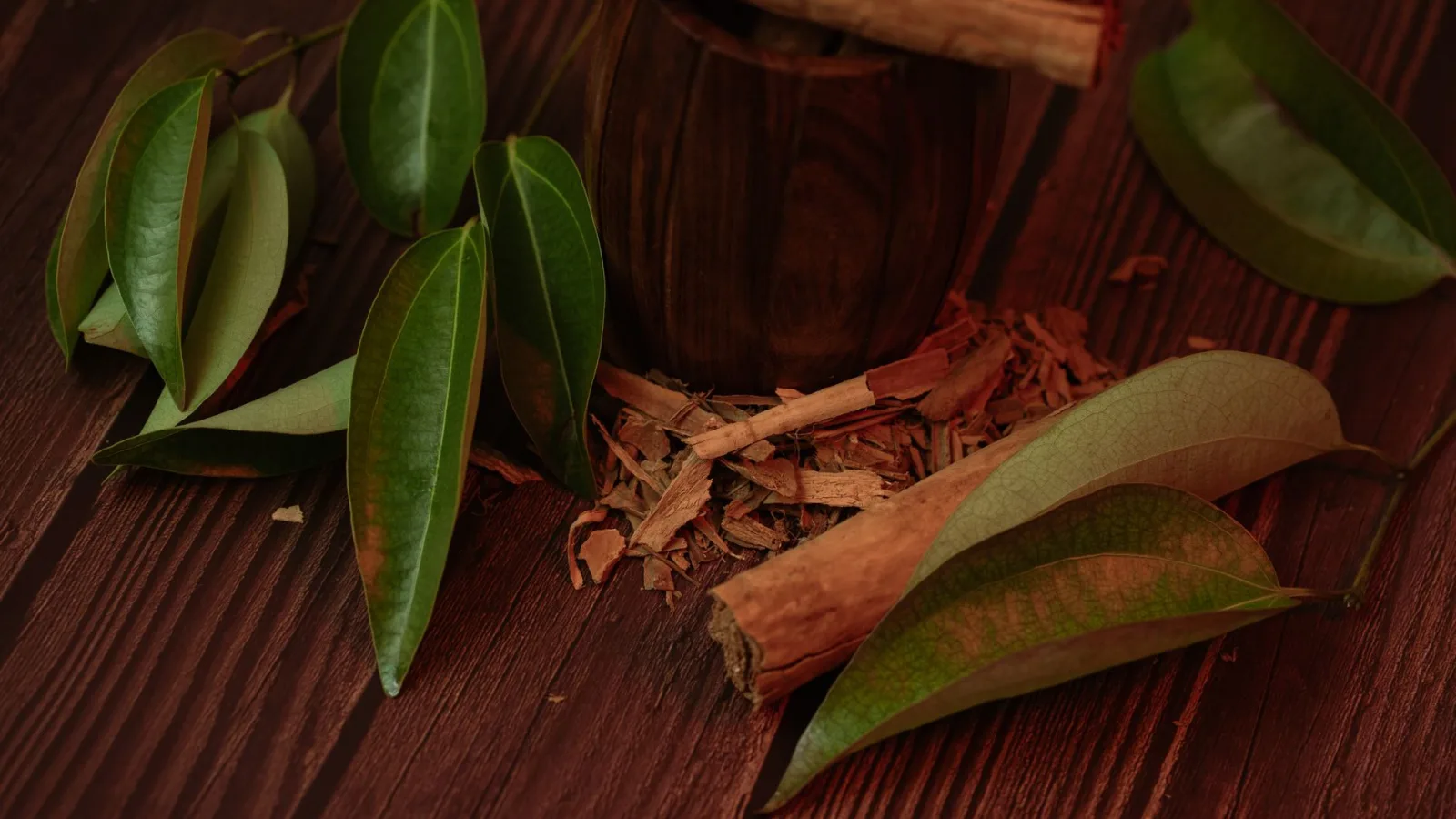
Growing a Cinnamon Tree in a Pot
Cinnamon is a tropical tree that a single frost will finish off, so in cold-winter climates it lives in a pot. Here's how to plant one, carry it through the winter indoors, peel and dry your own bark — and how much cinnamon is actually safe to eat.