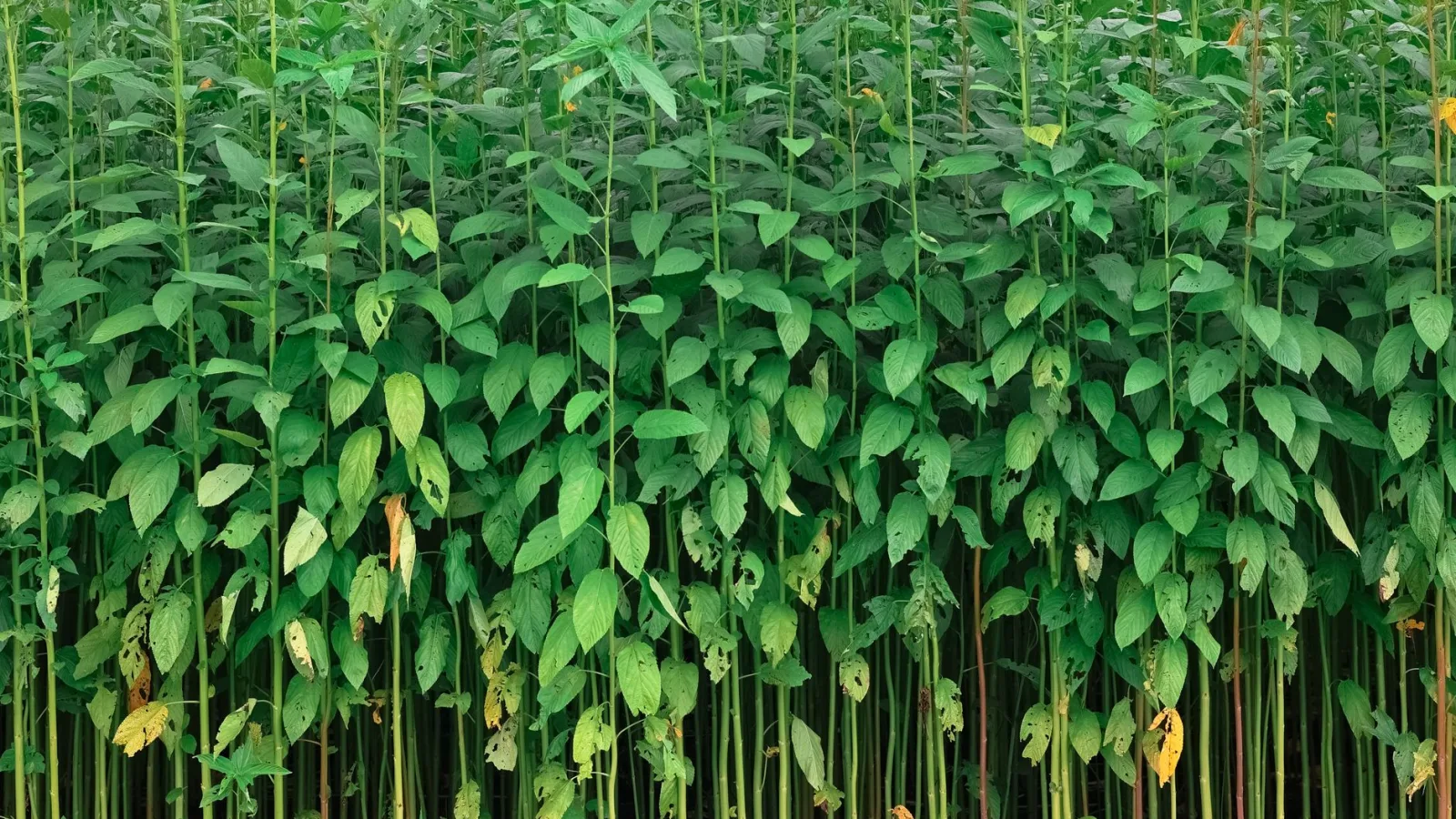
After a couple of frosts, a ramie clump has almost nothing left above ground. A few dry stalks still stand, and the leaves that spread wide all summer are crumbling into the soil. The roots will overwinter underground, but the leaf harvest runs from May through September in the Northern Hemisphere, so any leaves in your kitchen right now were blanched and frozen back in summer. Look up ramie leaves before you steam rice cakes with them, and you'll find claims that they're rich in calcium, usually with a number attached. What you often won't find is what state the leaf was in when that number was measured.
Where the Calcium Story Comes From
Ramie (Boehmeria nivea) is a perennial in the nettle family. The cellulose fibers in its stem bark are woven into cloth, and its leaves go into rice cakes and soups. It's grown widely in China, India, Thailand, Brazil, and the Philippines. Ramie also appears in the herbs section (chobu) of Dongui Bogam, the classic Korean medical text, but the part it covers is the root, called jeogeun. On its nature and flavor, the text describes it as cold in one place and neutral in another, and as sweet and nontoxic. The part gardeners harvest and eat, though, is the leaf, and the calcium in the leaf comes from modern compositional analysis. According to the analysis data compiled in Homiclub's ramie crop guide, ramie leaves are high in dietary fiber and rank toward the top among leafy greens for calcium and other minerals.
These two records are different in kind. The nature-and-flavor entries in the old medical text belong to a traditional prescribing system and aren't the same as a modern medical judgment. Compositional analysis measures what the leaf is made of; it doesn't go as far as saying the leaf protects your bones or cures disease. It's fair to think of ramie leaf simply as one more calcium-containing green you can add to your diet.
Fresh Leaf vs. Dried Powder: Same Leaf, Different Numbers
The guide's data comes with one caveat: the values vary widely depending on the leaf's age and on whether it was blanched or dried. The processing side has a simple explanation. A freshly picked leaf is mostly water by weight, so when you dry it and grind it into powder, the weight drops but nearly all the calcium stays. That's why the "calcium per 100 g" figure can differ several-fold between fresh leaf and powder made from the very same leaf. Blanching is a different story. Raw ramie leaves are unpleasant to chew because of their fine hairs and tough veins, so they're blanched before use, and some water-soluble nutrients likely leach out into the cooking water. Blanch young leaves in boiling water for 2 to 3 minutes and older leaves a little longer, just until the veins bend softly under your fingertip, then lift them out. Discard the blanching water and rinse the leaves in cold water.
Keep this in mind when you see comparisons like "several times more calcium than milk." Milk is mostly water too, so if you set 100 g of dried leaf powder next to 100 g of milk, the leaf comes out far ahead. But what actually goes into rice cakes and soup is blanched leaf with the water squeezed out, and a single serving contains far less than 100 g of powder. When you look at a ramie leaf figure, check what state the leaf was in when it was measured before you look at how big the number is.
How Do Upper and Lower Leaves Differ?
Leaf age is something you can choose for yourself in the garden. According to plant physiology textbooks, calcium is a mineral that, once deposited in a leaf, doesn't readily move to other parts of the plant. In other words, the longer a leaf stays on the stem, the more calcium it collects. So with ramie, too, it's reasonable to guess that the older leaves low on the stem hold more calcium. The guide doesn't include values for ramie leaves broken down by age, so this part is an estimate based on general principles.
Older leaves develop thicker veins and stay stiff even after blanching, which gives rice cakes a coarse texture. The young leaves near the top are tender and blend easily into rice-flour dough. At harvest time, try picking the top three or four leaves on each stem for rice cakes and the ones below for soup. Stirring ground perilla seeds (a nutty, rich staple of Korean cooking) into the soup helps its natural oils soften the scratchy texture of the tougher leaves. The fine hairs on the leaf undersides can rough up your hands, so wear gloves if you're picking a lot.
How Much Leaf Goes Into One Rice Cake or One Bowl of Soup
In Korea, ramie leaves are eaten mostly in rice cakes. Blanched leaves are ground fine and kneaded into non-glutinous rice flour, and the dough is filled with sweet red bean paste, shaped into half-moons, and steamed to make mosiip songpyeon, or ramie leaf rice cakes. The more leaf you add, the deeper the green from the chlorophyll, but the stiffer the cakes get. Start with 50 g of blanched, squeezed leaf for every 500 g of rice flour and work up from there. Shape that dough into about thirty songpyeon, and each one holds less than 2 g of leaf.
A bowl of soup holds more leaf than that. Dissolve doenjang (Korean fermented soybean paste) in 1 L of water and bring it to a boil, then add 50 g of blanched leaves and 15 g of ground perilla seeds just before you turn off the heat. Divided into four bowls, that's a little over 12 g of leaf per bowl.
When you're sizing up the calcium in ramie leaves, the figures to start with aren't the ones for 100 g of dried powder. They're the less than 2 g of leaf in a single songpyeon and the little over 12 g in a bowl of soup.
Sources: Heo Jun, Dongui Bogam, Tangaek-pyeon (Materia Medica), Herbs Section (1613) · Homiclub Crop Guide, Ramie entry · Taiz, Zeiger, et al., Plant Physiology and Development, 6th ed. (2015)