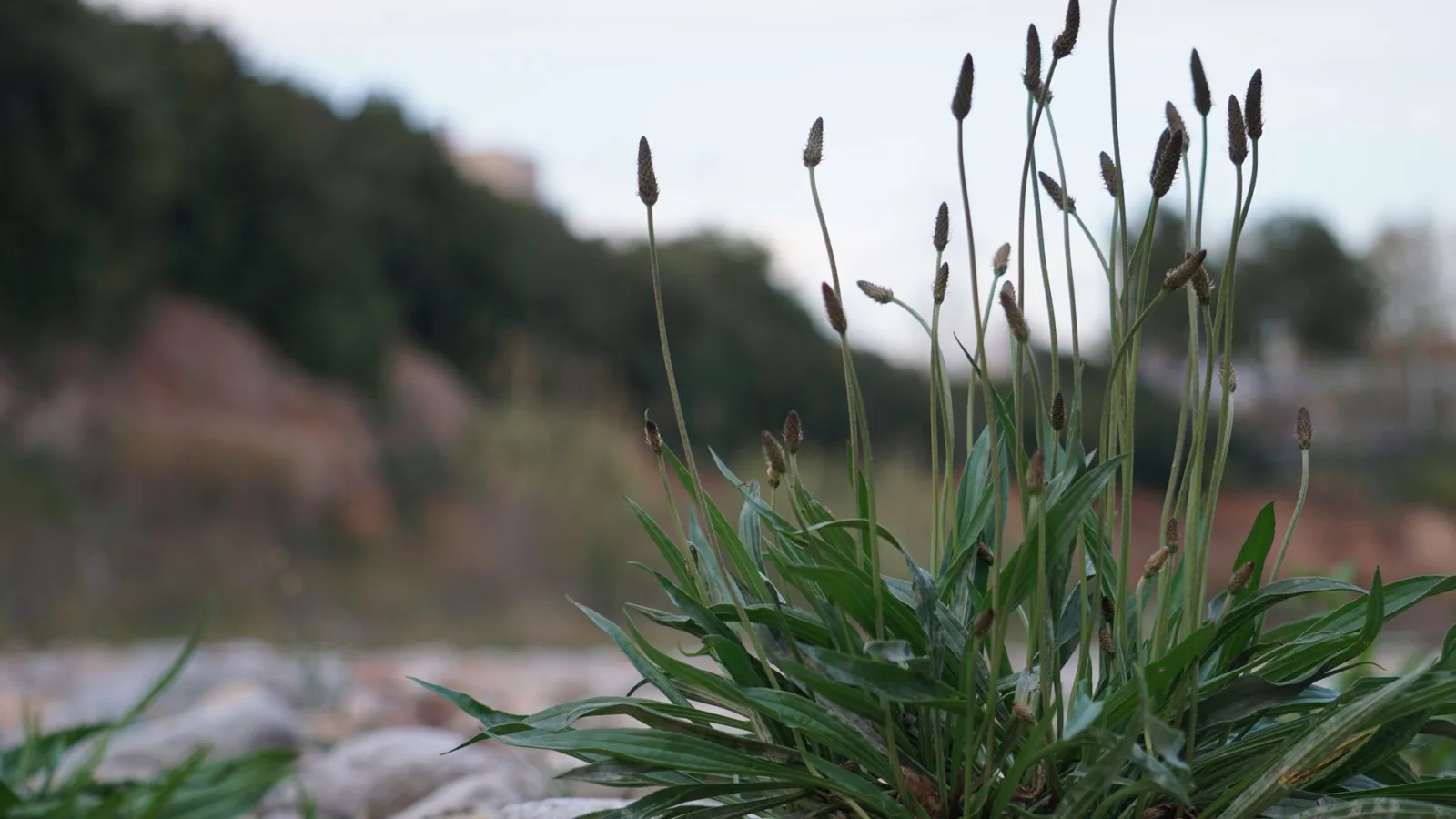
In September, along the edge of the garden — on the packed dirt path where feet come and go — you'll spot a plant whose leaves lie flat to the ground in a wide rosette. Five or so parallel veins stand out on each leaf, and when it's stepped on it springs back open soon enough. This is plantain (Plantago asiatica). It's the weed you pull and toss when you turn the beds, and the one you go out looking for again in spring to gather as a wild green.
In the Northern Hemisphere, September is a good time to get plantain seed into the ground. Sow in March–April or in September, and cut the leaves from April through June. Because the plant overwinters as a rosette pressed flat to the soil, a fall sowing means the spring leaves come up that much sooner.
What the Dongui Bogam Recorded as 車前子
The Dongui Bogam, the 17th-century Korean medical compendium, lists it in the herbs section (草部) under the name 車前子 (chajeonja). Beside the Chinese characters sit two vernacular Korean names in the old spelling: 길경이 ᄡᅵ (gilgyeong-i ssi) and 뵈ᄡᅡᆼ이ᄡᅵ (boessang-i ssi). Its nature is given as cold in one place and neutral in another; its taste as sweet and salty, with no toxicity.
The name gets an explanation, too. It is also called 부이 (芣苢), and it is described as having large leaves and long seed spikes. It grows readily along roadsides and springs up especially where an ox has left its hoofprints — hence 車前, "before the cart." The harvest times are recorded as well: gather the shoots in the fifth lunar month, and collect the seed in the ninth or tenth lunar month, drying it in the shade. This is a record from an old medical text, and it is not the same as a judgment made today.
The same book also carries a sub-entry that groups the leaves and root (葉及根) together, with no parent name in the heading. All that survives there is a single line about pressing them for juice, so the entry on its own gives no way to tell which plant it means.
What Today's Analysis Finds in the Leaves
Modern component analysis has identified iridoid glycosides such as aucubin in the leaves of Plantago species, along with phenylethanoid glycosides such as plantamajoside and acteoside. The same work found that levels vary a great deal with harvest timing and leaf age. This describes chemical composition; it has nothing to do with preventing or treating disease.
Where the two accounts overlap is in the timing of the harvest. The fifth lunar month, when the old text says to gather the shoots, falls while the leaves are still young — worth setting beside the modern finding that content shifts with leaf age. Still, the old record speaks in terms of nature and taste, while today's analysis speaks in compound names and concentrations. It's hard to call those the same statement. What actually reaches your body when you eat plantain as a green is mostly dietary fiber, minerals, and the mucilaginous polysaccharides that turn slippery in water.
Psyllium Husk Comes from a Different Plant
The psyllium husk sold as a fiber supplement comes from somewhere else entirely. It's the seed coat of Plantago ovata, grown in India — a different species from the Plantago asiatica that turns up in the field. The Chinese-character names overlap and the common names sound alike, which makes the two easy to mix up. Gathering plantain leaves from the garden to eat and taking psyllium husk are two separate things — please keep them apart.
Sow It, Blanch It, Dress It
Growing it asks very little of you. It does fine in soil that gets walked on, so scatter the seed over a scrap of ground along the edge of your beds. In the Northern Hemisphere, sow in March–April or September, and from April through June, once the leaves are about the size of your palm, cut from the outside in. Leave the center bud alone and a single plant will give you several harvests. The sowing and harvest months are laid out in the plantain entry in the crop guide.
Blanch it before you eat it. The veins are thick and the fibers are tough, so blanch the leaves in salted water, rinse them in cold water, and wring them out well. Any water left behind will keep the seasoning from clinging. The flavor runs mild, so it takes well to a dressing of doenjang (fermented soybean paste), or to a stir-fry with a generous spoonful of ground perilla seed. The oil in the perilla softens the tough fibers so they're less noticeable.
- Doenjang soup: Chop the blanched leaves fine before adding them. The heavy veins are less of a nuisance that way.
- Jeon (savory pancake): Keep the flour batter on the thick side and fold the leaves in before frying. A thin batter lets them scatter.
- Mungnamul (dried wild green): Blanch and dry the leaves, then in winter soak them in water and boil them once more before using.
Next time you're out in the garden, clear a hand's width of soil on the path side and scatter some seed. Come spring, the first young leaves up — blanched and dressed with doenjang — make a plateful.