
Tangaek — Decoctions · Herbs
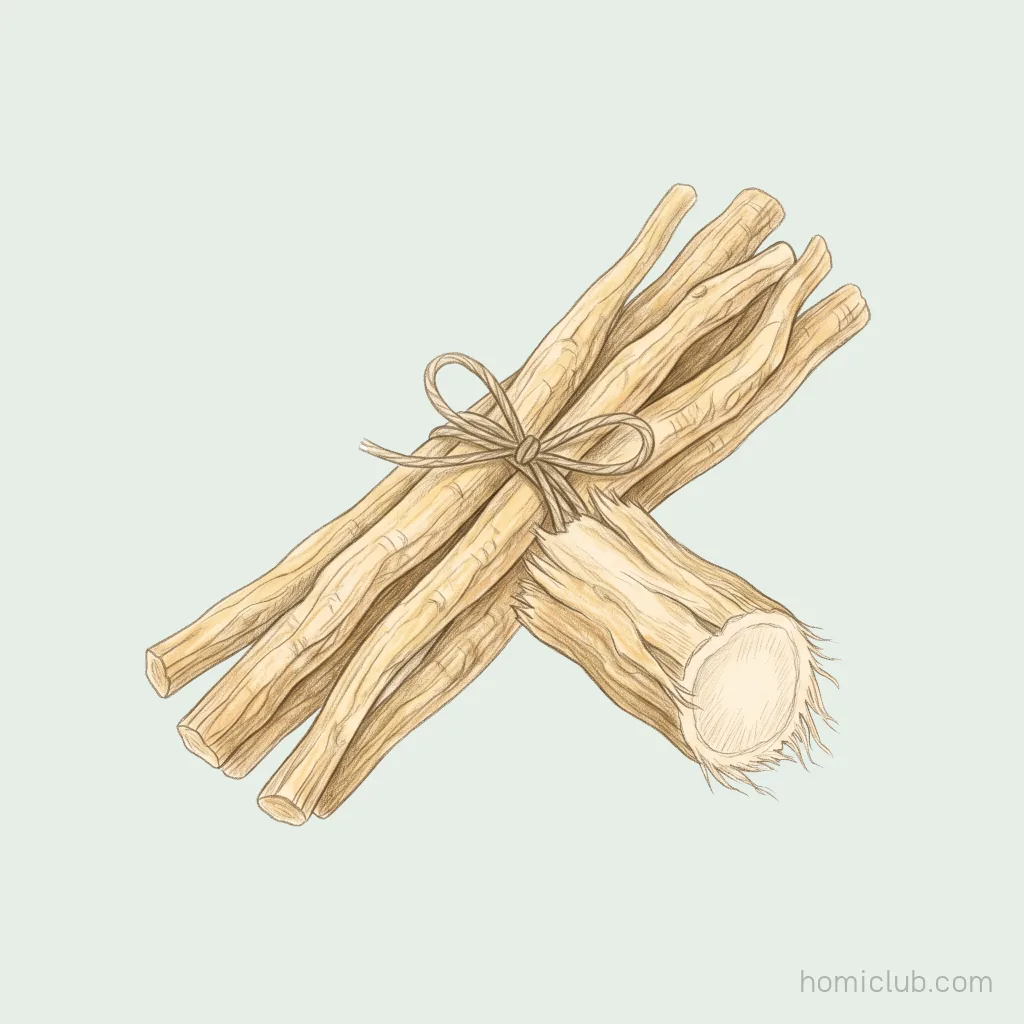
黃芪 Astragalus
 Related Crop · Astragalus →
Hwanggi is the root of a perennial legume, recorded under the old Korean name dannyeosam. It is the same root Koreans still drop into samgyetang and boiled-chicken broth. The Donguibogam preferred pieces soft as cotton and straight as an arrow shaft, dug in the second or tenth month and dried in shade.
Original, read line by line 東醫寶鑑 · Tangaek — Decoctions vol. 2
-
性微溫, 味甘, 無毒. 主虛損羸瘦.
Its nature is slightly warm, its taste sweet, and it is non-toxic. It chiefly addresses emaciation from depletion and damage.
HomiclubHwanggi is the root of a leguminous perennial, the same root Koreans still put into samgyetang and baeksuk chicken soups. The old Korean name means "root of the sweet neosam," paired against the bitter neosam (苦參, gosam).
-
益氣長肉, 止寒熱. 療腎衰耳聾, 治癰疽久敗瘡, 排膿止痛.
It boosts qi, builds flesh, and stops alternating chills and fever. It addresses deafness from decline of the sin (腎, kidney), treats ongjeo (癰疽, deep-rooted sores) and long-festering wounds, expels pus, and stops pain.
-
又治小兒百病, 婦人崩漏, 帶下諸疾.
It also treats the hundred ailments of children and the various disorders of women such as bungnu (崩漏, flooding and spotting) and daeha (帶下, vaginal discharge).
-
生原野, 處處有之. 二月十月採根, 陰乾. 《本草》
It grows in open fields and is found everywhere. Dig the root in the second and tenth months and dry it in the shade. 《Boncho (本草)》
-
治氣虛盜汗自汗, 卽皮表之藥. 又治咯血, 柔脾胃, 是爲中州之藥.
It treats night sweats and spontaneous sweating from qi vacuity, and so is a medicine of the skin and exterior. It also treats coughing of blood and softens the bi and wi (脾胃, spleen and stomach), and so is a medicine of the middle region.
-
又治傷寒尺脉不至, 補腎藏元氣, 爲裏藥. 是上中下內外三焦之藥也.
It also treats a cheok (尺, cubit) pulse that fails to arrive in cold damage and supplements the original qi of the kidney, and so is a medicine of the interior. It is thus a medicine for the upper, middle, and lower, the inner and outer samcho (三焦, triple burner).
-
入手少陽經ㆍ足太陰經ㆍ足少陰命門之劑. 《湯液》
It is a preparation that enters the hand soyang and foot taeeum channels and the foot soeum myeongmun (命門, gate of life). 《Tangaek (湯液)》
-
肥白人多汗者, 服之有功. 蒼黑人氣實者, 不可服. 《正傳》
For a plump, pale person who sweats a great deal, taking it has merit. A dark, sallow person whose qi is replete must not take it. 《Jeongjeon (正傳)》
-
綿軟箭幹者佳. 瘡瘍生用, 肺虛蜜水炒, 下虛鹽水炒用. 《入門》
Roots that are soft as cotton wool and straight as an arrow shaft are the fine ones. For sores use it raw; for lung vacuity roast it with honey water; for lower-body vacuity roast it with salt water. 《Ipmun (入門)》
HomiclubRoots soft as cotton and straight as an arrow shaft were prized. This passage separates the preparations by use: raw, roasted with honey water, or roasted with salt water.
Related Crop
Astragalus →
Reading on Astragalus
Herbs — more entries
This is a cultural and historical record from a classical text, not a claim about any food’s effects. Nothing here is a health supplement or intended to prevent or treat disease. Consult a medical professional about health concerns. · Text: Korean Medicine Classics DB · Reading: Homiclub