- Type
- Tubers & Storage Roots
- Difficulty
- Moderate
- Season
- Spring
- Sowing
- From bulb
Turmeric
Curcuma longa
Curcumin · a rhizome that dyes everything yellow
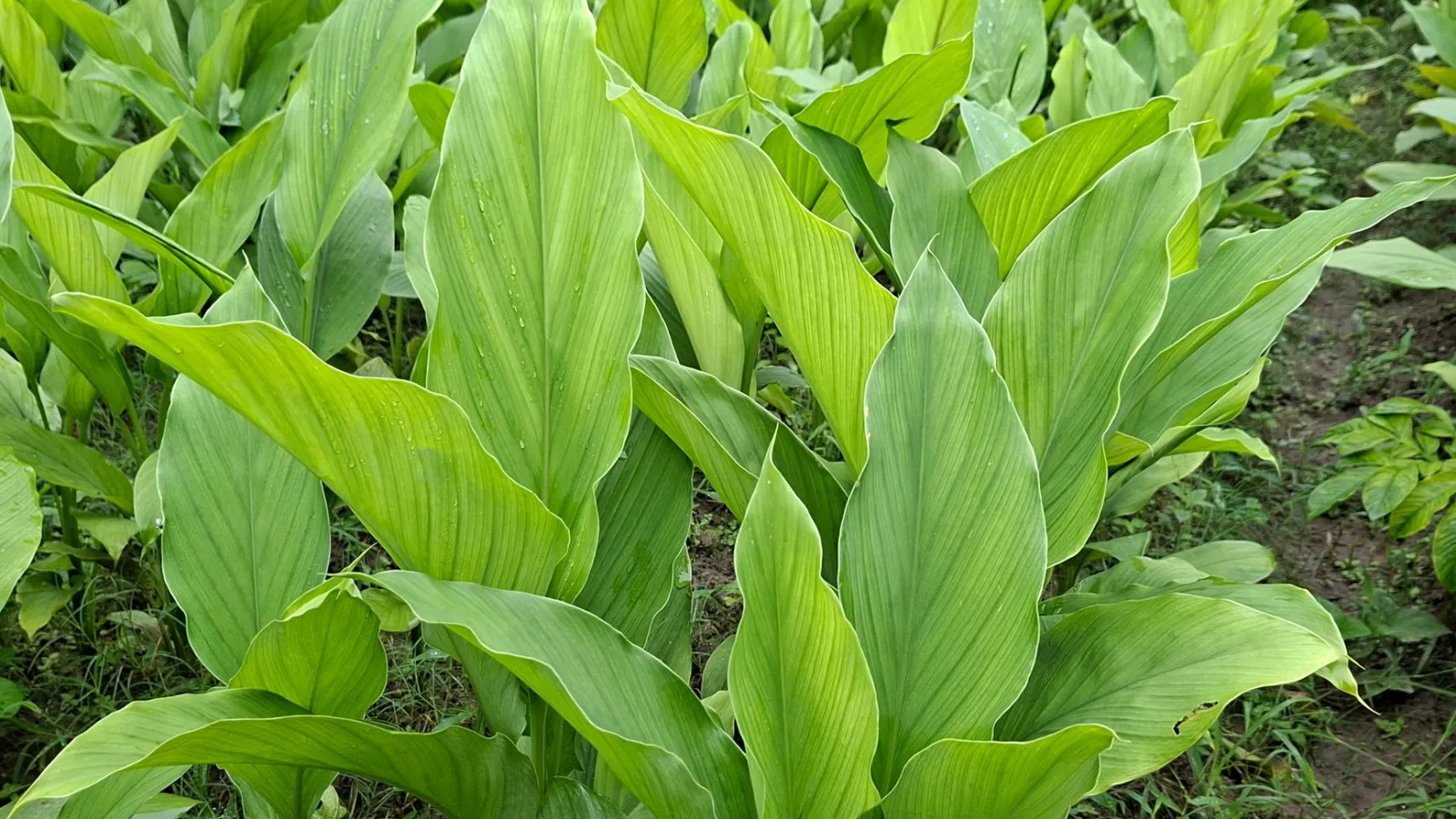
Turmeric is a perennial in the ginger family, grown for the thickened rhizome that swells underground. It is field-grown in Korea's south and on Jeju, with Jindo known as the main producing area; further north it is a one-season crop in a pot at least 30cm deep. Planted in late April, it carries broad leaves all summer and is lifted in November once frost has flattened the foliage, and because it cannot survive a Korean winter outdoors the seed rhizomes are lifted and stored separately. The part this entry describes is the underground rhizome, which the pharmacopoeia files as 薑黃 while filing the tuberous roots as 鬱金; the yellow powder used in cooking comes from the rhizome. The Donguibogam likewise carries 鬱金 and 薑黃 as two separate entries in the Herb section and gives them opposite natures — 鬱金 cold, 薑黃 hot. The 鬱金 entry records a pungent and bitter taste with no toxicity, says it grows in many places, that pieces shaped like a cicada's belly are the good ones, and that it should be washed in water and dried over a low fire before use.
Year-Round Calendar
- 1
- 2
- 3
- 4
- 5
- 6
- 7
- 8
- 9
- 10
- 11
- 12
- 4
- 5
- 10
- 11
Where It Grows
-
Origin
The plant's homeland, and the source of most of the world's production and exports. Telangana, Andhra Pradesh and Tamil Nadu are the main centres. Harvest January, February, March
- 1
- 2
- 3
- Major producer Widely grown in the hill country of the north-east, with heavy domestic consumption.
- Major producer Grown in the dry central zone, with a substantial share sent to India.
- Major producer Known as kunyit, and grown mainly on Java.
- Major producer Grown in Sichuan, Guangxi and Yunnan.
- Major producer Grown around Kaduna, the largest producing area in Africa.
It originates in South Asia, and in India above all. Because it is a triploid that sets no viable seed, it spreads only when people split the rhizomes and replant them, so the very route by which its growing regions widened is a trace of the human hand. A note on names: Korean markets treat ulgeum and ganghwang as the same thing, but strictly speaking ganghwang is Curcuma longa, while ulgeum refers to other species of the same genus, such as C. aromatica. What is sold in Korea as Jindo ulgeum is usually C. longa.
- Optimum
- 20~30℃
- Range
- 15~35℃
- Hardiness
- Not hardy
The rhizomes only thicken where a hot, rainy season runs for more than eight months. Frost flattens the leaves and freezes the rhizomes to death underground, so in temperate regions the plant is grown as a single-season crop: planted in spring, lifted in autumn, with the seed rhizomes stored separately.
In Korea Southern Korea
Jindo in South Jeolla is known as the main producing area, and the crop is grown outdoors in open fields on Jeju and along the south coast. It cannot overwinter (survive the winter in the ground) in the open, so it is planted in spring and lifted in November of the same year, and the seed rhizomes are dug up and stored in a dark place at 10~15℃. In the central region it is planted in deep pots and finished within one season.
How to grow
- Light
- Five to six hours of sun. Leaf tips scorch where harsh west-facing afternoon sun hits
- Soil and depth
- Deep, free-draining sandy loam at least 30cm deep. Standing water rots the rhizome first
- Spacing
- Lay seed rhizomes 8-10cm deep, 30cm between plants and 60cm between rows. One plant per pot of 20 litres or more
- Watering
- The broad leaves use a lot of water in summer. Water pots deeply in the morning once the surface dries, but never leave water standing in the saucer
- Feeding
- Work in plenty of well-rotted compost as a base dressing, then one side dressing in July when the leaves are filling out
- Harvest
- Lift whole plants in late October or November, after frost has yellowed and flattened the leaves. Shake off the soil, wash, and separate what you will keep as seed rhizome from what you will eat
What makes the difference. For eating, slice thin and dry, or boil once and then dry before grinding. Boiling first gives a more even colour and cuts the risk of mould
Why this one is harder. It will not overwinter outdoors. Outside parts of the far south it freezes if left in the ground, so bury the lifted seed rhizomes in soil or sawdust, hold them somewhere dark at 10-15C, and replant in spring
Common problems
- Rhizome rot You will see Leaves yellow and slump from the bottom up, and the lifted rhizome is soft and smells sour What to do Drainage is almost always the cause. Raise the beds and add drainage holes to pots. Remove affected plants along with their soil
- White grubs (chafer larvae) You will see A healthy plant wilts, and the rhizome shows chewed hollows What to do Never use half-rotted compost. Turn the soil before planting and pick out larvae; if one plant goes down, dig around it and check
- Spider mites You will see Rough leaf undersides and speckled loss of colour on the upper surface What to do They build up in dry spells. Spray water onto the leaf undersides to wash them off, and use an approved organic product if it recurs
This page describes how a crop is grown and used. It does not claim health effects for any food, nor is it intended to prevent or treat disease. Component and study notes are references only and do not mean the same result occurs in people. Consult a medical professional about health concerns.
Health Benefits
What the Donguibogam records — 鬱金 and 薑黃 are separate entries. The Herb section of the Donguibogam carries 鬱金 and 薑黃 as two separate entries and gives them opposite natures: 鬱金 cold, 薑黃 hot. The part described here is the underground rhizome, which the pharmacopoeia files as 薑黃. The 鬱金 entry gives a pungent and bitter taste with no toxicity, notes that it grows in many places and that pieces shaped like a cicada's belly are the good ones, and adds that it should be washed in water and dried over a low fire before use. This is a historical medical record and differs from modern medical judgment.
Curcuminoid content analyses. Analyses comparing dried turmeric rhizomes across lines and growing areas generally report curcuminoids in the 2-5% range, with the same work noting large differences by site and drying method even within one line. This is compositional analysis and has nothing to do with disease.
Solubility and absorption studies. There is physical data reporting that curcumin is essentially insoluble in water, and pharmacokinetic work reporting higher blood concentrations when it is given together with piperine from black pepper. These describe how much of the compound enters the body, and say nothing in themselves about any effect. If anything they cut the other way: liver injury has been reported with high-dose formulations built for absorption, which is why such products are not handled like the spice amount.
Nutrition
- Curcuminoids (curcumin, demethoxycurcumin) (reported at 2-5% of the dried rhizome) — the polyphenol pigments behind the yellow
- Essential oil (turmerone, zingiberene) (2-7% of the dried rhizome) — volatile compounds giving the earthy, faintly bitter aroma
- Starch (40-50% of dry weight) — the storage carbohydrate of the rhizome
- Dietary fibre (around 20g per 100g dried) — the fibrous fraction of the rhizome
Curcuminoids and colour The yellow of turmeric comes from curcumin and its relatives. They are reported at 2-5% of the dried rhizome, with wide variation between lines and growing areas. The pigment is yellow in acid and turns red as the pH rises, which is why it doubles as a laboratory pH indicator. It breaks down slowly under light and heat, so keep the ground powder in a dark tin.
It barely dissolves in water Curcumin is close to insoluble in water and dissolves in oil and alcohol instead. That is why the colour spreads evenly in a curry or a stir-fry. Steeped in water alone, a little colour leaches out but most stays in the solids. Pharmacokinetic studies report that taking it with the piperine in black pepper raises the amount absorbed. What rises with absorption is the dose that actually reaches the body: liver injury has been reported repeatedly with high-dose curcumin supplements, piperine-containing formulations among them. People with gallstones or an obstructed bile duct, and people taking anticoagulants, stay away from such products. A concentrated formulation built to raise absorption is not handled like the spice amount.
Essential oil and aroma The dried rhizome holds 2-7% volatile compounds, among them turmerone, ar-turmerone and zingiberene. The earthy smell and bitter finish of freshly grated turmeric are these compounds. Being volatile, the aroma cooks off in a long fry, and ground powder is noticeably flatter after about six months. Grinding small amounts as needed works better.
Starch and processing Nearly half the dry weight of the rhizome is starch. Freshly dug pieces run around 80% water and mould readily if left whole, so they are sliced thin and dried, or boiled first and then dried before grinding. Boiling before drying gives a more even colour. Ground turmeric cakes once it picks up moisture, so keep it sealed.
Pairings
○ With fat — Curcuminoids are fat-soluble, so frying in oil spreads the colour and aroma evenly. That is the reason spices go into hot oil first when a curry is built. Long frying drives the aroma off, so add it late.
○ Black pepper — Pharmacokinetic studies have repeatedly reported that piperine from black pepper raises blood levels of curcumin taken alongside it. It is the usual explanation given for the two travelling together through Indian spice blends. In cooking, a generous grind of pepper is enough. Black pepper
○ Milk or coconut milk — Warmed into a liquid with some fat in it, the colour disperses smoothly and the earthiness softens. This is the golden latte. A teaspoon of powder is plenty for a mug; more and the bitterness comes forward.
△ The spice amount and a concentrated supplement are not the same thing — The pinch that goes into a curry or a stir-fry and a supplement built around concentrated curcumin are not treated as one and the same. Formulations that add piperine from black pepper to raise absorption change how much actually enters the body. Do not exceed the intake printed on a high-strength product, and do not reason that because turmeric has long been a spice, more of it must be fine. Liver injury has been reported with high-dose supplements.
△ People with gallstones or bile duct disease — People with gallstones or an obstructed bile duct are advised not to take turmeric or curcumin in quantity. Anyone considering intake beyond ordinary culinary amounts should raise it first with the clinician already treating them.
△ People on anticoagulants or facing surgery — For people taking medicines that slow blood clotting, interaction with high-dose turmeric supplements is discussed, so such a supplement is not started on one's own. Anyone scheduled for surgery or a procedure should disclose the supplements they are taking beforehand.
Varieties
- Autumn turmeric (rhizome) — What Koreans usually mean by ulgeum. Known as the deepest-coloured line in curcuminoids
- Spring turmeric (rhizome) — The Curcuma aromatica line. More bitter, paler in colour
- Purple turmeric (rhizome) — The Curcuma zedoaria line. Violet-tinged cut face and a sharper scent
- Jindo local line (rhizome) — The line carried on by Korea's largest producing area. Thick seed rhizomes
Source: Donguibogam, Herb Section 鬱金 · Rural Development Administration (Nongsaro)