- Type
- Leafy Greens
- Difficulty
- Easy
- Season
- Spring·Fall
- Sowing
- Transplant
Rock Pine (Wason)
Orostachys japonica
Organic acids, flavonoids · a succulent on old roof tiles
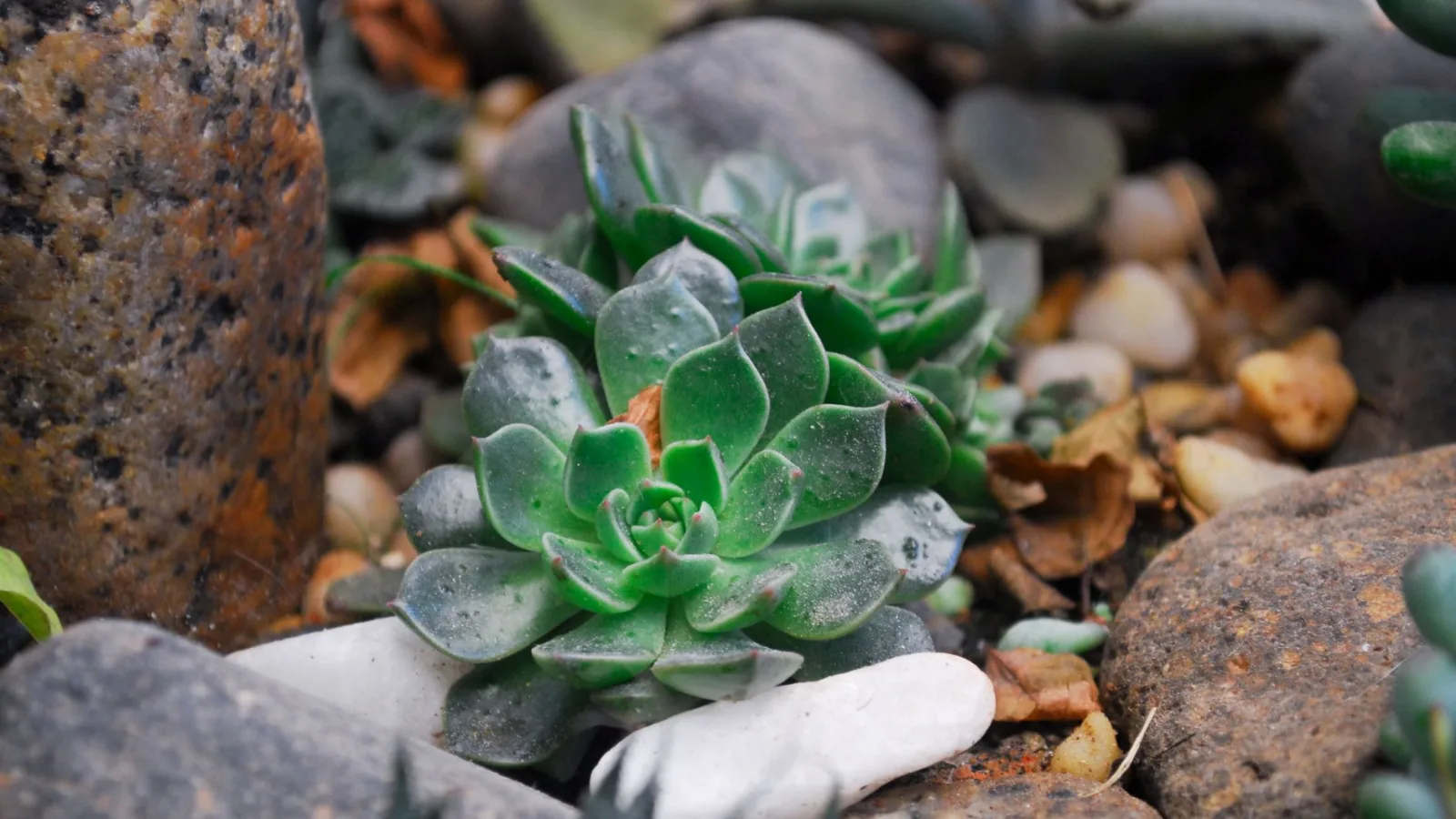
Orostachys japonica is a perennial succulent in the stonecrop family. The English name rock pine renders a Korean name built from the words for rock and pine, given for the pine-like look of the rosette; the plant is a stonecrop, not a conifer. True to that name it grips thin, dry footholds — rock crevices and the ridges of old tiled roofs. In the city it is grown in a shallow pot on a bright windowsill or rooftop, where forgetting to water beats watering often. The Donguibogam lists it in the herb section as 昨葉何草, describing it as neutral in nature, sour in taste, and free of toxicity, and explains the alias 瓦松, tile pine: it grows on aged roof tiles and looks like a pine from a distance. The same entry notes that it is gathered in the sixth and seventh lunar months and dried in the sun.
Year-Round Calendar
- 1
- 2
- 3
- 4
- 5
- 6
- 7
- 8
- 9
- 10
- 11
- 12
- 4
- 5
- 9
- 10
- 11
Where It Grows
-
Main producer
It grows wild across the whole country, and is now raised under cover in South Gyeongsang and South Jeolla under the name wason. Harvest September, October, November
- 9
- 10
- 11
- Wild population Grows wild on rocky slopes in the northeast.
- Wild population Clings to rocky ground and old roofs from Honshu southward.
- Wild population Grows wild on rocky slopes in the Far East, including Primorsky Krai.
Its native range is temperate East Asia, spanning Korea, northeastern China, Japan and the Russian Far East; since it cannot be pinned to any single country, no country-of-origin row has been set. Korea is effectively the only place that grows it at commercial scale, and the rest of the range is wild habitat, so the list below is not ranked by output — it simply names the countries where the plant grows wild or is cultivated.
- Optimum
- 15~25℃
- Range
- 0~32℃
- Hardiness
- Hardy
A succulent that lives clinging to places where the soil is thin and dries out fast — rock crevices, or old tiled roofs. Its roots turn soft the moment they stand in water, so it has to be kept clear of the rain through the monsoon season; in winter it pulls its leaves in tight and sits out the cold in the open ground.
Harvested 2–3 years after planting. Seedlings go in during April and May, and plants left to grow for two or three years are the thickest. A plant that sends up a flower stalk sets seed and then dries up and dies, so to carry a planting on you have to split off the offsets clustered at its side and set them out before the stalk rises.
In Korea Nationwide
It grows in sunny rock crevices and on old tiled roofs. Most of what reaches the market now comes from protected cultivation in South Gyeongsang and South Jeolla, and the plants are cut from September to November, plump and well filled out, before the flower stalk goes up.
How to grow
- Light
- At least 5 hours of direct sun. In dim light the rosette opens up and stretches
- Soil and depth
- Very free-draining mix, roughly 6 parts coarse grit to 4 parts potting soil. Keep the drainage hole clear
- Spacing
- 10-15cm between plants. Space several rosettes across a wide shallow pot
- Watering
- Water thoroughly, until it runs from the base, only once the soil is bone dry. Move the pot under cover during the rainy season
- Feeding
- Almost no feeding needed. A few slow-release pellets on the surface in spring is enough
- Harvest
- Cut plants at the base from September to November, once the rosettes have plumped up. They are fullest just before the flower stalk rises
What makes the difference. Offsets that form alongside the parent root readily when detached and potted separately. This is faster and more reliable than seed
Why this one is harder. Flowering kills the plant. Rock pine sets seed once and the mother rosette then dries up and dies, so to keep a plant going you must split off the offsets before the flower stalk rises
Common problems
- Aphids You will see Clusters between new leaves and on flower stalks, leaving a sticky film What to do Rinse them off with a jet of water and spray a soap-and-oil emulsion if they return. Dry the leaf crevices promptly so water does not sit there
- Scale insects You will see White cottony masses or brown shells at the leaf bases What to do Wipe them off with a cotton swab dipped in alcohol. Isolate the plant if numbers are high
- Fungus gnats You will see Small black flies over the soil and softening at the plant base What to do Water less often and top the soil with coarse grit. Set yellow sticky traps to catch the adults
This page describes how a crop is grown and used. It does not claim health effects for any food, nor is it intended to prevent or treat disease. Component and study notes are references only and do not mean the same result occurs in people. Consult a medical professional about health concerns.
Health Benefits
The Donguibogam record — nature, taste, and the name. The Donguibogam lists Orostachys japonica in the herb section as 昨葉何草. It is described as neutral in nature, sour in taste, and free of toxicity. The text explains the alias 瓦松, tile pine: the plant grows on aged roof tiles and resembles a pine seen from afar. It also records gathering in the sixth and seventh lunar months, followed by sun drying. This is an old medical record and differs from modern medical judgement.
Analysis of flavonoid composition. Analyses have reported kaempferol- and quercetin-type flavonoid glycosides in Orostachys japonica. The same reports note wide variation in total amounts depending on growing site and harvest timing. This concerns compositional analysis and has no bearing on preventing or treating any illness.
Nutrition
- Water in succulent leaves (most of the fresh leaf weight) — storage tissue for dry footholds
- Organic acids (malic acid and others) (highest before dawn) — sour compounds built up overnight by CAM metabolism
- Flavonoid glycosides (kaempferol and quercetin types) (reported in leaves and flower stalks) — polyphenols commonly reported across the stonecrop family
Water in the succulent leaf The leaf of Orostachys japonica is mostly water. To survive on rock that rarely sees rain, the plant built thick internal tissue that holds moisture. Freshly picked leaves feel heavy and snap crisply, but they shrink dramatically once dried. The Donguibogam instruction to dry the plant in the sun follows from this trait.
Sourness that peaks at dawn Many stonecrop succulents run CAM metabolism. They open their stomata at night, take in carbon dioxide, store it as malic acid, then use it during the day. As a result, leaves picked at dawn taste sharper than leaves from the same plant picked at noon. That overlaps with the Donguibogam note that the taste is sour.
Flavonoids Kaempferol- and quercetin-type flavonoid glycosides have been reported in Orostachys japonica. These are polyphenols also detected across several stonecrop species. Reports note that total amounts vary widely with sun exposure and harvest timing. This guide records only that the compounds were identified.
Pairings
○ Raw in salads — Rinse young rosettes and serve them as they are. The sourness and crunch are pronounced enough that a heavy dressing is unnecessary. Dust collects between the leaves, so rinse under running water while turning the rosette over.
○ Vinegar or plum syrup pickles — The plant is already high in organic acids, so pickling suits it. Wash and dry the leaves completely before steeping, or they turn mushy. After about two weeks the sourness spreads evenly. Korean Plum (Maesil)
○ Dried for tea — The Donguibogam also records drying it in the sun. Spread the pieces thin and dry them hard, otherwise mould sets in. Keep the dried material sealed in a cool place.
△ Confusion with ornamental succulents — Echeveria and Sempervivum — The rosette shape is close enough that people have eaten ornamental succulents believing them to be wason. Echeveria sold at flower markets, and Sempervivum traded in Korea under the name geomi-bawisol, are not sold as food and may carry residues from treatments used on ornamentals. Buy plants grown and sold for eating. Do not tear a leaf off the windowsill pot on impulse.
△ Wild foraging — Wild populations have declined, so digging up wild plants is not advised. Rosettes on old tiled roofs and retaining walls sit on someone else's building, and on surfaces where roofing and paint runoff collects. In the city it is better to buy a cultivated plant and move it into a pot.
△ Eating a lot of it raw — The sourness is strong, and a large raw serving at once can leave the stomach uncomfortable. Start with a few leaves and increase slowly. Anyone pregnant or taking regular medication should speak with their doctor or pharmacist first.
Varieties
- Orostachys malacophylla (seedling) — Rounded leaf tips. Sold under the same wason name
- Orostachys iwarenge (seedling) — Leaves spread wide like a lotus. Grows on southern coastal rock
- Orostachys minuta (seedling) — Small, tight rosettes clinging to mountain rock faces
Source: Donguibogam, Herb Section, 昨葉荷草 · Rural Development Administration (Nongsaro)