- Type
- Mushrooms
- Difficulty
- Hard
- Season
- Summer·Fall
- Sowing
- Grows wild
Puffball Mushroom
Lycoperdon perlatum
Polysaccharides and spore dust · a field mushroom that bursts like smoke once ripe
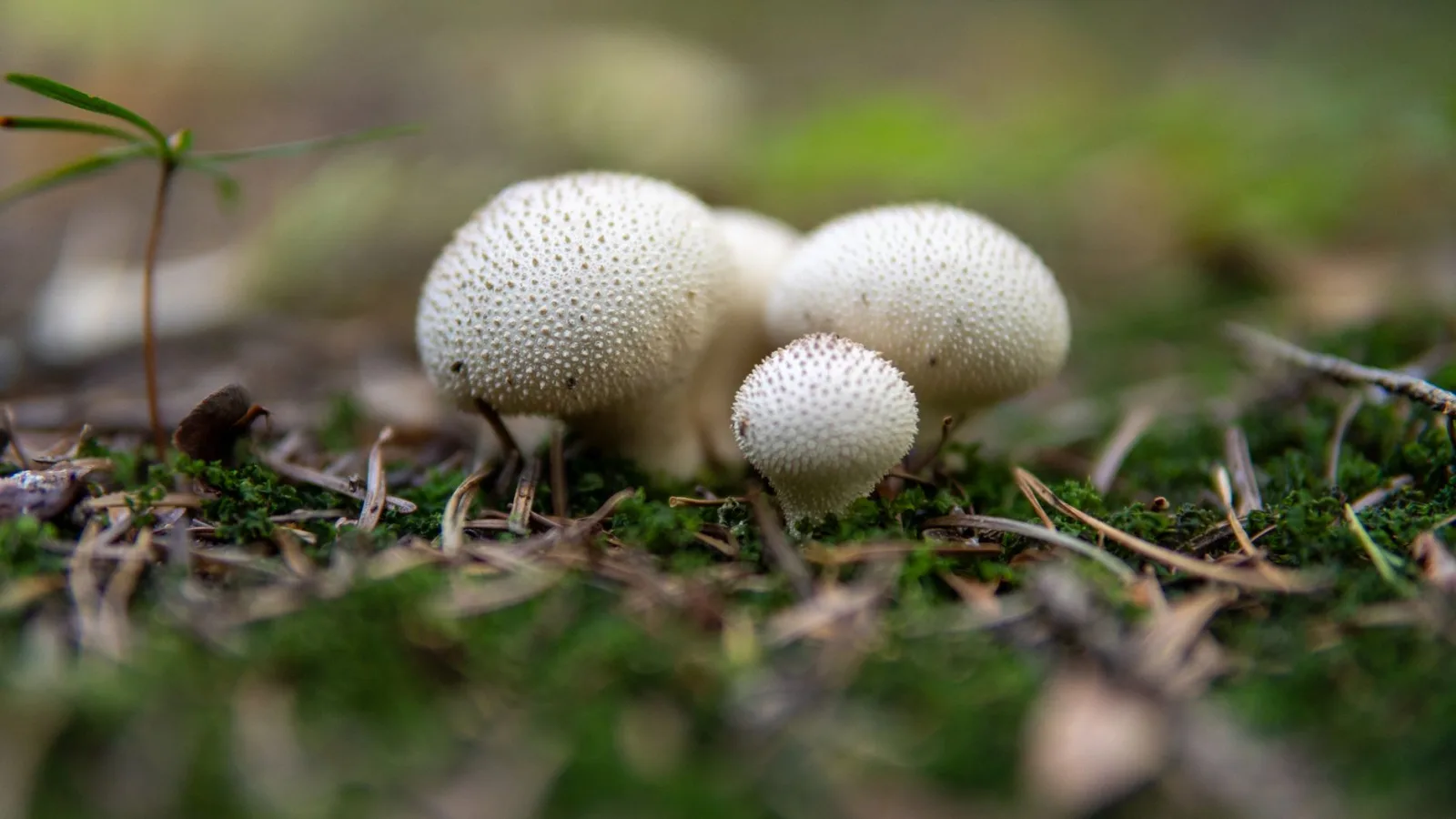
The common puffball comes up in grassland, on forest floors and around rotting wood between summer and autumn. Young, it is a round white ball studded with small warts; ripe, the inside turns to brown dust and a pore opens at the top so that every touch sends spores up like smoke. The Donguibogam recorded the same thing — struck, it gives off a purple dust — and compared the sizes, the large ones like a peck measure and the small ones like a pint. Only the young ones are eaten, and only those whose interior, when cut, is evenly and completely white. Any yellow or brown creeping in means spores have begun to form, and the mushroom is discarded. That cutting step carries a far heavier reason as well — the young egg stage of the Amanita mushrooms also reads as a white ball from outside, and a lengthwise cut settles it immediately by showing the outline of a cap and stem inside. The rule that a wild mushroom whose species you cannot confirm is neither picked nor eaten applies here without exception.
Year-Round Calendar
- 1
- 2
- 3
- 4
- 5
- 6
- 7
- 8
- 9
- 10
- 11
- 12
- 7
- 8
- 9
- 10
Where It Grows
-
Wild population
Comes up after rain on forest floors, in grassland and around rotting wood, throughout the country. Harvest July, August, September, October
- 7
- 8
- 9
- 10
- Wild population Occurs in the forests of North China and Northeast China.
- Wild population Occurs in forests and grassland from Honshu northward.
The puffball grows throughout the temperate forests of the Northern Hemisphere, so shading in every country where it occurs would leave the map without meaning. It is not cultivated, so there are no production figures either; only East Asia, where the practice of gathering and eating it has carried on since early times, has been marked. It is common in Europe and North America as well.
- Optimum
- 15~25℃
- Range
- 10~30℃
- Hardiness
- Not applicable
- Day length
- Not applicable
This is not a cultivated mushroom, so what decides when it appears is rain. Between summer and autumn it comes up within a few days of a rainfall, on the forest floor, in grassland and around rotting wood; when dry days run on, it does not appear.
In Korea Nationwide
How to grow
- Light
- Not a cultivated fungus. It comes up on its own on forest floors, in grassland and around rotting wood
- Soil and depth
- It grows on loose leaf-litter soil and on rotting wood. The Donguibogam likewise recorded damp ground and rotting wood
- Spacing
- It often comes up in troops. Do not strip a patch; leave the ripe ones so the spores spread
- Watering
- It appears within days of rain. A run of dry weather produces nothing
- Feeding
- There is nothing for a person to do. It fruits as wood and leaf litter break down
- Harvest
- July to October, appearing after rain. Take only young specimens that are white outside and firm under a fingertip, pulling them up at the base. Cut each one lengthwise where you stand and confirm the interior is evenly white
What makes the difference. Use what you pick the same day. Cook it through, and with any wild-picked mushroom, taste only a small amount the first time
Why this one is harder. The hardest part is the picking itself. A wild mushroom whose species you cannot confirm is neither picked nor eaten. This is not a difference a photograph or an outward look can settle, and the step of cutting one open is never skipped
Common problems
- A yellowing interior You will see Cut open, the inside is yellow or brown What to do Spores have begun to form. Do not eat it; put it back where it stood
- Insect holes You will see Small holes on the outside and tunnels running through the cut interior What to do Fungus gnat larvae are inside. Discard it
- Young Amanita eggs You will see A white ball on the outside, but the cut shows the outline of a cap and stem inside What to do It is not a puffball. Discard it there, and cut open everything else picked from the same spot to check again
This page describes how a crop is grown and used. It does not claim health effects for any food, nor is it intended to prevent or treat disease. Component and study notes are references only and do not mean the same result occurs in people. Consult a medical professional about health concerns.
Health Benefits
The old record — mabal (馬勃). The Donguibogam lists the fungus in the Herb section as 馬勃, recording the vernacular name in the same form still used today. It gives a neutral nature, a pungent taste and no toxicity. It says the fungus grows on damp ground and on rotting wood, that it is hollow and soft like purple floss, and compares the sizes, the large ones like a peck measure and the small ones like a pint. Struck, it gives off a purple dust — what is now called the spore mass. This is a historical medical record and differs from modern medical judgment.
Reported cases of spore inhalation. Medical literature reports cases of coughing and airway irritation after inhaling large amounts of ripe puffball spores. This is a route separate from eating, and it is the ground for keeping faces away when handling ripe specimens.
The state of the young fruiting body. Descriptions of fruiting body development record that a young puffball is evenly white inside with no pattern, yellowing as spores form and finally turning to brown dust. That is why cutting a specimen open reads ripeness and screens out other fungi in the same motion.
Nutrition
- Polysaccharides (beta-glucans and others) (structural material of the fruiting body cell wall) — the polysaccharides that build fungal cell walls
- Spores (fill the interior of a ripe fruiting body) — reproductive cells that read as brown dust
- Water (most of a young fruiting body) — the state that goes with a white interior
Cutting it open comes first Only the young fruiting body is eaten. Cut it in half lengthwise and use it only if the interior is evenly and completely white; any yellow or brown means spores have begun to form and the mushroom is discarded. That step reads ripeness and screens out the young Amanita egg at the same time.
Ripe means spores A ripe puffball turns to brown dust inside and opens a pore at the top. A raindrop or a press of the hand sends spores out of that pore like smoke. The Donguibogam recorded that struck, it gives off a purple dust. In this state it is not food.
Do not breathe the spore dust Cases of coughing and airway irritation have been reported after inhaling puffball spore dust at close range. Children like to burst them underfoot, so keep faces away. Bag ripe specimens rather than carrying them loose when clearing them.
Water and cooking A young fruiting body is mostly water and weeps as soon as it is cut. Thick slices, oil and a short turn over high heat is the usual handling. Cook it through, and with any wild-picked mushroom, taste only a small amount the first time.
Pairings
○ Oil and salt — thick slices, hard heat — Slice the young, cut-and-checked specimen thick and fry it in oil. It releases a lot of water, so keep the heat high and the time short, and salt it at the end.
○ Egg batter — Coat thick slices in flour and beaten egg and pan-fry. Lower the heat and turn them so the centre cooks through. Do not settle for a seared surface.
○ Butter and pepper — Fried in butter the texture softens and pepper carries the aroma. Add the butter only once the water has cooked off, or it burns. Black pepper
△ Confusion with the young Amanita egg — The real hazard in picking puffballs is the egg stage of the Amanita mushrooms. Deadly species such as Amanita phalloides and Amanita virosa are white and egg-shaped when young and cannot be told from a puffball by the outside alone. Cut every specimen in half lengthwise — if the outline of a cap and stem shows inside, it is an Amanita and it is discarded. A young puffball is evenly white inside with no pattern at all. If you are not certain, neither pick nor eat.
△ Any colour inside — If the cut interior is yellow or brown, it is not eaten. Spores have begun to form, and left alone it will turn to dust. A white exterior counts for nothing; the interior decides.
△ Inhaling spore dust — Do not breathe in the spore dust of a bursting ripe puffball at close range. Coughing and airway irritation have been reported after inhalation. Keep children's faces away when they burst them underfoot, and bag them when clearing them.
Source: Donguibogam, Herb Section 馬勃 · National Institute of Biological Resources