

- Type
- Gourds & Squash
- Difficulty
- Moderate
- Season
- Summer·Fall
- Sowing
- From seed
Luffa (sponge gourd)
Luffa aegyptiaca
Mucilage and a fibre net, in a vine whose fruit turns into a scrubber
Luffa is an annual gourd vine whose ripe fruit contains a net of fibre that becomes, with no further processing, a kitchen sponge. The Donguibogam records it as sagwa and preserves its other names, cheonna and cheonnaksa, along with a separate name for the leaf. It also notes where it came from: seed obtained from China and transplanted, a fruit shaped like a cucumber but far longer and larger. The text gives both uses that still hold today, the young fruit boiled and eaten with ginger and vinegar, and the dried fruit stripped of skin and seed so the interior can scour dishes. In Korean cities it is a common shade vine for late summer, and some households tap the stem in autumn for the sap, which is used as a skin tonic.
Year-Round Calendar
- 1
- 2
- 3
- 4
- 5
- 6
- 7
- 8
- 9
- 10
- 11
- 12
- 4
- 5
- 7
- 8
- 9
- 10
Where It Grows
- Main producer Known as sigua (silk gourd), it is widely grown as a vegetable in South and Central China, while places such as Shangcheng in Henan grow it for loofahs and export them.
- Major producer Widely grown as a vegetable. The statistics are often lumped together with other gourd-family vegetables such as cucumber and bitter gourd.
- Major producer In the south it is grown as a vegetable year-round.
- Major producer The leading production area in Central America for growing loofah sponges.
- Major producer Grown for loofahs on irrigated land in the Nile valley and exported.
Native to tropical Asia; because the origin is specified only as a region, no country-of-origin row has been set up. The Donguibogam (the Korean medical classic) records that the seed was obtained from China and transplanted. Today the uses have split in two: growing it for the young fruit as a vegetable is concentrated in East Asia, Southeast Asia and India, while growing the ripe fruit for its fiber as a loofah is handled by China, Central America and Egypt. The FAO does not count luffa separately, so there are no figures ranking production by country.
- Optimum
- 22~30℃
- Range
- 15~35℃
- Hardiness
- Not hardy
A heat-loving annual vine from tropical Asia. Frost kills it outright, and growth stops below 15℃. Four months are enough if the fruit is to be picked young and eaten, but for the fiber inside to harden enough to be used as a loofah, the warm days must run for more than four months before the first frost.
In Korea Nationwide
It can be grown anywhere in the country, but only in the south, where frost comes late, does the fruit ripen far enough to be used as a loofah. In the central region it is more often picked young and eaten, or trained up as a summer shade screen.
How to grow
- Light
- Six hours of direct sun or more. Short on light it sets few female flowers and the fruit stay stubby.
- Soil and depth
- Fertile and free-draining. In a container use at least 30 L of potting mix with well-rotted compost worked through.
- Spacing
- 60 to 80 cm between plants, or one plant per 30 L container. The vine runs 3 to 4 m, so netting or a frame is not optional.
- Watering
- Large leaves and heavy transpiration mean daily watering in summer. In a container, water in the morning until it runs from the base, and water again in the evening if the leaves flag at midday.
- Feeding
- Start feeding a month after planting and repeat every three weeks. Switch to a potassium-rich fertiliser once fruit begins to set.
- Harvest
- For eating, pick in July and August at 15 to 20 cm while the skin is still soft. For sponges, leave fruit on the vine into September or October until the skin dries brown and the seeds rattle when you shake it.
What makes the difference. Label which fruit are for eating and which are for sponges before they grow. Take the first few young off the vine to cook and leave two or three later ones to mature fully. To make the sponge, soak the picked fruit in water for three or four days until the skin loosens and peels, shake the seeds out, then dry it in shade. To lighten it, soak 30 minutes in dilute oxygen bleach and rinse thoroughly. As a summer shade screen, angle the netting out from the window and the leaves cover it evenly.
Common problems
- Powdery mildew You will see White floury patches on the leaves, which then dry and curl What to do Thin the lower leaves for airflow and water the soil rather than the foliage.
- Cotton aphid You will see Colonies on shoot tips and leaf undersides, with curling and sticky leaves What to do Wash them off with water early; if it escalates, use a registered product aimed at the leaf undersides.
- Cucurbit leaf beetle You will see Round holes chewed through the leaves and seedlings that stall What to do Cover young plants with fine mesh and hand-pick any beetles you find.
This page describes how a crop is grown and used. It does not claim health effects for any food, nor is it intended to prevent or treat disease. Component and study notes are references only and do not mean the same result occurs in people. Consult a medical professional about health concerns.
Health Benefits
What the Donguibogam recorded. The Donguibogam records this vine as sagwa and preserves its other names, cheonna and cheonnaksa, along with a separate name for the leaf. It also notes where it came from: seed obtained from China and transplanted, a fruit shaped like a cucumber but far longer and larger. This is a record of names and form from an old medical text, not a judgment that holds today.
Research on its constituents. Compositional analyses and antioxidant activity assays on luffa saponins and mucilaginous polysaccharides have been reported. Most of it is laboratory work, and nothing has been established in humans.
Nutrition
- Cellulose fibre (The netted tissue inside a ripe fruit) — The part that becomes a sponge
- Mucilage polysaccharides (The slipperiness of stem sap and young fruit) — Long used as a base for skin lotion
- Triterpenoid saponins (Found in fruit and seed) — The bitterness that increases as the fruit ripens
- Cucurbitacin (The bitter compound particular to the gourd family) — Occasionally comes through strongly in an individual fruit
Young fruit behaves like cucumber A freshly picked young luffa is mostly water and low in energy, and you can treat it much as you would a cucumber. The original text says as much: boil the young ones and eat them with ginger and vinegar. Past about 20 cm, though, fibre starts to set inside and it stops being pleasant to eat.
Ripe, only the cellulose net remains As the fruit matures the flesh dries away and what is left is a tangled cellulose network of vascular bundles. That is the sponge. The original text describes removing skin and seeds from the dried fruit and scouring dishes with the interior, which is exactly what people still do with it.
Mucilage in the stem sap The sap collected by cutting the stem in autumn contains polysaccharide mucilage. It has a long history as a skin tonic and is still used as a cosmetic ingredient. Collected sap spoils within days at room temperature, so refrigerate it or stabilise it with a little alcohol.
Saponins and bitterness: if it tastes bitter, throw it out The fruit and seeds contain triterpenoid saponins, and the amount rises as the fruit matures. That is why a full-grown luffa tastes bitter. Separately from that, a rare individual plant in the gourd family carries strong cucurbitacin, and that bitterness does not cook out. Spit out the first mouthful if it tastes bitter and discard the whole fruit. Such fruit tends to come from plants raised from home-saved seed, in which the bitter trait segregates out again, or from plants that have been through heat and drought stress, so once bitterness appears the fruit has stopped being food and should be grown on for the sponge.
Pairings
○ Ginger and vinegar — Exactly what the original text prescribes: boil the young fruit and eat it with ginger and vinegar. Aroma and acidity give a very mild vegetable something to stand on. Ginger
○ Egg and shrimp — Young luffa releases a lot of water in the pan, so stir-fry it hot and fast with quick-cooking partners like egg or shrimp. This is the most common treatment across Chinese cooking.
○ Doenjang soup — Sliced thin in place of courgette, it takes up the broth well. Add it at the end, since long cooking turns it to mush.
△ A fruit that tastes bitter — Gourds occasionally throw individuals high in cucurbitacin, and luffa accumulates saponins as it matures on top of that. If a mouthful is clearly bitter, spit it out and discard the fruit. Eating a quantity of bitter gourd causes vomiting and diarrhoea.
△ Eating full-grown fruit — Once a fruit passes 20 cm and fibre has set inside, it is no longer food. It is an indigestible mass of fibre and the bitterness has risen with it. Decide from the start which fruit are for eating and which are for sponges.
△ Seeds and sap — Luffa seeds concentrate saponins and can upset your stomach eaten as they are. Even with young fruit, scrape the seeds out if they have hardened. Drinking the stem sap is also a bad idea; traditionally it went on the skin, not into a glass.
Varieties
- Common luffa (Seed) — Grows straight to 30-60 cm. The usual choice for sponges.
- Angled luffa (Seed) — Sharp lengthwise ridges. Eaten young as a vegetable in Southeast Asia.
- Edible line (Seed) — Tender skin and little bitterness; the young fruit goes into stir-fries and soups.
Source: Donguibogam, Vegetable Section (絲瓜) · Korean Plant Names Index · Rural Development Administration (nongsaro.go.kr)
Stories about Luffa (sponge gourd)
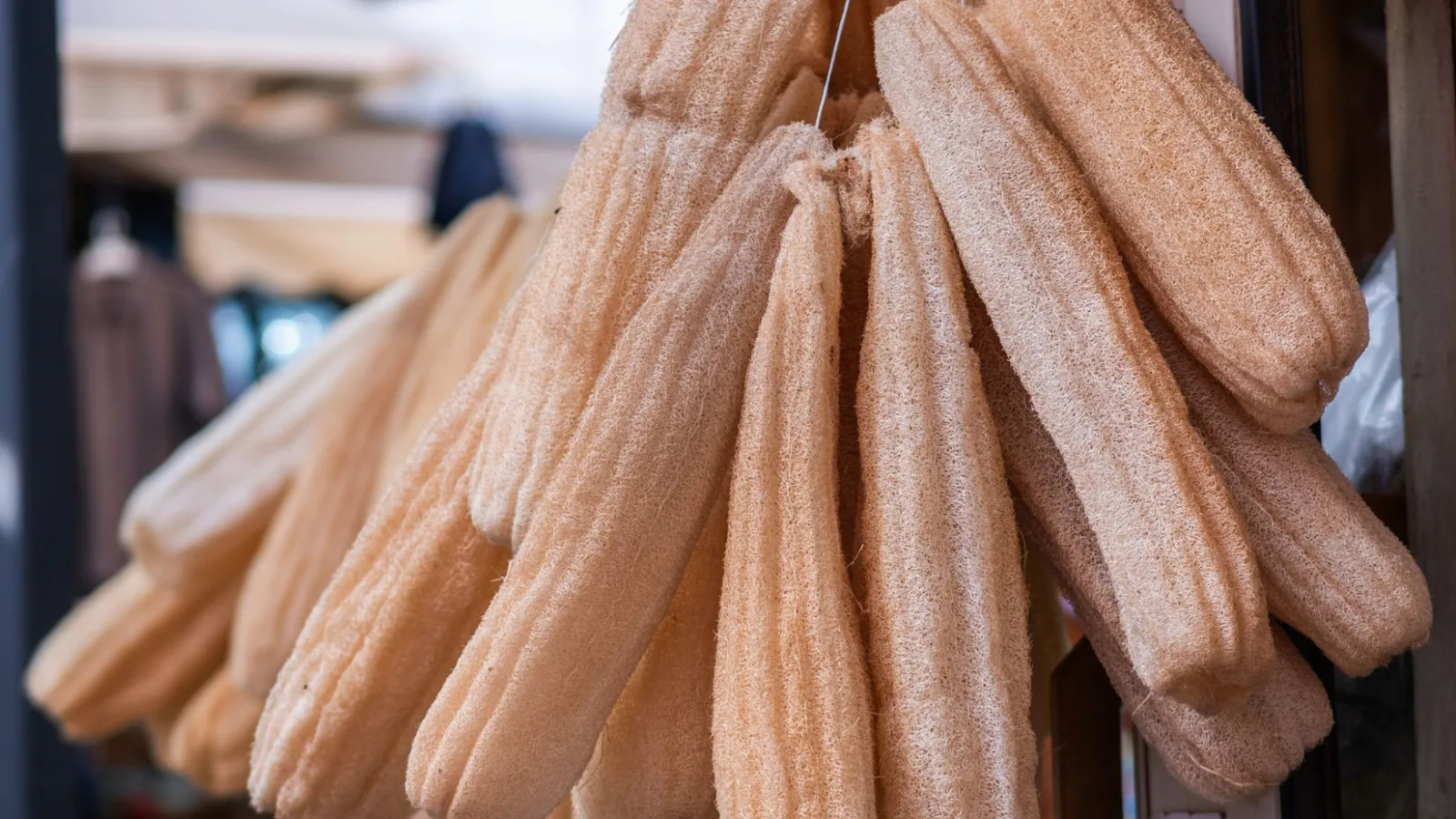
Luffa Sap: Why It Goes on Your Skin, Not in Your Glass
Every fall, gardeners cut their luffa vines to collect the sap, and many wonder whether it's safe to drink. Here's what's in it, what the research does and doesn't show, and why it's best kept as a skin toner.
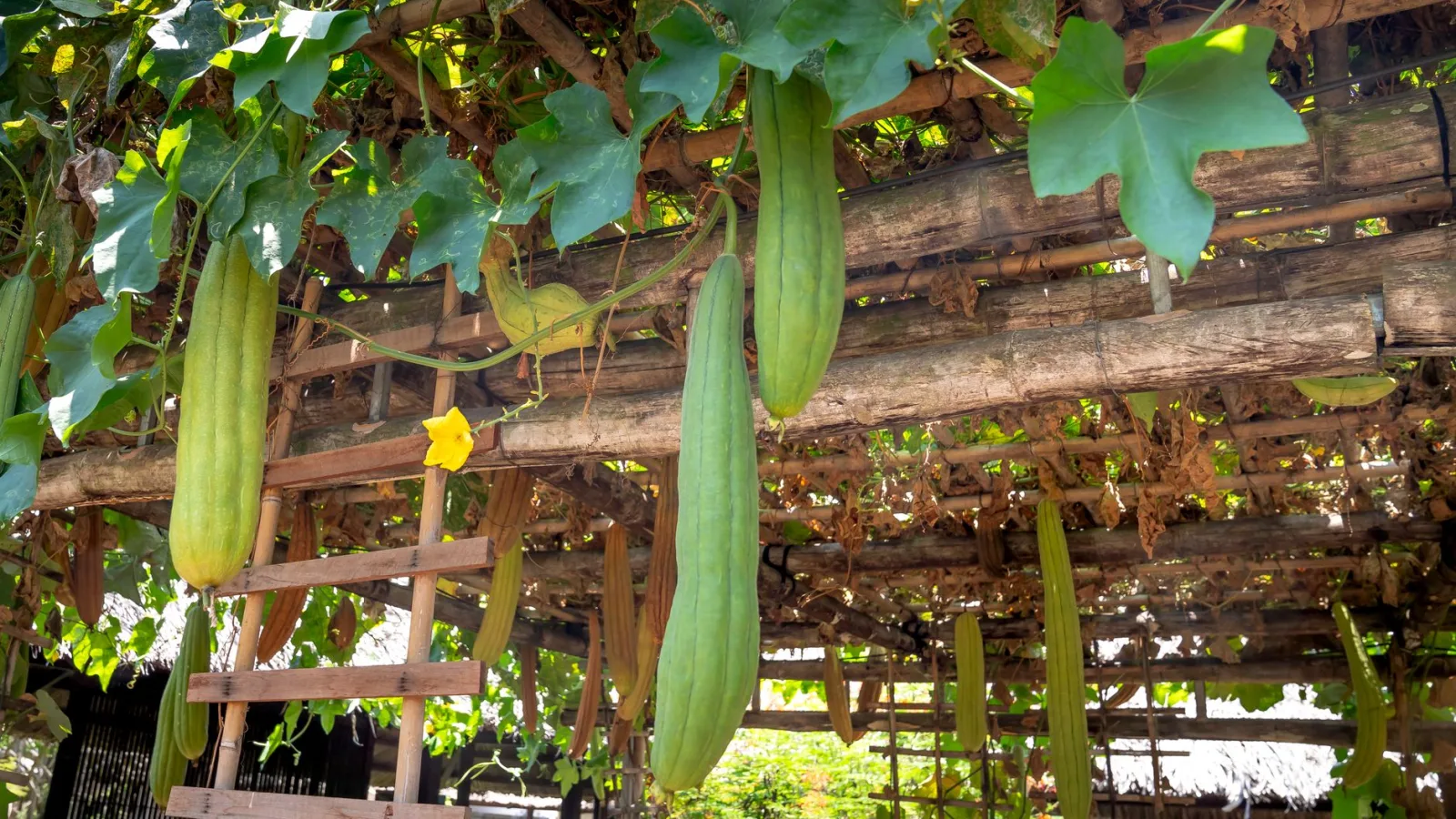
Luffa: How Much of It Can You Actually Eat?
Edible luffa and inedible luffa hang on the same vine, and the difference comes down to bitterness, size, and which parts you leave alone. Here's how to tell them apart before you cook.