- Type
- Fruiting Vegetables
- Difficulty
- Moderate
- Season
- Spring·Summer·Fall
- Sowing
- From seed
Chinese Lantern
Physalis alkekengi var. franchetii
Withanolides · the ornamental lantern plant and the edible kinds are different species
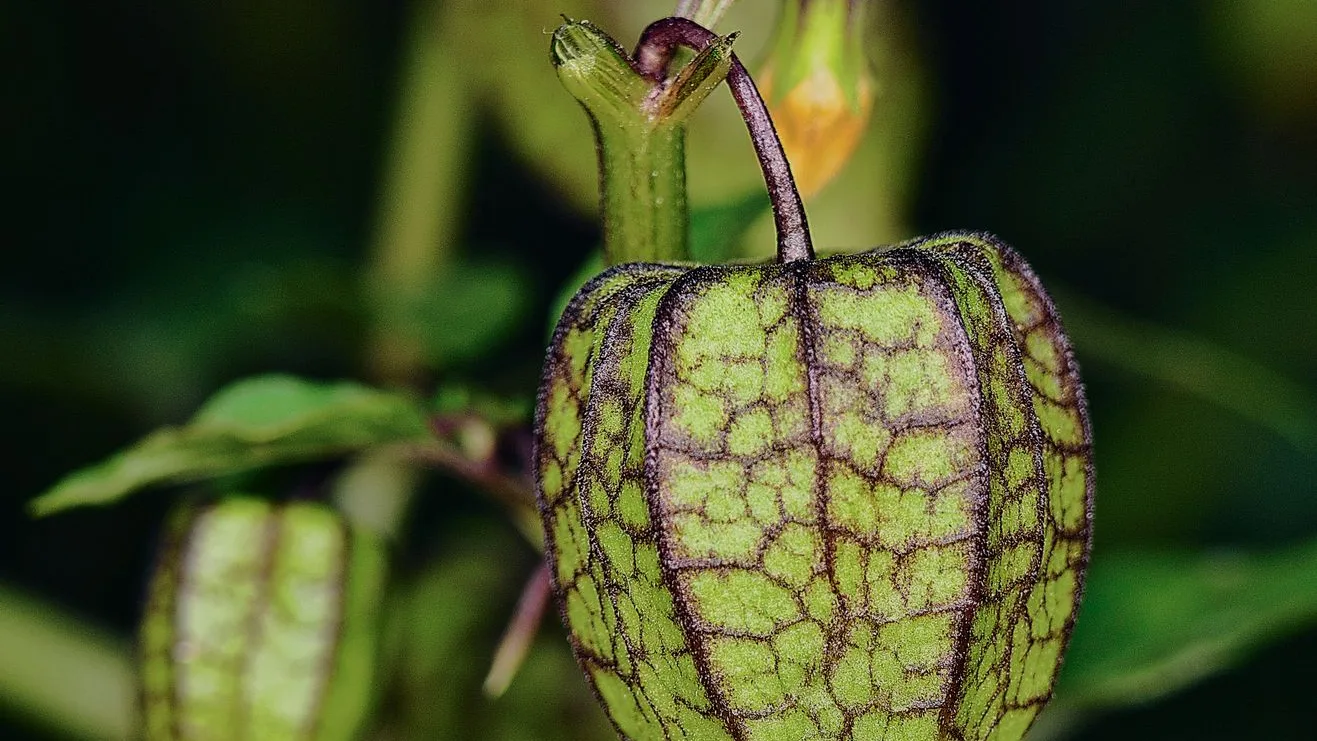
The Chinese lantern plant is a nightshade whose calyx inflates after flowering into a papery lantern around the fruit. This red-lanterned plant, the one commonly seen in ornamental beds, is grown for looks rather than for eating, and its leaves, stems and unripe fruit hold the withanolides. Those parts are left alone not because they taste bitter but because eating them has been reported to bring on nausea, vomiting and diarrhoea, so keep children away from the red fruit in a bed or a pot. The kinds grown for their fruit — cape gooseberry, ground cherry, tomatillo — are different species in the same genus, and the composition, cooking and growing notes in this entry describe those edible kinds. In a city plot, sow them indoors in March or April, plant out in May, and pick from August until frost. Ripeness shows as the calyx drying to brown paper, and in the ground cherry types the fruit simply drops when it is ready. The red-lanterned plant is a perennial whose rhizomes overwinter and send up shoots again the following year, so choose its position with that in mind. The Donguibogam lists the plant in the Herb section as 酸漿, giving it a nature that is neutral and cold, a sour taste and no toxicity, and explains that the name comes from the sour juice of the fruit. That is a historical medical record and differs from modern medical judgment.
Year-Round Calendar
- 1
- 2
- 3
- 4
- 5
- 6
- 7
- 8
- 9
- 10
- 11
- 12
- 3
- 4
- 8
- 9
- 10
Where It Grows
- Wild population Chinese lantern (P. alkekengi) grows wild in the open country of North China and Northeast China, and is also planted in fields.
- Origin The native home of the tomatillo (P. philadelphica) and its largest producer. It is grown on the central plateau and on irrigated land, and eaten in quantity as well.
- Main producer Produces more Cape gooseberry (P. peruviana) for export than anywhere else. It is grown in the cool high country of the Andean foothills, at 1,800–2,800 m above sea level.
- Major producer The same Cape gooseberry (P. peruviana) is grown here in the high Andes, where it is called aguaymanto.
The genus Physalis covers several kinds, and each kind has a different native range. The Chinese lantern seen in flower beds is an Old World plant native from Europe across to East Asia; the tomatillo is native to Mexico, and the Cape gooseberry to the Andes. Because the Andes runs across Peru, Colombia and Ecuador, no separate origin row is given for it and the point is recorded here instead. Since three different species are shaded on one map, the scientific name is stated on every row.
- Optimum
- 18~28℃
- Range
- 10~32℃
- Hardiness
- Hardy
Chinese lantern (Physalis alkekengi) is a perennial that overwinters on underground rhizomes and comes up again the following year, so it tolerates cold of around −20℃. The edible kinds — ground cherry, Cape gooseberry and tomatillo — are annuals that a single frost kills, so they are set out in their final position only once the late frosts have passed. Either way, the fruit fills out properly only in a spot that gets sun all day.
In Korea Nationwide
Chinese lantern grows in open country and flower beds across the whole country, overwintering on its rhizomes and coming up again year after year. The edible kinds are sown indoors in March–April, set out in their final position in May, and picked from August until the frosts.
How to grow
- Light
- Six hours of direct sun or more. Short of light the fruit stays sour and never sweetens
- Soil and depth
- Free-draining field soil at least 25cm deep. Ground that would grow tomatoes will do as it is
- Spacing
- 50 to 60cm between plants, 70cm between rows. They sprawl widely, and crowded plants rot in the middle
- Watering
- Water once the surface dries. Erratic watering while fruit is on brings splitting and soft spots at the blossom end
- Feeding
- Well-rotted compost as a base. From the first set of fruit, side dress every two to three weeks with phosphorus and potassium; excess nitrogen builds leaf and nothing else
- Harvest
- Pick cape gooseberries when the husk has dried brown and the yellow fruit shows through. Ground cherries drop when ripe, so lay straw or fleece underneath and collect them daily. Tomatillos are ready as the fruit fills the husk to bursting; left longer, they split
What makes the difference. Left inside their husks the fruit keeps for weeks at room temperature. For storage, do not husk them — spread them out somewhere cool as they are
Why this one is harder. As nightshades alongside aubergine, tomato and chilli, they bring on bacterial wilt and blight when replanted in the same ground. Hold to a two or three year rotation. Dropped fruit seeds itself all over the plot the following year, so if you do not want it spreading, clear fallen fruit the same season
Common problems
- 28-spotted potato ladybird You will see Leaves scraped to a translucent mesh, with a heavily spotted ladybird sitting on them What to do Pick off adults and larvae and rub out the yellow egg clusters on leaf undersides. Numbers climb fast when aubergines or potatoes are planted alongside
- Whitefly You will see White flies lift off when the plant is touched; leaves turn sticky and then sooty What to do Hang yellow sticky traps at plant height and strip the older lower leaves to open up airflow
- Thrips You will see Silvery scarring and black specks on leaves and young fruit What to do Use blue sticky traps and clear weeds from the edge of the bed. Hot, dry spells make them worse
This page describes how a crop is grown and used. It does not claim health effects for any food, nor is it intended to prevent or treat disease. Component and study notes are references only and do not mean the same result occurs in people. Consult a medical professional about health concerns.
Health Benefits
What the Donguibogam records — the name, nature and taste. The Donguibogam lists the plant in the Herb section as 酸漿. It gives a nature that is neutral and cold, a sour taste and no toxicity. It says the plant is found everywhere, that the fruit sits in a pouch-like chamber holding a berry the size of a plum or apricot, reddish-yellow, and that the name 酸漿 was taken from its sour-juice flavour. It adds that the root resembles that of water dropwort, is white, and is intensely bitter. This is a historical medical record and differs from modern medical judgment.
Compositional analysis of ripe fruit. Studies analysing cape gooseberry and related Physalis fruit report carotenoids and vitamin C in fully ripe fruit, with carotenoid content rising through ripening. The same work reports that withanolide compounds are comparatively concentrated in leaves, stems and unripe fruit. These are analyses of composition and distribution and have nothing to do with disease.
Nutrition
- Withanolides (physalins) (concentrated in the leaves, stems and unripe fruit of the ornamental lantern plant) — bitter steroidal lactones reported across the nightshades
- Vitamin C (in the ripe fruit of the edible kinds (cape gooseberry, ground cherry)) — a water-soluble vitamin that falls off with cooking
- Carotenoids (beta-carotene, zeaxanthin and others reported in the ripe fruit of the edible kinds) — fat-soluble pigments behind the yellow and orange
- Pectin (higher in under-ripe fruit of the edible kinds) — the polysaccharide behind a preserve setting
Ripe colour and carotenoids Cape gooseberries and ground cherries turn from green to yellow-orange as they ripen. The colour comes from accumulating carotenoids including beta-carotene, and analyses report distinctly more carotenoid in fully ripe fruit than in unripe. Fruit that has not coloured through also tastes sour and astringent. Using colour as the ripeness test is the practical approach.
Vitamin C and acidity Fruit in this group is high in organic acids, so sourness leads. Vitamin C is present but heat-sensitive, and a good share of it is lost when the fruit goes into jam or a preserve. Eating them raw costs the least. Better to use them within a few days of picking than to hold them long in the fridge.
Pectin and preserves The fruit carries enough pectin to set with sugar alone. Adding a few under-ripe fruits raises the pectin and firms the texture. Under-ripe fruit brings its bitter compounds along too, so keep that proportion low. Tomatillos are strong in both acid and pectin, which is what thickens a salsa verde.
Pairings
○ Yoghurt and salads — Halve ripe cape gooseberries over plain yoghurt. The acidity meets the milk fat and the two balance. Strip the husk and use the fruit only.
○ Jam and preserves — There is enough pectin that sugar alone will set it. A little lemon juice keeps the colour bright. The seeds are small enough to leave in without being noticed.
○ Salsa verde — Husk tomatillos, wash off the sticky film underneath, then roast or blanch them. Blended with onion, chilli and coriander they make a green salsa. Raw they taste sharply green, so one cooking step is worth it.
△ Unripe fruit, leaves and stems — These are nightshades, and the leaves, stems and unripe fruit carry bitter alkaloids and withanolide compounds. Eaten in quantity they can bring on nausea and stomach pain, so eat only fruit that has coloured fully. The red Chinese lantern plant (Physalis alkekengi) in an ornamental bed is not a type grown to eat — keep children from picking it. Even on the edible types, leave anything still tinged green.
△ The husk is not food — The papery calyx around the fruit is not a part that gets eaten. It peels away easily once it has dried brown, so that is the moment to take it off. Cape gooseberries sometimes leave a sticky film under the husk, so rinse them.
△ Nightshade allergy and feeding children — Anyone who has reacted to aubergine, tomato or chilli does well to be careful with this genus too. Start a child on one or two fully ripe fruits. For home-grown fruit, check what has been sprayed on the bed and wash before serving. Eggplant
Varieties
- Chinese lantern plant (seed) — Calyx turns scarlet. An ornamental type, not one grown to eat
- Cape gooseberry (goldenberry) (seed) — Physalis peruviana. Ripens yellow, sour and sweet at once
- Ground cherry (seed) — Physalis grisea. Small, markedly sweet fruit that drops when ripe
- Tomatillo (seed) — Physalis philadelphica. Grows large and green until it splits the husk. The base of salsa verde
Source: Donguibogam, Herb Section 酸漿 · Rural Development Administration (Nongsaro) · Korean Food Composition Table