- Type
- Trees & Vines
- Difficulty
- Hard
- Season
- Summer
- Sowing
- Plant a sapling
Plum Kernel
Prunus salicina
Amygdalin, fixed oil · the kernel inside a plum stone
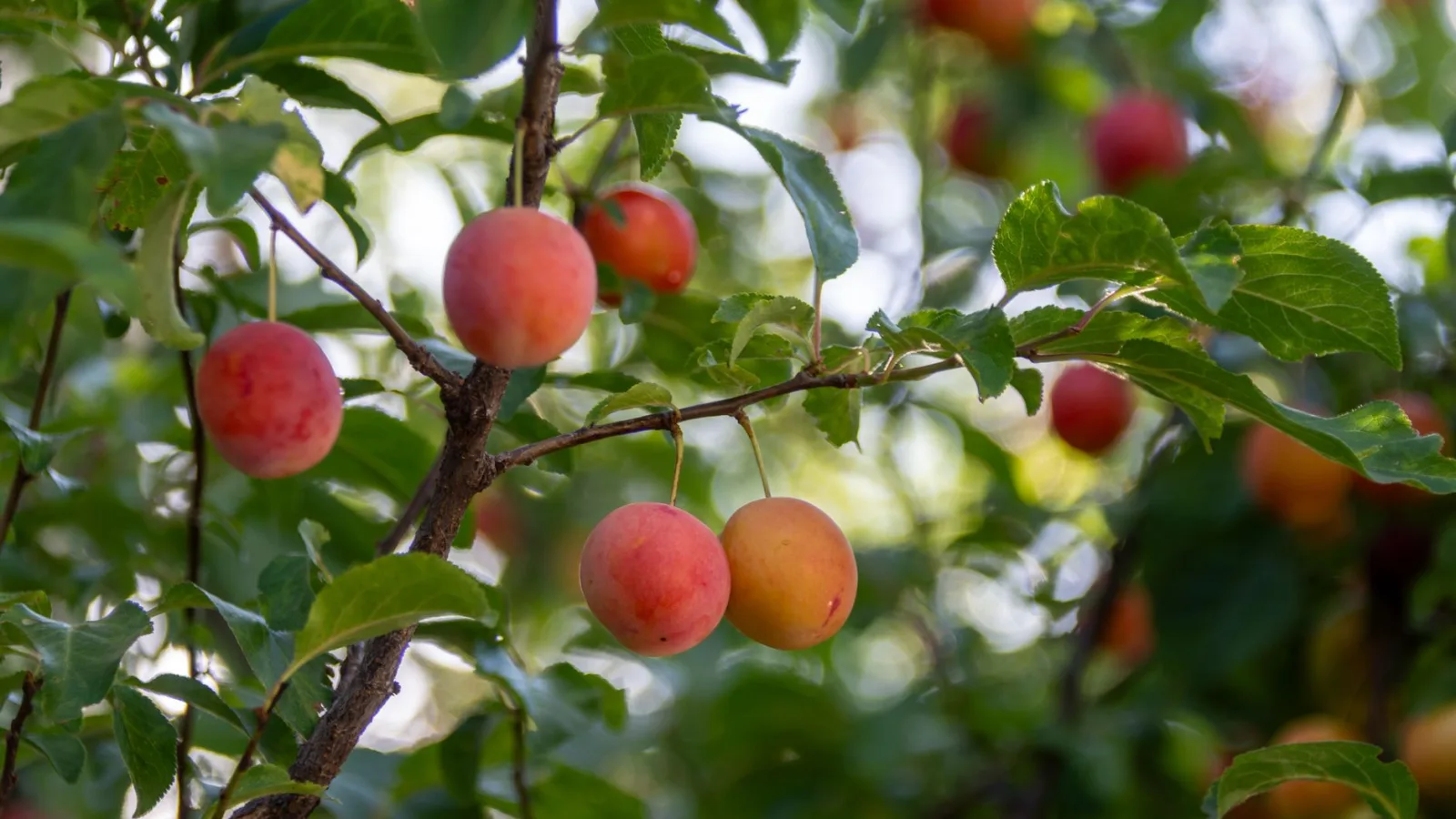
Oyat is the old Korean word for plum, and oyatssi means the kernel you get by cracking the stone open. It is not something you eat; it is a part used in historical prescriptions. The Donguibogam described gathering it in the sixth and seventh lunar months, scalding it to slip off the skin and tip, then grinding it. Like apricot and peach kernels from the same rose family, it contains cyanogenic glycosides, which puts it firmly outside the category of food. What you actually meet in a city is the flesh of the plum itself, and the tree runs three to six metres, which makes fruiting in a pot unlikely.
Year-Round Calendar
- 1
- 2
- 3
- 4
- 5
- 6
- 7
- 8
- 9
- 10
- 11
- 12
- 3
- 4
- 11
- 6
- 7
- 8
Where It Grows
-
Origin
This is where the Asian plum (Prunus salicina) was domesticated, and it accounts for more than half of world plum production. Liaoning, Shandong and Sichuan are the growing regions. Harvest June, July, August
- 6
- 7
- 8
- Major producer The largest producer in Europe, though what is grown here is the European plum (Prunus domestica), a different species.
- Major producer European plum country as well, where most of the crop is dried or distilled into spirits.
-
Major producer
Being in the Southern Hemisphere, the harvest arrives during the Korean winter. Fresh plum exports are substantial. Harvest December, January, February, March
- 1
- 2
- 3
- 12
-
Major producer
California's Central Valley is the center, and the varieties grown there are Asian plums that came in by way of Japan. Harvest May, June, July, August, September
- 5
- 6
- 7
- 8
- 9
- Major producer Along the Mediterranean and Aegean coasts, both Asian and European plums are produced.
Oyat is the old Korean word for the plum, and oyatssi is the kernel taken from inside a cracked plum stone. The Asian plum (Prunus salicina) was domesticated in China's Yangtze River basin and spread from there to Korea and Japan; in the late nineteenth century it reached the United States by way of Japan and became the basis of today's fresh plum varieties. The FAO counts Asian and European plums under a single heading, so the Romanian and Serbian rankings belong to the European plum — the two are different trees.
- Optimum
- 15~25℃
- Range
- 5~32℃
- Hardiness
- Hardy
This is a deciduous fruit tree that needs a certain number of hours below 7℃ in winter before its flower buds will open evenly the following spring, so where winters are too mild the bloom comes in unevenly. At the other extreme, a late frost during the March–April bloom costs that year's fruit. The fruit also splits easily in the summer monsoon rains.
Harvested 3–4 years after planting. Three or four years must pass after the saplings go in before the trees begin to set fruit. The planting month and the harvest month do not fall in the same year. Most varieties need pollen from another variety to set fruit, so a single tree on its own will struggle to give a harvest.
In Korea Nationwide
Gimcheon, Uiseong and Gyeongsan in North Gyeongsang, Okcheon in North Chungcheong, and parts of North Jeolla are the known growing areas. In mountain basins where late frosts often fall during the bloom, the harvest swings sharply from one year to the next.
How to grow
- Light
- Six hours of direct sun or more. Less light means fewer flower buds.
- Soil and depth
- Free-draining sandy loam. Standing water rots the roots quickly.
- Spacing
- Four to five metres in the ground. A pot needs to be at least 60 cm across, and even then the crop is small.
- Watering
- Keep it moist through the planting year; after that, only during June and July while the fruit swells.
- Feeding
- Compost in winter after leaf drop, one top dressing after flowering. No nitrogen in late summer.
- Harvest
- Late June to late August, with two months between early and late varieties. Pick when colour reaches the stem end and the fruit starts to smell.
What makes the difference. Do not crack the stones open. The kernel inside contains cyanogenic glycosides. Discard stones when preparing the fruit, and leave none in jam or syrup. Plums soften within two days of ripening, so pick them slightly firm and finish them at room temperature.
Why this one is harder. A mature tree is three to six metres. Most varieties need pollen from a different variety to set fruit, so a single tree rarely produces.
Common problems
- Peach fruit moth You will see Pinprick marks on the skin with brown damage inside. What to do Bag the fruit in early June and clear windfalls as they drop.
- Brown rot You will see Brown patches spreading on ripening fruit with grey mould over them. What to do Never leave affected fruit hanging on the tree, and thin branches for airflow.
- Aphids You will see New shoots curl and leaf undersides turn sticky. What to do Hose the new growth in spring; cut out shoots that are badly infested.
This page describes how a crop is grown and used. It does not claim health effects for any food, nor is it intended to prevent or treat disease. Component and study notes are references only and do not mean the same result occurs in people. Consult a medical professional about health concerns.
Health Benefits
What the old record says. Plum kernel appears in the Donguibogam's fruit section as ihaegin. The root bark and the leaves are listed separately, each in its own place. This is a record from a seventeenth-century medical text and not a practice to reproduce; the kernel is never eaten raw.
What studies have observed. Antioxidant experiments have been reported on the polyphenols in plum flesh and skin. The kernel is not a subject of food research, for safety reasons.
Nutrition
- Amygdalin (A cyanogenic glycoside in the kernel) — Breaks down to cyanide by enzymes in the body. Never eat the kernel raw.
- Fixed oil (30-40 % of the kernel by weight) — The oil concentrated in the kernel
- Anthocyanins (The red-purple pigment of plum skin) — Classified as polyphenols
- Sorbitol (The sugar alcohol of plum flesh) — A water-soluble sugar alcohol behind the sweetness
Amygdalin in the kernel Kernels inside rose-family stone fruit contain amygdalin. Chewed or ground and swallowed, enzymes in the body break it down and cyanide is released. This is the same class of compound found in apricot and peach kernels, and plum is no exception. The old preparation of scalding, peeling, and grinding was a way of handling that compound. Cracking stones open at home is not something to do.
Sorbitol in the flesh Plum flesh contains the sugar alcohol sorbitol. It is poorly absorbed in the small intestine and draws water into the colon. That is why several plums in a row can loosen the bowels. Dried plums concentrate it further, since the water is gone.
Polyphenols in the skin The anthocyanins and phenolic acids in a red plum sit mostly in the skin. Peeling it throws away the colour and those compounds together. The white bloom on the surface is not pesticide but a wax the fruit makes itself. Rub it clean under running water and eat the skin.
Pairings
○ Eating plums unpeeled — The edible part is the flesh, and the polyphenols concentrate in the skin, so washing beats peeling. The white bloom rinses off and is natural wax, not residue.
○ Preserves and jam — Plums that have started to soften cook down well with sugar once stoned. There is enough pectin that no setting agent is needed. Take every stone out before the pot goes on.
○ Yogurt and cheese — The acidity of plum cuts the fat in dairy. Sliced thin over the top, it needs no added sweetener. Very ripe fruit is aromatic, so pair it with a firmer cheese.
△ Do not crack the stone and eat the kernel — The kernel inside a plum stone contains amygdalin; chewed or ground and swallowed, enzymes in the body break it down and cyanide is released. It belongs to the same class of compound as apricot and peach kernels, and plum is no exception. Cracking stones open at home to eat or grind the kernel is not done. The part that is eaten is the flesh. Apricot Kernel · Peach Kernel
Varieties
- Daeseok-josaeng (Sapling) — An early variety ripening in late June. Red, with sourness remaining.
- Formosa (Sapling) — Harvested mid-July. Yellow skin and soft flesh.
- Chuhi (Sapling) — A late variety harvested in late August. Large and firm.
- Native Korean plum (Sapling) — The old landrace still standing at village entrances. Small and sharply sour.
Source: Donguibogam, Fruit Section (李核仁) · Rural Development Administration (nongsaro.go.kr)