- Type
- Leafy Greens
- Difficulty
- Easy
- Season
- Spring·Fall
- Sowing
- From seed
Asian plantain
Plantago asiatica
Aucubin · a spring rosette green
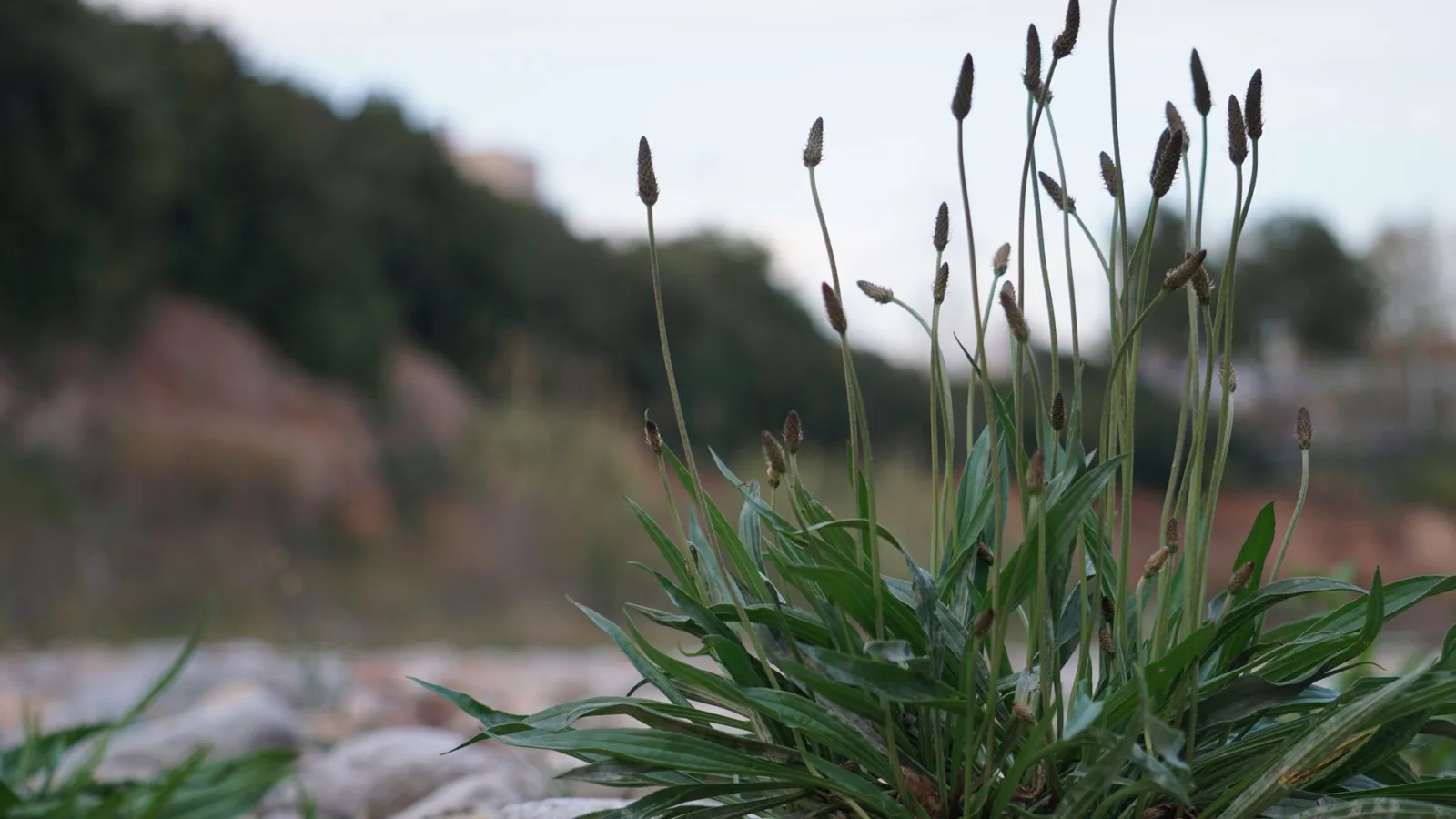
Asian plantain is a perennial field herb whose leaves spread flat against the ground like a cushion. Five to seven ribs run the length of each leaf and gather toward the stalk, and a slender flower stem rises straight from the centre carrying a narrow spike. In the city it turns up in pavement cracks and along the edges of walking paths, exactly where feet compact the ground — but those are the worst places to gather it, so collecting seed and raising it in a corner of a plot is the better route. The Donguibogam lists it in the Herb Section as 車前子, records the vernacular Korean names alongside the Chinese, and describes it as cold in nature — neutral by one account — sweet and salty in taste, and free of toxicity. The same entry explains the name 車前, 'before the cart', because the plant grows readily by roadsides and favours the hollows left by cattle tracks, and gives the gathering season: shoots in the fifth lunar month, seed in the ninth and tenth, dried in shade.
Year-Round Calendar
- 1
- 2
- 3
- 4
- 5
- 6
- 7
- 8
- 9
- 10
- 11
- 12
- 3
- 4
- 9
- 4
- 5
- 6
Where It Grows
- Main producer Under the name cheqian (車前) it is grown as a large-scale field crop for seed in Ji'an, Jiangxi, and in Sichuan. In China, however, that name covers both Plantago asiatica and P. depressa together.
-
Wild population
Common in open fields, along roadsides and on field margins throughout the country. Some gardeners save the seed and sow it in a corner of the kitchen garden. Harvest April, May, June
- 4
- 5
- 6
- Wild population Known as obako (オオバコ), it is common in open fields, along roadsides and around the edges of sports grounds.
Its native range is East Asia — Korea, China and Japan, reaching into eastern Siberia. The plantains common along roadsides in Europe and North America are different species, greater plantain (Plantago major) and ribwort plantain (P. lanceolata), so they are not shaded on the same map. The only country that grows it as a field crop on any scale is China, where it is raised for the seed; elsewhere it is mostly gathered where it comes up on its own.
- Optimum
- 15~25℃
- Range
- 5~30℃
- Hardiness
- Hardy
A perennial of sunny open ground and roadsides. It passes the winter as a flat rosette of leaves pressed against the soil, then sends up new growth from the root. Because it tolerates ground packed hard by foot traffic, it takes hold in places where other plants cannot survive.
In Korea Nationwide
Common in open fields, along roadsides and on field margins throughout the country. Being a perennial, once it establishes itself the leaves come up from the same crown year after year. Instead of digging it from trampled roadsides, gardeners save the seed and sow it separately in a corner of the kitchen garden.
How to grow
- Light
- Full sun suits it best, and it survives in partial shade. Four hours a day is enough to keep it growing
- Soil and depth
- Not fussy. Slightly compacted ground actually helps, since fewer competitors tolerate it. Just avoid anywhere water stands
- Spacing
- 15~20cm between plants. Each one spreads into a flat cushion, so crowding makes the leaves overlap and rot
- Watering
- Water when the surface dries. For the two weeks or so until seedlings appear, water little and often so the soil surface never dries out
- Feeding
- Almost no feeding needed. Heavy nitrogen gives large, soft leaves that cook badly
- Harvest
- Pick outer young leaves between April and June, before the flower stem rises from the centre. Take leaves only rather than pulling the plant, and one crown gives several pickings. For seed, strip the whole spike in October or November once it has dried brown
What makes the difference. The seed is tiny, so barely cover it. Scatter on the surface, press it down with a flat palm, and lay thin fleece over the bed to hold moisture until the seedlings show, then lift it
Why this one is harder. Seed spreads easily and within a few years the plant is everywhere in the bed. Keep only the plants you want seed from and cut the flower stems off the rest before the spikes dry
Common problems
- Slugs You will see Irregular holes chewed through leaves, with silvery trails left behind What to do Hunt at night with a torch. Clear pots and stones off the ground to remove hiding places
- Aphids You will see Colonies on flower stems and new leaves What to do Wash off with a jet of water; if they return, use egg-yolk oil
- Powdery mildew You will see White floury patches spreading across the upper leaf surface What to do Thin overlapping leaves to open up airflow, and take affected leaves out of the plot
This page describes how a crop is grown and used. It does not claim health effects for any food, nor is it intended to prevent or treat disease. Component and study notes are references only and do not mean the same result occurs in people. Consult a medical professional about health concerns.
Health Benefits
What the Donguibogam records — vernacular names, nature and taste. The Donguibogam lists it in the Herb Section as 車前子 and sets the vernacular Korean names beside the Chinese ones. It is described as cold in nature, neutral by one account, sweet and salty in taste, and free of toxicity. The entry identifies it with 芣苢, notes the large leaves and long spike, and explains the name 車前, 'before the cart', because the plant grows readily by roadsides and favours the hollows left by cattle tracks. It also gives the gathering season — shoots in the fifth lunar month, seed in the ninth and tenth, dried in shade. This is a record from an old medical text and differs from modern medical judgement.
Composition analysis. Analyses have reported iridoid glycosides such as aucubin and phenylethanoid glycosides such as plantamajoside and acteoside in Plantago leaves. The same work found levels varying widely with collection date and leaf age. This concerns composition only, and has no bearing on the prevention or treatment of disease.
Told apart from psyllium husk. The psyllium husk traded as a fibre supplement is the seed coat of Plantago ovata, cultivated in India, and a different species from the Plantago asiatica growing in Korean fields. The names are close and the Chinese characters overlap, so the two are commonly conflated and this guide keeps them separate.
Nutrition
- Aucubin (iridoid glycoside) (present in leaf and seed) — a glycoside characteristically reported in the Plantago genus
- Plantamajoside and acteoside (identified in leaf extracts) — phenylethanoid glycoside group
- Mucilaginous polysaccharides (abundant in the seed coat) — polysaccharides that swell and turn viscous in water
- Dietary fibre and minerals (measured on young leaves) — the bulk of what the leaf contributes as a cooked green
Young leaves and blanching Only leaves taken before the flower stem rises are worth cooking. The ribs are thick and stringy, so blanch for 2~3 minutes in salted boiling water, rinse in cold water and squeeze dry. Discard the blanching water, then dress the leaves or drop them into soup. Once the flower stem is up, no amount of blanching softens the leaf.
Seed mucilage, and what psyllium actually is The seed coat holds polysaccharides that swell and turn viscous in water. The psyllium husk sold as a fibre supplement, however, comes from a different species grown in India, Plantago ovata, and not from the Asian plantain of Korean fields, Plantago asiatica. The names overlap and so do the Chinese characters, which is why the two are so often conflated. This guide records only that they are separate species.
Aucubin and phenylethanoids Analyses have reported iridoid glycosides such as aucubin and phenylethanoid glycosides such as plantamajoside and acteoside in Plantago leaves. The same work found levels varying widely with collection date and leaf age. This is a record of composition and nothing beyond that.
Pairings
○ Perilla seed powder and doenjang — Blanched plantain is plain on its own, so it suits a doenjang dressing or a stir-fry with a generous spoon of ground perilla seed. The oil in the perilla softens how the tough ribs read on the tongue. Squeeze the leaves dry before dressing or the seasoning slides off. Perilla (Deulkkae)
○ Soup and pancakes — Chop the blanched leaves into doenjang soup, or fold them into a flour batter and pan-fry as jeon. Frying makes the coarse ribs far less noticeable. Keep the batter thick so the leaves hold together.
○ Dried for winter — Blanched and dried, the leaves keep through winter as muknamul. Rehydrate the dried leaves, then simmer once more before cooking. This is the way to handle a large single spring harvest.
△ Gathering from roadsides and car park edges — The places where plantain is easiest to spot are the worst places to pick it. Soil beside traffic lanes and along car park edges accumulates heavy metals, and park beds and apartment landscaping are routinely sprayed with herbicide. Check with whoever manages the ground about spraying, or simply collect seed and grow it in a plot.
△ Confusing it with young foxglove — In spring, when only the flat rosette is showing, it can be mistaken for a young foxglove (Digitalis purpurea) planted in ornamental beds — a confusion behind poisoning cases reported in Europe. Plantain leaves carry five to seven heavy ribs running parallel and converging at the stalk, with a relatively smooth underside. Foxglove leaves are net-veined, greyish with fine hairs underneath, and finely toothed along the edge. The safest rule is simply not to gather around planted beds.
△ Dock and sheep sorrel mixed in — Curled dock and sheep sorrel overwinter as rosettes in the same spring fields and grow right alongside plantain. Both are high in oxalic acid, taste sharply sour, and are not eaten in quantity at one sitting. If a leaf is long and narrow and tastes sour when chewed, it is not plantain — set it aside. Curly Dock
Varieties
- Plantago asiatica (seed) — The common species. Oval leaf blade on a long stalk
- Plantago major var. japonica (seed) — Larger, thicker leaves. Found inland and near the coast
- Plantago depressa (seed) — Fine hairs on leaf and flower stem. Prefers dry ground
- Plantago lanceolata (seed) — Narrow, lance-shaped leaves. A European species now naturalised widely
Source: Donguibogam, Herb Section, 車前子 · National List of Species of Korea · RDA Nongsaro