- Type
- Trees & Vines
- Difficulty
- Hard
- Season
- Fall
- Sowing
- Plant a sapling
Persimmon (hongsi)
Diospyros kaki
Tannins and beta-carotene, in a red fruit that softens late in autumn
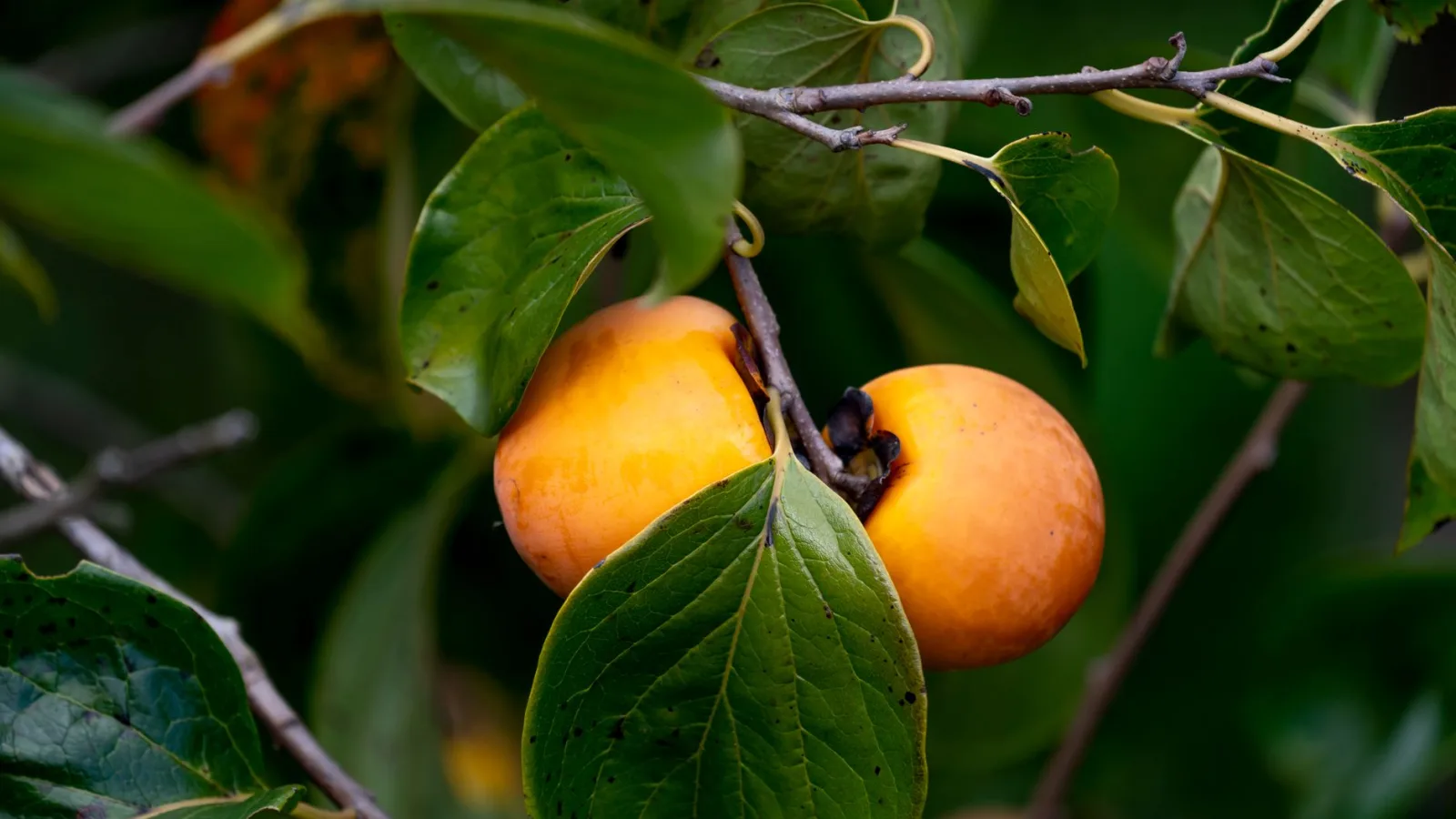
Persimmon is the autumn fruit of Diospyros kaki. It divides into two broad groups: sweet persimmons, which lose their astringency on the tree and are eaten firm, and astringent persimmons, which have to be treated, softened or dried before they are edible. Hongsi is the name for an astringent persimmon that has ripened all the way to soft. The Donguibogam sorts the fruit into categories: hongsi for the soft-ripe form, baeksi for sun-dried, osi for fire-dried, and sisang for the thick powder that gathers on the skin of dried fruit. It also records the observation that an unripe persimmon is green and astringent, and that the astringency disappears on its own as the fruit turns red. A separate entry covers goyeom, the tiny wild date-plum, with a note that its nature is extremely cold and one should not eat many. The figures given in this entry are measured on raw sweet persimmon; soft hongsi and dried gotgam differ in water and sugar, so the same weight gives different numbers. In Korean cities you meet persimmons in late autumn as soft yeonsi, crisp sweet dan-gam, and dried gotgam, and a dwarf-rootstock sapling in a large pot will give you a few fruit on a balcony.
Year-Round Calendar
- 1
- 2
- 3
- 4
- 5
- 6
- 7
- 8
- 9
- 10
- 11
- 12
- 3
- 4
- 10
- 11
Where It Grows
-
Origin
Native to the Yangtze basin and the largest producer, supplying about three quarters of the world's persimmons. Shaanxi, Hebei, Guangxi and Shandong are the main areas. Harvest September, October, November
- 9
- 10
- 11
-
Main producer
Sweet persimmon is known from Changwon, Gimhae and Jinju in South Gyeongsang, astringent persimmon from Cheongdo and Sangju in North Gyeongsang and from Yeongam in South Jeolla. Harvest October, November
- 10
- 11
-
Main producer
The Júcar valley in Valencia is Europe's largest growing area and the source of the Rojo Brillante variety. Harvest October, November, December
- 10
- 11
- 12
-
Main producer
Wakayama, Nara and Fukuoka are the growing areas, and many sweet persimmon varieties have been bred out there. Harvest October, November
- 10
- 11
-
Major producer
Grown in the low-lying land along the Caspian coast and shipped towards Russia. Harvest October, November
- 10
- 11
-
Major producer
Being in the southern hemisphere, its harvest runs out of step with the northern one. The state of São Paulo is the growing area. Harvest February, March, April, May
- 2
- 3
- 4
- 5
It arose in the Yangtze basin in China, crossed to Korea and Japan, where it has long been grown, and from the late 19th century moved on to the Mediterranean and South America. Most production is still in East Asia, but with Spain serving the European market and Brazil covering the southern-hemisphere season, the months in which persimmons appear have widened across the year.
- Optimum
- 15~25℃
- Range
- 5~35℃
- Hardiness
- Half-hardy
A temperate deciduous fruit tree. It does best where the mean annual temperature is 11–15℃, and sweet persimmon survives only in the south, where winter lows rarely drop below −13℃. Astringent persimmon takes the cold better and grows as far as the foothills of the central region. Its roots spread shallowly, so it suffers in summer drought, and a frost or two around ripening brings up the sweetness.
Harvested 3–5 years after planting. A grafted sapling starts to bear fruit three to five years after planting, and a proper harvest takes longer still. There is no harvest in the year of planting. The tree tends to crop heavily every other year, so the fruit is thinned in June.
In Korea Central Korea and south
Astringent persimmon grows from the central region southward, as far as the foothills, while sweet persimmon is confined to the south, where winters are mild. Saplings are planted in March–April and the fruit is picked in October–November. Cheongdo and Sangju in North Gyeongsang are known for astringent persimmon used for dried persimmon (gotgam), and Changwon and Gimhae in South Gyeongsang for sweet persimmon.
How to grow
- Light
- At least six hours of direct sun. Short on light, the tree flowers sparsely and drops fruit before it ripens.
- Soil and depth
- Free-draining sandy loam at pH 5.5 to 6.5. In a pot, use one at least 45 cm across and 60 L in volume, filled with potting mix and coarse grit at about 7 to 3.
- Spacing
- In the ground, 5 to 6 m between trees. Even on dwarfing rootstock, one tree per large pot and no more.
- Watering
- Persimmon roots run shallow and the tree dislikes drought. In a pot, water until it runs from the drainage holes whenever the surface dries, and keep it evenly moist through August and September while fruit is sizing. Standing water in the saucer will rot the roots.
- Feeding
- Compost as a base dressing in March, a top dressing in June. Excess nitrogen gives you leaf growth and dropped fruitlets. One more feed in November after harvest builds stronger buds for next year.
- Harvest
- October and November, once colour has run right up to the calyx. Cut with shears leaving the calyx attached. Pick sweet varieties while still firm; astringent ones come off hard and are either ripened to hongsi or peeled and hung as dried gotgam. Sugar is highest after one or two frosts.
What makes the difference. In a pot, buy a two or three year old tree grafted on dwarfing rootstock, and expect three to five years before fruit. Thin in June to one fruit per branch, which reduces the tree's habit of cropping only every other year. To remove astringency, seal the fruit in a plastic bag with paper dabbed in soju and leave at room temperature for three to five days. To ripen to hongsi, add an apple to the bag and it goes about three days faster.
Why this one is harder. In open ground the tree reaches 10 m with a wide root system. Even on dwarfing rootstock in a pot, you are looking at three to five years for a handful of fruit.
Common problems
- Persimmon fruit moth You will see The area around the calyx browns and the fruit drops before ripening What to do Clear fallen fruit the same day, and in winter scrape the rough bark off the trunk to destroy overwintering pupae underneath.
- Scale insects You will see White waxy lumps on the branches, sticky leaves, and black sooty mould following behind What to do Apply horticultural oil in winter and scrub colonies off the bark with a stiff brush.
- Anthracnose You will see Sunken black spots on fruit and new shoots, rotting outward from those spots What to do It spreads through the wet months of June to August, so remove infected fruit immediately and thin branches for airflow.
This page describes how a crop is grown and used. It does not claim health effects for any food, nor is it intended to prevent or treat disease. Component and study notes are references only and do not mean the same result occurs in people. Consult a medical professional about health concerns.
Health Benefits
What the Donguibogam recorded. Persimmon appears in the Donguibogam's fruit section as hongsi, with separate notes for sun-dried baeksi and for the small date-plum. The same passage records the prohibition on eating it with crab. This is a record from a seventeenth-century medical text, not a modern medical judgement.
Research on tannins and carotenoids. Antioxidant activity assays and animal studies on persimmon tannins and carotenoids have been reported a number of times. Whether the same effects appear in people has not been established.
The date-plum calyx and the persimmon calyx are not the same material. At the end of its entry on the small date-plum (小柿), the original text notes the calyx of that fruit (小柿蔕) separately and records only that its nature is astringent. The date-plum belongs to the same genus as the persimmon but is a different tree. The calyx still handled as a herbal material today (柿蔕) is the calyx of the persimmon tree, so it is a different material from the date-plum calyx of the original text. This is a record from a historical medical text, not a modern medical judgement.
Nutrition
- Tannins (The astringent compounds) — Turn into a water-insoluble form as the fruit ripens or is treated
- Beta-carotene and cryptoxanthin (The orange carotenoids) — Fat-soluble antioxidant pigments
- Vitamin C (About 50 mg per 100 g, measured on raw sweet persimmon) — Heat-sensitive; mostly lost in drying
- Dietary fibre and pectin (About 6 g per 100 g, measured on raw sweet persimmon) — High for a fruit
The tannin does not leave The astringency of an unripe persimmon comes from water-soluble tannins. As the fruit ripens, or goes through deastringency treatment, those tannins convert to an insoluble form the tongue can no longer detect. The compound has not gone anywhere, only changed shape, and it still binds protein in the stomach. That is the reason not to eat astringent or dried persimmons in quantity on an empty stomach. The Donguibogam described the same thing from the outside: green and astringent at first, red when ripe, with the astringency vanishing by itself.
Beta-carotene and cryptoxanthin That deep orange comes from carotenoids, mainly beta-carotene and beta-cryptoxanthin. They are fat-soluble, so more is absorbed when the fruit is eaten alongside something with fat in it. The riper and darker the fruit, the higher the content tends to run.
Vitamin C, and the white bloom on dried fruit The figures in this entry are measured on raw sweet persimmon. That fruit carries around 50 mg of vitamin C per 100 g, which holds its own against citrus. Drying, though, destroys most of it and leaves behind concentrated sugar and fibre. The white powder on dried persimmons is not mould but sugar seeping out of the flesh and crystallising, and analyses find glucose and fructose together with sugar alcohols such as mannitol. This is exactly what the original text calls sisang, persimmon frost.
Fibre and sugar together At about 6 g of fibre per 100 g, raw sweet persimmon is high for a fruit, and the sugar runs high to match. Drying pulls out the water and roughly triples or quadruples the sugar by weight. For anyone watching blood sugar, fresh fruit beats dried, and one at a sitting is a sensible stopping point.
Pairings
○ Nuts — Rolling walnuts inside dried persimmon is a long-standing Korean sweet. Fat and protein from the nut slow the sugar down a little, and the contrast between chewy and crisp does the rest.
○ Yoghurt and dairy — Mash a fully soft hongsi into plain yoghurt and you get plenty of sweetness with no sugar added. The fat in the dairy helps carry the carotenoids across. Frozen and blended, the same mixture turns straight into sorbet.
○ Cinnamon and ginger — Sujeonggwa floats dried persimmon in a cinnamon and ginger decoction, warm spices set against a fruit that is cooling by nature. For anyone with slow digestion it sits better than persimmon on its own. Cinnamon · Ginger
△ Astringent or dried persimmon, eaten in quantity on an empty stomach — Persimmon tannin does not disappear when the fruit ripens or is treated; it only changes form. Eaten in quantity on an empty stomach, astringent or dried persimmon can bind with stomach contents into a hard mass, a bezoar. Eat one or two after a meal rather than before, and take dried persimmon slowly, with water or other food.
△ After stomach surgery, or when the stomach empties slowly — In people who have had part of the stomach removed, or whose stomach empties slowly, such masses form more readily, and cases of bowel obstruction have been reported. Avoid astringent and dried persimmon, and keep even sweet or soft-ripe fruit to a small amount at a time. Persistent stomach pain and vomiting after eating persimmon calls for medical attention rather than waiting.
Varieties
- Fuyu (Sapling) — The most widely planted sweet persimmon in Korea. Peeled and eaten while firm.
- Daebong (Sapling) — A large, pointed astringent persimmon. Eaten as hongsi once it softens.
- Dungsi (Sapling) — The astringent persimmon used for dried gotgam. The main variety around Sangju and Yeongdong.
- Date-plum (Sapling) — The 小柿 of the original text. Very small fruit; used as rootstock for grafting persimmon.
Source: Donguibogam, Fruit Section (紅柿) · Rural Development Administration (nongsaro.go.kr)