- Type
- Trees & Vines
- Difficulty
- Hard
- Season
- Fall
- Sowing
- Plant a sapling
Asian Pear
Pyrus pyrifolia
Sorbitol and water · an autumn fruit with gritty stone cells
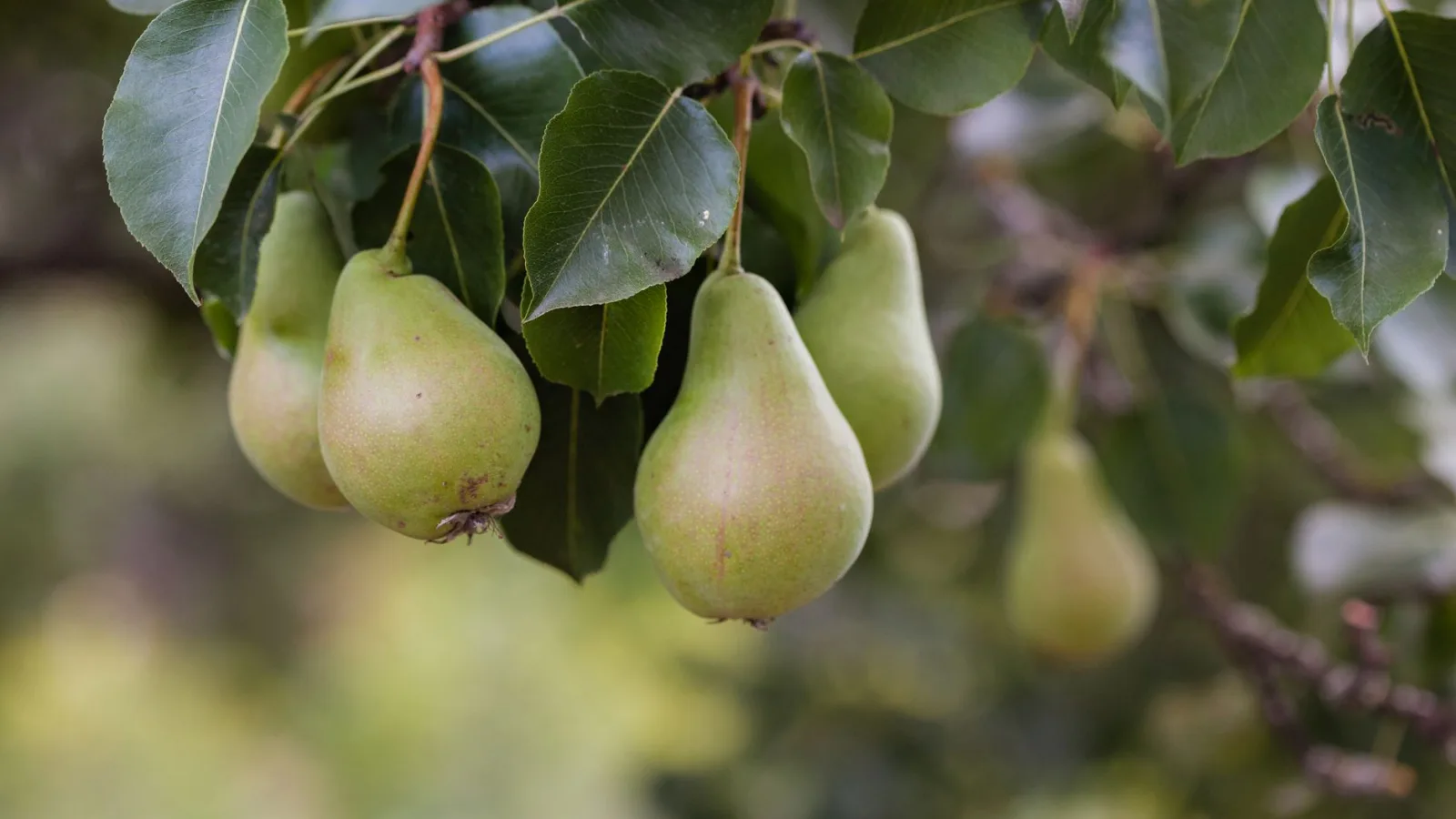
Asian pear grows on a rose-family tree and runs over 85 percent water, so it floods the mouth the moment you bite it. Grainy stone cells give it a texture clearly distinct from a European pear. The Donguibogam records it in the fruit section as 梨子, cold in nature and sweet with a touch of sour — an old medical record rather than a modern judgement. When juice is made, the seeds and core come out first and only the flesh goes into the press.
Year-Round Calendar
- 1
- 2
- 3
- 4
- 5
- 6
- 7
- 8
- 9
- 10
- 11
- 12
- 3
- 11
- 9
- 10
Where It Grows
-
Main producer
Accounts for most of the world's pear production. Hebei, Shandong and Liaoning are the centres, and Asian pear types dominate. Harvest August, September, October
- 8
- 9
- 10
-
Major producer
An Asian pear producer built around Singo. Naju in South Jeolla, Cheonan in South Chungcheong, Anseong and Pyeongtaek in Gyeonggi, and Ulsan are the known areas. Harvest September, October
- 9
- 10
-
Major producer
An Asian pear producer of cultivars such as Kosui and Niitaka. Chiba, Ibaraki and Tottori are the centres. Harvest August, September, October
- 8
- 9
- 10
- Major producer Asian pears are grown in the central highlands — cool upland farming — while in the lowlands, where winter cold is insufficient, growers graft on flower-bud shoots cut in the highlands to obtain fruit.
East Asia, from south-central China through Korea and Japan, is the native range of the Asian pear (Pyrus pyrifolia), and the places growing this group today still lie largely within it. Singo, the mainstay cultivar in Korea, was bred in Japan. World pear figures count the European pear (Pyrus communis) of Europe, the Americas and the Southern Hemisphere in the same total, so growing regions such as Italy, the United States, Argentina and South Africa are producing a different species and have to be read separately when they appear on the same map.
- Optimum
- 20~25℃
- Range
- 10~32℃
- Hardiness
- Hardy
- Day length
- Not applicable
The trees need a set number of hours of cold in winter before the following year's blossoms will open evenly. A late frost during the April flowering period decides the whole season's crop, and if water runs short in July–August the fruit stays small. Through winter dormancy the tree tolerates about -20℃. Flower buds break in response to spring temperatures once the winter chill has been met, not to day length.
Harvested 3–5 years after planting. From planting a grafted sapling to a proper crop takes three or four years, sometimes five. The trees set poorly with their own pollen, so a tree of another cultivar that flowers at the same time has to stand beside them.
In Korea Nationwide
Naju in South Jeolla, Cheonan in South Chungcheong, Anseong and Pyeongtaek in Gyeonggi, and Ulsan are the known growing areas. Late frost during the April flowering period and summer typhoons are the major variables.
How to grow
- Light
- For open ground.
- Soil and depth
- For open ground.
- Spacing
- For open ground.
- Watering
- Water shortage during spring bloom and the July-August sizing period gives you small fruit.
- Feeding
- Compost as a base dressing in February, with one top dressing in June.
- Harvest
- Pick in September or October, once the ground color shifts from green to yellow-brown and the area around the stem smooths out.
What makes the difference. A pot is effectively out of reach. When buying, look for a broad base opposite the stem, good weight in the hand, and evenly spread skin russeting.
Why this one is harder. It reaches 5 to 10 m at maturity, and needs a second cultivar nearby to supply pollen before it will set fruit.
Common problems
- Pear scab You will see Sooty black lesions spread across leaves and young fruit What to do Rake up and remove fallen leaves. In wet years, open the canopy for airflow
- Pear psylla You will see Sticky honeydew on leaves and fruit, with sooty mold following What to do Scrape off loose bark in winter to reduce overwintering adults
This page describes how a crop is grown and used. It does not claim health effects for any food, nor is it intended to prevent or treat disease. Component and study notes are references only and do not mean the same result occurs in people. Consult a medical professional about health concerns.
Health Benefits
What the Donguibogam records — nature and taste. The Donguibogam lists pear in the fruit section as 梨子 (ija). It is recorded as cold in nature, sweet with a slight sourness, and free of toxicity. This is a record from a seventeenth-century medical text and differs from modern medical judgement.
The limits of what can be said now. Pear is over 85 percent water and contains sorbitol. Human studies feeding pear itself are scarce, so what can be said today reaches only as far as composition.
Nutrition
- Water (Over 85 %) — Most of the flesh by weight
- Sorbitol (A sugar alcohol common in rose-family fruit) — Poorly absorbed in the small intestine
Sorbitol Pear carries a relatively high load of the sugar alcohol sorbitol. Sorbitol absorbs poorly in the small intestine and pulls water into the gut. Eaten in quantity, that same mechanism can leave the belly loose and bloated.
Protein-digesting enzymes Protease activity has been reported in pear flesh, and it is discussed alongside the custom of grating pear into bulgogi marinade. The surface of the meat softens and the pear's sweetness goes in with it.
Seeds and core taken out before juicing Pear juice is pressed from the flesh alone. Rose-family seeds contain amygdalin, and cutting out the seeds and the hard core first is the long-standing way to prepare the fruit.
Pairings
○ Beef in bulgogi marinade — Grated pear tenderizes the meat and sweetens it at the same time. The finish is cleaner than sugar alone gives you.
○ Ginger and honey as baesuk — Baesuk, a whole pear cored and steamed with ginger and honey, has long been a winter drink. Warming ginger balances a fruit the texts call cold. Ginger
△ Large amounts with a sensitive gut — Between sorbitol and fructose, pear counts as a high-FODMAP fruit. Anyone with irritable bowel syndrome or sorbitol sensitivity can get bloating and loose stools from half a pear.
△ Oral allergy syndrome — People with birch pollen allergy may find that raw rose-family fruits like pear and apple make the mouth itch or swell. Cooking often reduces the reaction.
Varieties
- Niitaka (Sapling) — The largest planted area in Korea. Stores well and grows large.
- Wonhwang (Sapling) — An early variety ready in late August. High in sugar.
Source: Donguibogam, Fruit Section (梨子) · Rural Development Administration (nongsaro.go.kr) · National Institute of Horticultural and Herbal Science