

- Type
- Leafy Greens
- Difficulty
- Easy
- Season
- Spring·Summer·Fall
- Sowing
- From seed
Castor bean
Ricinus communis
Ricinoleic acid and ricin · only the leaves are boiled, dried and eaten
The castor bean, ajukkari or pimaja in Korean, is grown here as an annual. Its deeply cut leaves open like a spread hand and reach the size of a face, and it was once planted along field edges and against walls for the leaf harvest. The pimaja leaf that appears on the Jeongwol Daeboreum table is this plant: leaves picked in summer are boiled, leached, dried and then soaked and stir-fried through the winter. The seed is another matter entirely. Castor seed contains a protein toxin called ricin, and poisonings after chewing and swallowing only a few seeds have been reported in Korea and abroad. The seeds are not eaten, are not left where a child can reach, and are never shelled or ground. Pressed castor oil is processed so that the protein does not carry into the oil, which is a different thing from eating the seed. The Donguibogam lists the plant in the Herb section as bimaja, the hanja drug name for castor seed, with the Korean name ajukkari, saying the leaves resemble hemp but are far larger and that the seed looks like the tick that fastens on cattle, which gave it the name. It sets the nature down as neutral, the taste as sweet and pungent, and records slight toxicity, along with a preparation: boil in salt water, remove the coat and use only the kernel.
Year-Round Calendar
- 1
- 2
- 3
- 4
- 5
- 6
- 7
- 8
- 9
- 10
- 11
- 12
- 4
- 5
- 7
- 8
- 9
Where It Grows
- Main producer It produces most of the world's castor seed. The semi-arid country of Gujarat and Rajasthan is the centre of it.
- Major producer It lies across the crop's native range in East Africa, so the harvest comes from cultivated fields and open ground alike.
- Major producer In North China and the Northeast it is grown for oil on the earth banks around fields.
- Major producer The growing country is the semi-arid interior of the northeast, including the state of Bahia.
- Origin The East African highlands are counted as its place of origin, and wild plants are still common there.
East Africa, and Ethiopia and its surroundings in particular, is counted as its home, and it has been in use long enough that seeds turn up in ancient Egyptian tombs. Today the point of the crop is the oil pressed from the seeds, so growing is concentrated in dry subtropical fields, and India alone accounts for most of the world's production. Korea is different in that the plant has long been set along the earth banks around fields for its leaves, eaten as namul (greens boiled and seasoned), rather than for oil.
- Optimum
- 20~30℃
- Range
- 15~38℃
- Hardiness
- Not hardy
A herbaceous plant out of tropical Africa, in its native range it grows like a tree that lives for many years, but frost kills it, so in Korea it becomes an annual. It stands heat and drought well, and the stronger the sunlight, the wider its leaves spread.
In Korea Nationwide
It is grown as an annual, up until the frost comes. There is a long-standing use for it: a few plants set on the earth banks around fields and at the foot of walls, the leaves picked from July to September, then boiled and dried for keeping.
How to grow
- Light
- Six or seven hours of sun. The better the light, the wider the leaves open
- Soil and depth
- At least 30cm deep with some richness. The root goes down thick, so choose a large pot
- Spacing
- 80cm between plants or more. The leaves reach the size of a face and will cover each other if crowded
- Watering
- Soak it through a summer drought. Let it dry and the leaves droop and yellow from the bottom
- Feeding
- Work in plenty of base compost, then a weak feed once a month after leaf picking starts
- Harvest
- Pick full-grown leaves with their stalks from July to September. Leave the central growing point and work up from the bottom, and picking carries on until the frosts
What makes the difference. Boil the picked leaves, rinse them several times in cold water, soak them, then dry them in the sun. Throw the boiling water away. Once bone dry, bag them and keep them somewhere cool
Why this one is harder. The seed is what to watch. Glove up and cut the pods off as they ripen, and never leave seed where a child or a pet can reach. The seeds are not eaten
Common problems
- Stink bugs You will see They settle on leaves and young stems to feed, leaving pale stippling What to do Pick them off in the morning. Where numbers are high, shake the leaves over a bowl
- Leaf-rolling caterpillars You will see Leaves rolled and stuck shut with a caterpillar inside What to do Unroll the leaf, take the caterpillar out and remove that leaf
- Powdery mildew You will see White dust settles on the upper leaf surface What to do It spreads when damp lingers after the rains. Thin the lower leaves for airflow and remove affected ones
This page describes how a crop is grown and used. It does not claim health effects for any food, nor is it intended to prevent or treat disease. Component and study notes are references only and do not mean the same result occurs in people. Consult a medical professional about health concerns.
Health Benefits
The old record — bimaja (萆麻子). The Donguibogam lists the plant in the Herb section as bimaja, the hanja drug name for castor seed, and gives the Korean name as ajukkari. It sets the nature down as neutral and the taste as sweet and pungent, and records that it is slightly toxic. The leaves resemble hemp but are far larger, it says, and the seed looks like the tick that fastens on cattle, which gave the plant its name. It also records a preparation: boil in salt water, remove the coat and use only the kernel. What an old medical text wrote differs from how it is judged today, and the seed is not treated as food now.
What is understood about ricin today. The protein ricin has been isolated from castor seed, and poisonings from small quantities have been reported in Korea and abroad. This concerns a different part of the plant from the leaf that is boiled and dried for eating. It is a safety record, and the seed is not treated as food under any preparation.
The history of boiling and drying the leaf. Boiling pimaja leaf, leaching it, drying it and soaking it again through the winter has carried on as one of the dried greens of Jeongwol Daeboreum. Discarding the boiling water and rinsing repeatedly is the core of that preparation. This is a record of food culture and technique.
Nutrition
- Ricin (present in the seed) — a protein toxin in the seed — a different part of the plant from the leaf or the pressed oil
- Ricinoleic acid (most of the fatty acid in castor oil) — the fatty acid that makes up the oil
- Ricinine (distributed in leaf and seed) — an alkaloid reported from the plant
- Dietary fibre (high in the boiled and dried leaf) — the fibre behind the chewy bite of a dried green
Boiling, leaching and drying Pimaja leaf is not a green that goes straight from the plant to the pan. It is boiled, rinsed several times in cold water, left to soak, then dried in the sun. To use it in winter it is soaked again, boiled and stir-fried. Not skipping that preparation is the practice that has been kept.
Fibre in a dried green Boiled and dried, the leaf loses its water and the fibre per unit weight climbs sharply. The bite is chewy and the volume drops, so a handful feeds several people. Soak it in plenty of water and give it enough time.
Ricin in the seed Castor seed contains a protein toxin called ricin. Poisonings after chewing and swallowing only a few seeds have been reported in Korea and abroad, and chewing them is more dangerous than swallowing them whole. This concerns a different part of the plant from the leaf, and the seed is not treated as food under any preparation.
Castor oil is another product The oil pressed from the seed is mostly ricinoleic acid, and because ricin is a protein it is processed so as not to carry into the oil. That oil goes to industry and cosmetics; what this entry covers is the leaf.
Pairings
○ Perilla oil — Soaked pimaja leaf wants perilla oil to soften the coarseness left by drying. Heat the oil, turn the leaves through it, then add a splash of water, cover and let it steam.
○ Soup soy sauce and minced garlic — Dried greens season better with soup soy sauce than with salt, which keeps both colour and flavour. Work in minced garlic by hand before stir-frying. Garlic
○ Daeboreum five-grain rice — Boiled and dried pimaja leaf is one of the dried greens on the Daeboreum table. Wrapping a spoonful of five-grain rice in a leaf is a long-standing way to eat it.
△ The seed — not eaten — Castor seed holds the protein toxin ricin, and poisonings from only a few seeds have been reported. The seeds are not eaten, not shelled, not ground and not chewed. Their mottled pattern makes them easy for a child to pick up like a bean, so cut the pods off as they ripen and keep the seed out of reach.
△ Raw or under-leached leaves — Pimaja leaf is not eaten raw. It goes through boiling, repeated cold rinsing, soaking and drying. Throw the boiling water away. Do not use the fresh leaf as a wrap or in a quick-dressed salad.
△ Handling the pods bare-handed — Stripping the spiny pods bare-handed drives spines into your fingers and bursts seeds out. Wear gloves and cut whole pods off with scissors. Bag the cut pods for household waste rather than adding them to a compost heap.
△ Pets and livestock — Castor seed is dangerous to dogs, cats and livestock as well. If the plant stands in a yard or along a field edge, cut the flower spikes before the fruit ripens so no seed drops. Where animals pass, do not plant it at all.
Varieties
- Green-leaved stock (seed) — Green leaves and stems. The form usually planted for the leaf harvest
- Red-leaved stock (seed) — Red-flushed veins and stems. Also planted ornamentally
- Dried pimaja leaf (dried green) — The trade form, already boiled, leached and dried. Sold by the bag among dried greens
Source: Donguibogam, Herb Section 萆麻子 · Rural Development Administration (Nongsaro)
Stories about Castor bean
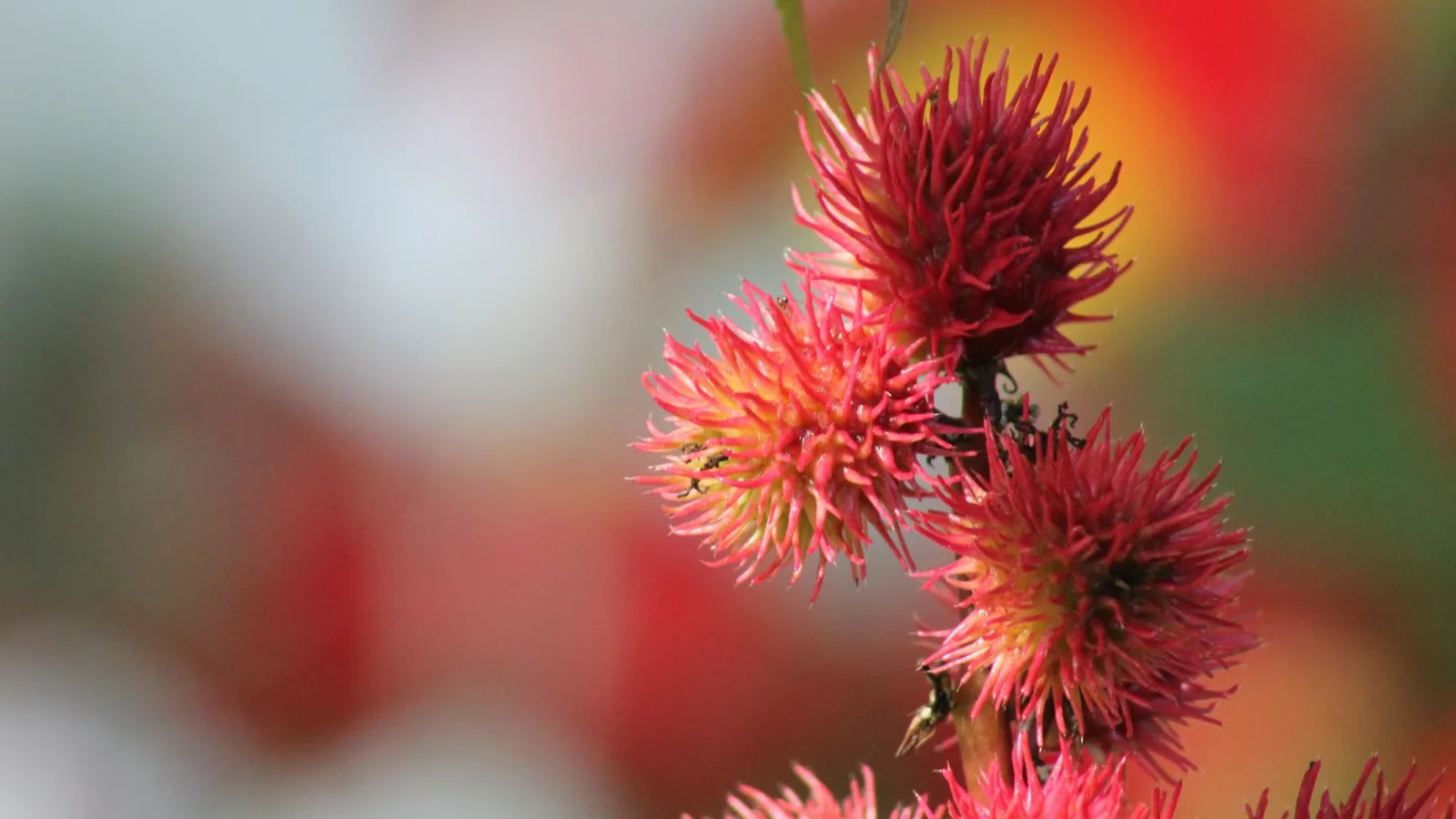
Castor Bean: Why the Seed, the Oil, and the Leaf Are Three Different Things
Castor bean gives you leaves you can cook and seeds you must never eat, and the pressed oil is a separate story from both. Here's how to tell the parts apart and handle the plant safely in a home garden.
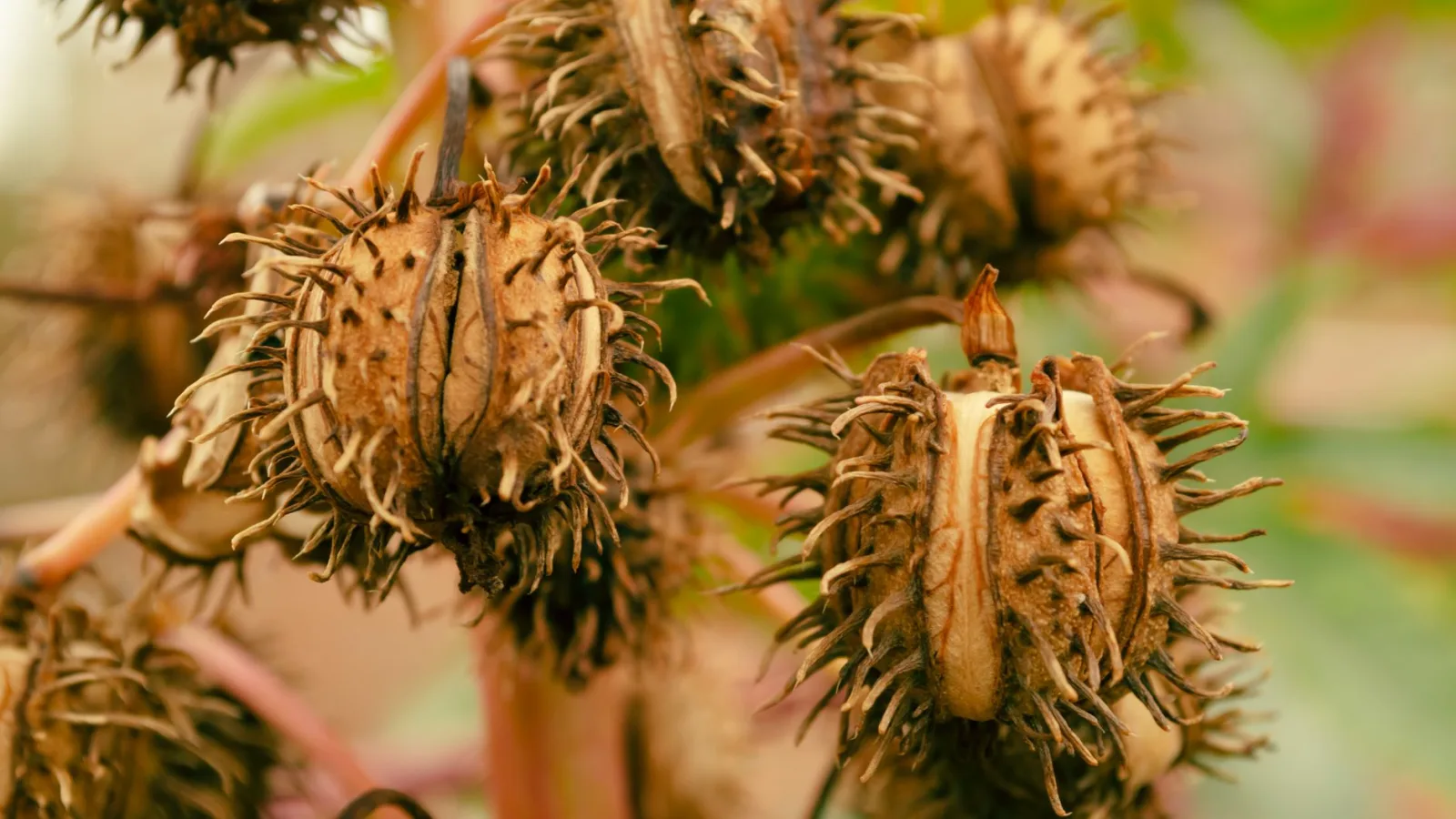
Castor Bean: Leave the Seeds, Take the Leaves — Bimaja in the *Dongui Bogam* and Today's Kitchen
Late summer is castor leaf season: the tender leaves can be blanched, rinsed, and dried for a winter's worth of namul. The seeds are a different story entirely — they never come into the kitchen.