- Type
- Grains
- Difficulty
- Easy
- Season
- Spring·Summer
- Sowing
- From seed
Buckwheat
Fagopyrum esculentum
Rutin — a grain harvested about two months from sowing
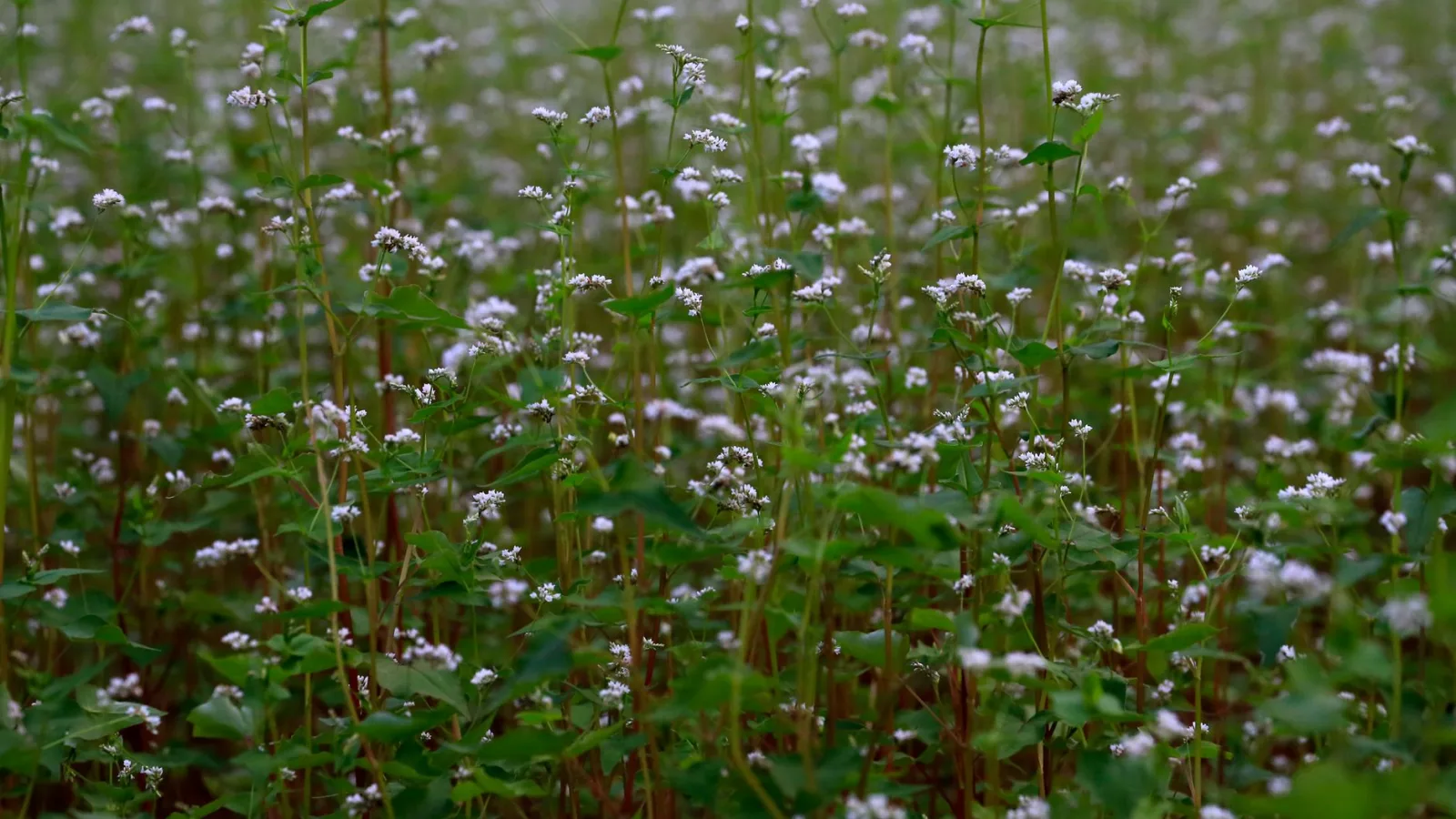
Buckwheat goes from seed to harvest in 60 to 80 days. It grows on poor soil, which is why it was traditionally sown late into ground where another crop had already failed, and its white late-summer flowers now earn it a place as an ornamental field crop. The Donguibogam lists it in the Grains section as 蕎麥, given in Korean as 'momil'. The text calls it neutral yet cold in nature, sweet in taste, and without toxicity, and it records two cautions: do not eat it with pork or mutton, and long continued eating brings dizziness. These are records from an old medical text and differ from modern medical judgment.
Year-Round Calendar
- 1
- 2
- 3
- 4
- 5
- 6
- 7
- 8
- 9
- 10
- 11
- 12
- 7
- 8
- 9
- 10
Where It Grows
-
Main producer
The world's largest producer. Cultivation centers on European Russia and western Siberia, including Altai and Bashkortostan. Harvest August, September
- 8
- 9
- Origin The mountains of Yunnan and Sichuan in the southwest are considered the crop's place of origin, and it remains among the top producers today. In the mountain areas, bitter buckwheat (Tartary buckwheat) is grown alongside it.
- Major producer Widely grown as a grain eaten as porridge.
- Major producer Grown to fit the short summers of the northern steppe.
- Major producer Grown in Brittany for galettes.
Originating in the mountains of southwestern China, it spread to the southern Himalayas and East Asia, and from there across northern Eurasia. Today Russia and China account for most of the world's production, and Japan, which uses large amounts for noodles, imports a substantial share of what it consumes. A short-season grain harvested 60–80 days after sowing, it has settled into cool high latitudes and mountain areas, and as a follow-up crop sown where another crop has failed.
- Optimum
- 17~23℃
- Range
- 10~30℃
- Hardiness
- Not hardy
- Day length
- Short-day
It ripens well in cool, sunny places. Buckwheat is a short-day plant, flowering earlier as the days shorten, though autumn-type varieties respond clearly to day length while summer types respond only weakly. If temperatures climb above 30℃ or drought sets in around flowering, the grains fail to fill, and since frost kills the plants outright, the crop is cut before the first light frost.
In Korea Nationwide
Jeju has the largest growing area, while Bongpyeong in Pyeongchang, Gangwon, is known for its buckwheat flowers. Since the sowing month is chosen so that flowering avoids the heat, the month differs from region to region.
- 3
- 4
- 8
- 9
- 6
- 7
- 11
- 6
- 7
- 9
- 10
- 7
- 8
- 9
- 10
How to grow
- Light
- Five hours or more a day. Good light brings better flowering
- Soil and depth
- Poor soil is fine as long as it drains. At least 15 cm deep. Rich soil produces leaf and little else
- Spacing
- Rows 30 cm apart, plants 10 cm apart. Broadcasting and then thinning also works
- Watering
- Keep it from drying until germination. After that, water only in a long dry spell
- Feeding
- Base fertilizer alone is enough. Extra nitrogen makes tall stems that fall over
- Harvest
- Cut when 70-80% of the seed has turned black. Cutting while the morning dew is on it loses fewer seeds
What makes the difference. Flowers set no seed if bees do not visit. Plant a block of several plants rather than a single one
Why this one is harder. Ripening is uneven, so a single plant carries both filled and unfilled seed. Wait for the last of it and the first-ripened seed shatters, which means picking the cutting date yourself
Common problems
- Aphids You will see Small insects mass on new shoots and flower stalks, and leaves curl What to do Wash them off with a jet of water; if they return, spray egg-yolk oil, covering leaf undersides
- Stink bugs You will see Puncture marks appear on filled seed and the grain comes out empty What to do Hand-pick them early in the morning. Clear surrounding weeds in advance
- Birds You will see Seed disappears from the tips of the heads as it fills What to do Net the plants once the seed starts turning black
This page describes how a crop is grown and used. It does not claim health effects for any food, nor is it intended to prevent or treat disease. Component and study notes are references only and do not mean the same result occurs in people. Consult a medical professional about health concerns.
Health Benefits
What the Donguibogam records. The Donguibogam lists buckwheat in the Grains section as 蕎麥, given in Korean as 'momil'. It calls the grain neutral yet cold in nature, sweet in taste, and without toxicity. It also leaves two cautions: not to eat it with pork or mutton, and that long continued eating brings dizziness. This is a record from an old medical text and differs from modern medical judgment.
Analyses of rutin content. Analyses have repeatedly reported rutin and other flavonoids in buckwheat groats and young shoots. Comparative work is well known for showing tartary buckwheat at rutin levels tens of times higher than common buckwheat. These are compositional findings and do not mean treatment or prevention of disease.
Analyses of protein composition. Analyses have reported that the amino acid profile of buckwheat protein carries a higher share of lysine than other grains. Because lysine is relatively scarce in rice and wheat, the finding is cited often in discussions of grain combinations. These are compositional findings and do not mean treatment or prevention of disease.
Nutrition
- Rutin (About 10-30 mg per 100 g in common buckwheat groats; tartary buckwheat is reported tens of times higher) — A flavonoid found in buckwheat
- Protein (Around 13 g per 100 g of flour) — High in lysine for a grain
- Dietary fiber (Around 10 g per 100 g of whole-groat flour) — Higher still when the hull is milled in
Rutin Buckwheat contains the flavonoid rutin. Common buckwheat groats are reported at about 10-30 mg per 100 g, while tartary buckwheat measures tens of times higher at the same weight. Rutin is slightly water-soluble and leaches into the noodle cooking water, which gives a compositional footing to the custom of drinking that water. Some analyses find higher levels in young shoots than in the groats.
Amino acid profile Buckwheat protein carries an unusually high share of lysine for a grain. Since lysine is the amino acid rice and wheat run short on, buckwheat is often described as the complement on a grain-heavy table. Its protein digestibility, however, is reported lower than that of wheat.
No gluten Buckwheat belongs to the knotweed family, not the grasses, so it has none of wheat's gluten. Dough made from buckwheat flour alone barely holds together, and pure buckwheat noodles break easily. That is why commercial buckwheat noodles usually contain wheat flour. Anyone avoiding wheat has to check the buckwheat percentage and the ingredient list.
Buckwheat is a declarable allergen Buckwheat sits on Korea's list of allergens that must be declared on an ingredient label. A few mouthfuls of noodles, or the small amount carried in a broth, have been reported to bring on hives, an itching mouth, vomiting or difficulty breathing, and cases of anaphylaxis are on record. The old text's line about the grain carrying no toxicity is a separate matter from allergy. This is why processed foods carry a separate 'contains buckwheat' declaration.
Pairings
○ Grated radish — Serving buckwheat noodles with grated radish is settled practice in both Japan and Gangwon Province. The radish's pungency and water cut through the heaviness buckwheat can leave. Grated radish loses its bite quickly, so grate it right before eating. Korean Radish (Mu)
○ Noodle water — There is a custom of drinking the water buckwheat noodles were boiled in rather than discarding it. Starch and compounds that leached out during cooking remain in it, making it a good substitute for broth. Stirring in a little leftover dipping sauce rounds off the meal.
○ Potato starch or wheat flour — Because buckwheat has no gluten, pure buckwheat dough tears. Adding 20-30% potato starch or wheat flour holds the dough together and makes it easier to roll. Rolling pure buckwheat instead calls for mixing with hot water so the starch is partly cooked first. Potato
△ Buckwheat allergy — small amounts count — Buckwheat is a declarable allergen, and very small amounts can bring on hives, an itching mouth, vomiting or difficulty breathing; anaphylaxis has been reported. Anyone who has ever reacted should avoid not only buckwheat noodles but buckwheat tea and processed foods containing buckwheat flour, and should ask about the broth and the noodle water when eating out. If breathing tightens or the face or throat begins to swell, call emergency services at once rather than waiting.
△ A child's first taste — Give a child a very small amount the first time. Starting no other new food on the same day is what makes it possible to tell what caused a reaction. Stay with the child for about two hours afterwards, and if buckwheat allergy runs in the family, speak to a doctor before the first taste.
△ Avoiding wheat — it may not be pure buckwheat — Most buckwheat noodles sold in shops contain wheat flour. What settles the question is the buckwheat percentage and the ingredient list on the back, not the name or the wording on the front. Since buckwheat flour alone barely holds a dough together, blending in wheat is the norm, so for anyone avoiding wheat the words 'buckwheat noodles' are not evidence of anything.
Varieties
- Yangjeol buckwheat — A Korean cultivar bred to be sown in both spring and autumn
- Landrace sweet buckwheat — The white-flowered type long grown around Bongpyeong
- Tartary buckwheat — Far higher in rutin than common buckwheat, and bitter to taste
- Buckwheat microgreens — Sown thickly and cut within about ten days
Source: Donguibogam, Grains section, 蕎麥 · Rural Development Administration (Nongsaro)