If you're prepping beds in mid-August for a fall crop of kohlrabi, there's usually a moment where you stop in front of the fertilizer bags. Urea, balanced blends, whatever the label says — that nitrogen was pulled out of thin air in a factory, literally. A greenhouse trial has now tested whether the stuff we flush away every day could take its place.
What the greenhouse kohlrabi showed
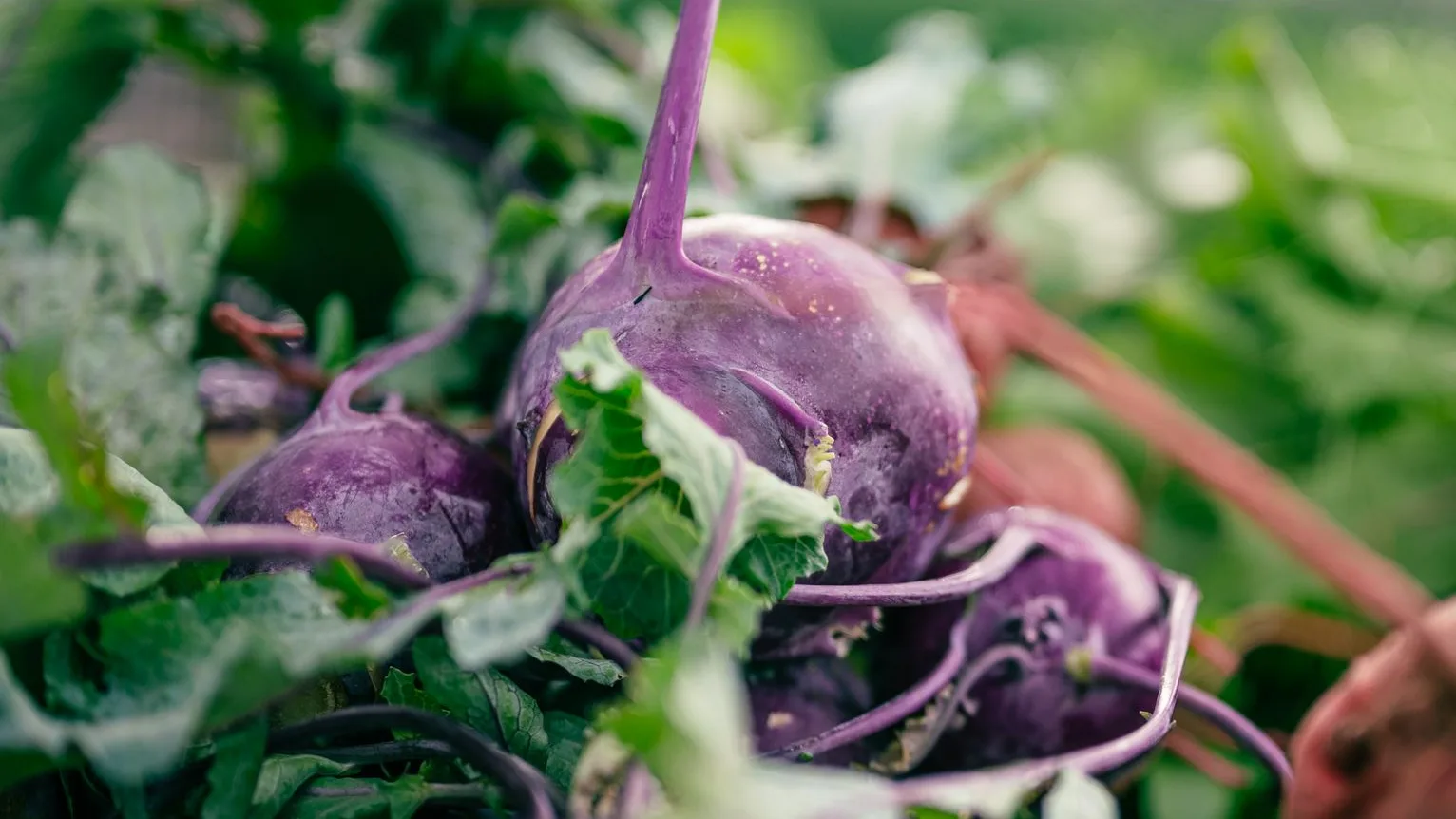
Researchers at the Leibniz Institute of Vegetable and Ornamental Crops in Germany grew kohlrabi in a greenhouse with temperature and water held steady. One group got standard mineral fertilizer. The other got a liquid fertilizer made by nitrifying human urine, plus compost made from fermented human feces. Nitrification is the step where microbes convert the ammonia in urine into nitrate. The smell drops off, and the nitrogen ends up in a form roots can take up right away.
The kohlrabi fed with urine-derived fertilizer came out comparable to the mineral-fertilized plants in both bulb size and nitrogen uptake. Nitrogen losses from the soil were similar between the two as well. In other words, you can cycle these nutrients back into the ground without giving up yield.
Factory-made nitrogen fertilizer runs on natural gas, so its price rises and falls with energy markets. Phosphate rock, the raw material behind phosphorus fertilizer, is concentrated in a handful of countries. That's the backdrop for the steady stream of European research into turning what leaves the bathroom back into something that feeds a crop.
Urine and feces do different jobs
Most of the nitrogen a person excretes leaves the body in urine. Feces carry more phosphorus and organic matter, which makes them useful for building up organic content in soil. Urine works as a nitrogen side-dressing; fecal compost works as a base dressing and a soil amendment. Compost alone releases nitrogen too slowly to cover what a plant needs during its hardest growth push. That's exactly why the trial used both together.
Kohlrabi belongs to the brassica family, alongside cabbage and napa cabbage, and it's a fairly hungry feeder — it has to swell a bulb in a short window. Too little nitrogen and the bulb stalls partway. Too much and you get a leafy plant with a bulb that takes its time. That responsiveness is part of why kohlrabi made a good test crop in the first place.
How far to take this in your own garden
The fertilizers in the trial were sanitized and lab-analyzed first. That's a different thing from pouring what's in your bathroom straight onto a garden bed. Pharmaceutical residues and pathogens are still open questions, so applying it directly to leafy greens you plan to eat raw isn't something to try.
Start instead with what's already within reach today. Mix vegetable scraps from the kitchen with dry leaves or rice hulls and let the pile stabilize — for getting phosphorus and organic matter into your soil, that's plenty. Finished compost smells like soil, shows no recognizable trace of what went into it, and sits at roughly the same temperature as the air around it. Once it hits those marks, work it in as a base dressing for kohlrabi.
Fall kohlrabi goes in between mid-August and early September, and if you harvest when the bulbs reach about 7–8 cm across (roughly 3 inches), they stay tender rather than woody. So today, give the compost pile a turn. That's what makes it ready to go into the kohlrabi bed three weeks from now.
Source · Greenhouse kohlrabi trial by Karoline Gangloff, Stefan Karlowsky, and colleagues at the Leibniz Institute of Vegetable and Ornamental Crops, Germany, published in Frontiers in Environmental Science