- Type
- Roots & Stems
- Difficulty
- Easy
- Season
- Spring·Fall
- Sowing
- Transplant
Kohlrabi
Brassica oleracea
Vitamin C, few calories, and a stem that swells above the ground
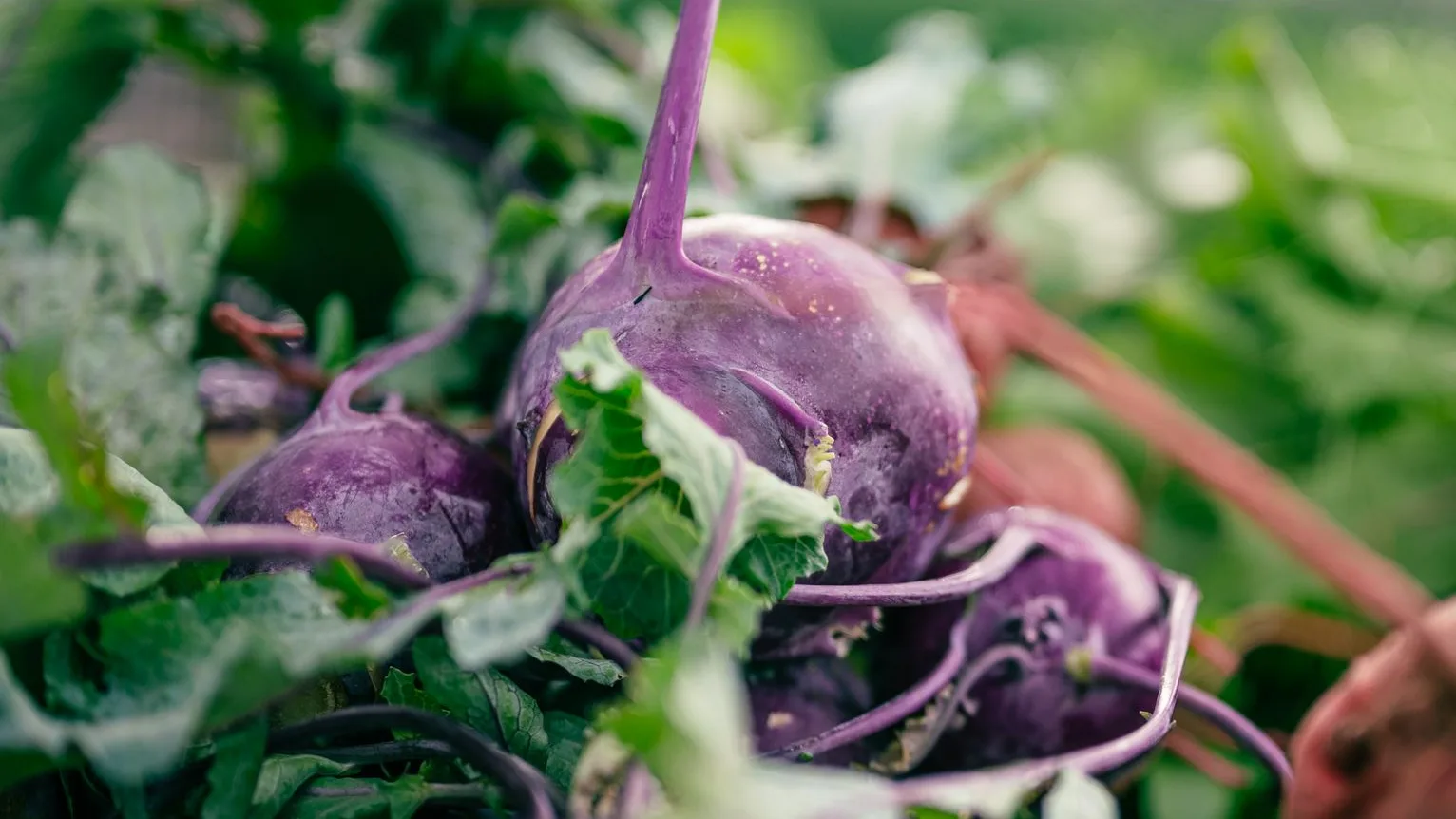
Kohlrabi looks like a root vegetable, but the part eaten is a stem that swells above the soil line. It combines the look of cabbage and turnip, is high in vitamin C and low in calories. Crunchy with a mild sweetness, it can be peeled thickly and eaten raw or tossed into a salad, and it also carries dietary fiber and potassium. It grows best in the cool weather of spring and fall; pull the plant once the swollen stem is about 7-8 cm across, before it grows tough.
Year-Round Calendar
- 1
- 2
- 3
- 4
- 5
- 6
- 7
- 8
- 9
- 10
- 11
- 12
- 3
- 8
- 6
- 11
Where It Grows
- Main producer Accounts for close to half of world production.
- Major producer Grown as a winter vegetable in Punjab, Uttar Pradesh and Kashmir.
- Major producer More than half of Europe's kohlrabi area is in Germany, centred on North Rhine-Westphalia, Rhineland-Palatinate and Lower Saxony.
Kohlrabi is a variety of cabbage (Brassica oleracea) that split off in northern Europe after the Middle Ages. Because its origin cannot be pinned to any single country, no place-of-origin row has been given here. Within Europe, Germany leads on both consumption and cultivation, but Asia is ahead on production volume itself. The FAO does not count kohlrabi separately, folding it in with cabbages, so the rankings are approximate.
- Optimum
- 15~20℃
- Range
- 5~25℃
- Hardiness
- Half-hardy
Kohlrabi likes cool weather. Above 25℃ the bulb stops swelling and the core turns tough and fibrous. If young seedlings sit through low temperatures for a long stretch, the plant runs to seed and throws up a flower stalk before the bulb has thickened.
In Korea Nationwide
- 8
- 9
- 1
- 2
- 12
- 3
- 8
- 6
- 11
How to grow
- Light
- Somewhere sunny
- Soil and depth
- 25cm deep
- Spacing
- 25cm
- Watering
- Steady. Dry-then-wet makes it split
- Feeding
- Base dressing plus one feed
- Harvest
- At 7 to 8cm across. Bigger means woody
What makes the difference. It is not a root crop. The swollen stem sitting on top of the soil is exactly right
Common problems
- Flea beetles You will see Small holes in the leaves What to do Fleece while young
This page describes how a crop is grown and used. It does not claim health effects for any food, nor is it intended to prevent or treat disease. Component and study notes are references only and do not mean the same result occurs in people. Consult a medical professional about health concerns.
Health Benefits
Glucosinolate composition. Kohlrabi (Brassica oleracea var. gongylodes) is a variety within the same species as broccoli and cauliflower, and it contains glucosinolates such as glucoraphanin and erucin. When the tissue is crushed, the enzyme myrosinase breaks these down into isothiocyanates. That is as far as the compositional analysis goes.
Breakdown products differ by plant part. An analysis of hydrolysis products by plant part found isothiocyanates dominant in the leaves and stems, and nitriles dominant in the swollen bulb. Which part is eaten, and how it is cooked, changes the mix of breakdown products.
Where it sits in cruciferous dietary research. Observational research continues to track how much cruciferous vegetables people eat alongside various health indicators. Such studies look at an overall dietary pattern rather than at kohlrabi on its own, and they have no bearing on preventing or treating any disease.
No standalone trial of kohlrabi. No randomized controlled trial of kohlrabi on its own has been identified. In human research it appears only as one cruciferous vegetable among several, so what can be said today stops at its composition.
Nutrition profile. Kohlrabi is reported to contain about 62 mg of vitamin C per 100 g, high among vegetables, and it also carries dietary fiber and potassium. At roughly 27 kcal per 100 g it is low in calories.
Nutrition
- Vitamin C (abundant (about 62 mg/100 g)) — water-soluble vitamin, sensitive to heat
- Dietary fiber (abundant) — a carbohydrate that is not digested
- Potassium (present) — a mineral common in vegetables
Glucosinolates & isothiocyanates Kohlrabi contains glucosinolates, the sulfur compounds common to brassica crops, which myrosinase enzymes break down into isothiocyanates. The slightly bitter, pungent flavor characteristic of cabbage-family vegetables comes from these breakdown products.
Vitamin C About 62 mg of vitamin C per 100 g places kohlrabi near the top among vegetables. Vitamin C is heat-sensitive and is best preserved when kohlrabi is eaten raw, and one small bulb covers a substantial share of the daily reference intake.
Vitamin K, B6, folate, potassium, calcium & dietary fiber Vitamin K and B6, folate, potassium, calcium and dietary fiber are all present in balance. Rather than standing out for a single nutrient, kohlrabi spreads many micronutrients evenly across its profile.
Flavonoids (quercetin & kaempferol) Flavonoids such as quercetin and kaempferol are present. They are known to show antioxidant activity under laboratory conditions; what follows when a person eats the vegetable is a separate question.
Indole-3-carbinol (I3C) & diindolylmethane (DIM) Indole-3-carbinol (I3C), common to the cabbage family, and its metabolite diindolylmethane (DIM) are both present. Research on these compounds continues in connection with estrogen metabolism.
Low in calories At roughly 27 kcal per 100 g, kohlrabi is a low-calorie vegetable. Its water and fiber content mean it carries little caloric load for its bulk.
Pairings
○ Apple and carrot — Julienned kohlrabi tossed with apple and carrot makes a coleslaw-style salad. All three are rich in vitamin C, so they work in synergy, and the crisp texture and natural sweetness come together in a satisfying light dish. Carrot
○ Olive oil and lemon — Thinly sliced kohlrabi dressed with olive oil and a squeeze of lemon is the simplest salad you can make. The lemon's acidity smooths out kohlrabi's faint bitterness, while the fat in olive oil helps your body absorb fat-soluble nutrients.
○ Yogurt and cheese — Eaten with yogurt or cheese, kohlrabi gains the protein and calcium it otherwise lacks. Using a yogurt dressing as a dip lets you keep the vegetable's natural flavor while rounding out the nutritional balance.
○ Meat — Kohlrabi-muchim (a seasoned salad) or kohlrabi kimchi are Korean-style takes that pair well alongside meat dishes. The spicy seasoning cuts through the richness of the meat, while kohlrabi's crisp texture refreshes the palate.
○ Garlic and vinegar — Pickled with garlic and vinegar, kohlrabi becomes jangajji, a Korean-style preserved side dish. It keeps well for long storage, and the allicin in garlic along with the tang of vinegar elevate the vegetable's flavor a notch. Garlic
△ Thyroid conditions and blood thinners — Like other cruciferous vegetables, kohlrabi contains glucosinolates that can partially interfere with thyroid hormone production when eaten in large amounts, and its abundant vitamin K can affect anticoagulant medications. Normal dietary amounts are fine, but if you have hypothyroidism or take warfarin, keep your intake consistent.
△ Kidney failure — Kohlrabi is relatively high in potassium, so people with kidney failure should limit it. When the kidneys can't clear potassium properly, it builds up in the body and raises the risk of complications, including irregular heart rhythms.
Varieties
- Green kohlrabi (Seedling transplanting) — Light green skin over white flesh, with a thin peel that is easy to pare for eating raw.
- Purple kohlrabi (Seedling transplanting) — Deep purple skin stands out in the bed, and the thicker peel has to be cut away generously.
Source: Food and Nutrition Information