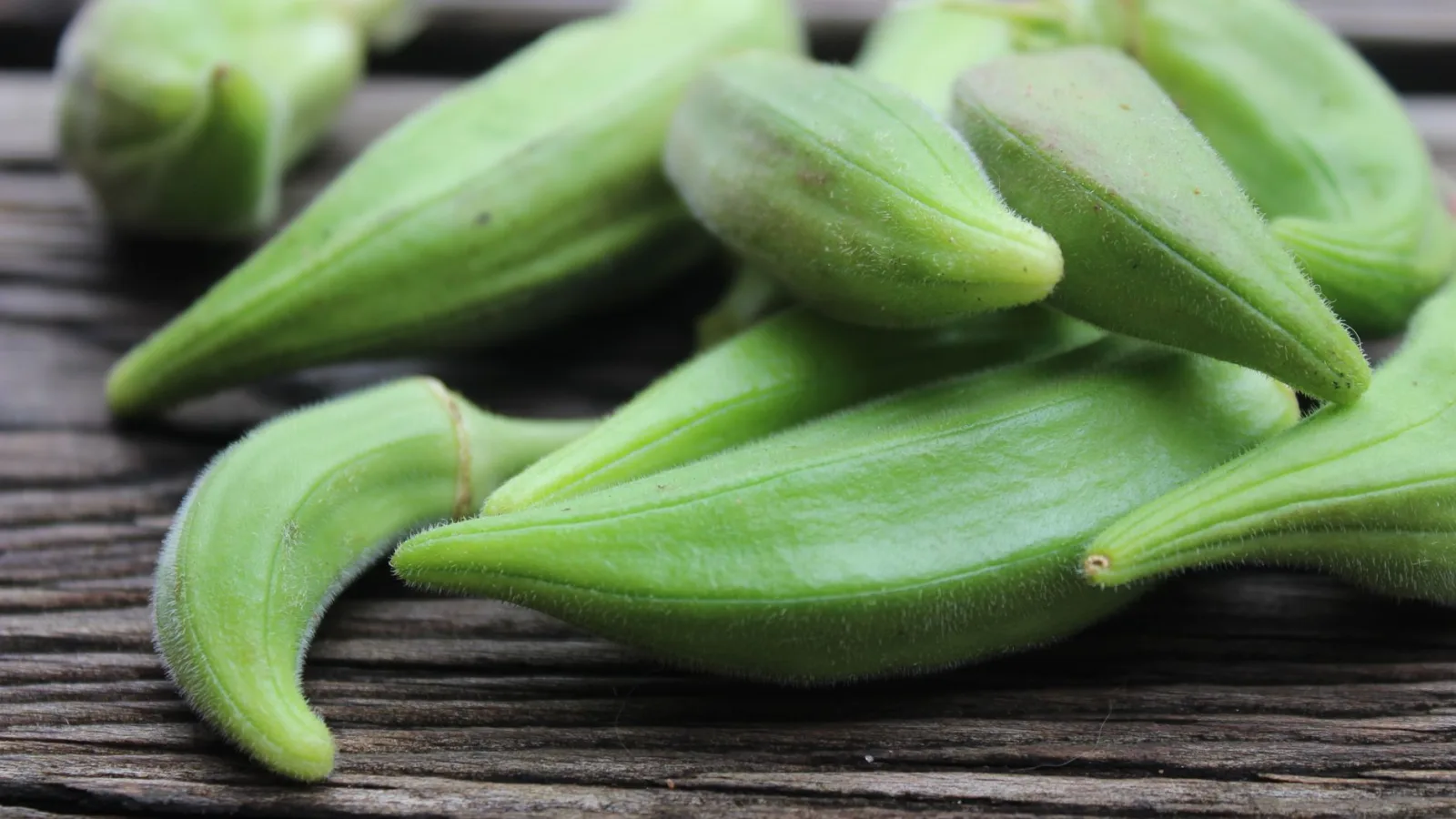
Meeting Okra in the Garden
Have you ever tucked a single okra plant into a corner of your summer garden? A yellow flower opens first, looking very much like a rose of Sharon, and once it fades a pod rises in its place — shaped like a green chile, pointing straight up at the sky, with a perfect star at its cross section. Pick one while it's still no longer than your finger, slice it into thin rounds, and a slick, glossy juice seeps out of every cut. That stickiness is what divides people into fans and skeptics, and it's fair to say that the whole character of okra (Abelmoschus esculentus) lives right there in the mucilage.
Okra is an African native and a member of the mallow family. It arrived at Korean tables fairly recently, so quite a few of you have probably met it in your own garden before you ever saw it at the market.
What Does the Donguibogam Say?
Here I have to be straight with you. Okra appears nowhere in Korea's classical medical literature. When the Donguibogam — the great seventeenth-century Korean medical compendium — was being compiled, this vegetable had simply not reached the peninsula yet. So to write "the Donguibogam regarded okra as a remedy for such-and-such" would be to invent a story that was never told.
Rather than dragging in an old remedy that doesn't exist, then, let's look at okra through the lens the Donguibogam used for vegetables. The old texts sorted foods by their nature: warming or cooling, slippery or drying. Borrow that yardstick, and okra's clearest trait is obvious — the slick mucilage that flows the moment you cut it. Korean tradition placed slippery vegetables like curled mallow (auk) and Korean yam (ma) in the category of foods that soothe and smooth the digestive tract, and okra would slot into that group quite naturally. But let me be clear that this is inference on our part, not something the Donguibogam ever recorded.
Set Against Today's Nutrition Science
Since the old records are silent, the honest way to understand okra is through modern nutrition. That slippery substance is made of mucin and pectin — soluble fiber, the kind that dissolves in water. Soluble fiber comes up constantly in discussions of gut health, and it's often mentioned alongside the way a meal's blood-sugar rise can be blunted rather than spiked.
There's something quietly resonant here: the old physicians who saw slippery vegetables as smoothing the insides, and today's researchers who describe soluble fiber as easing the flow of digestion, are looking at the same slick substance. Only the vocabulary has changed.
One caution, though. Claims that okra treats a particular illness still don't have much in the way of solid human research behind them. So rather than expecting it to work like medicine, the right frame is simpler: a good, fiber-rich vegetable worth bringing to the table.
From Garden to Table
Okra asks very little of a gardener. The pods are tender when young and turn woody as they grow, so harvest them while they're about finger length.
Cooking it is just as simple. Blanch the pods briefly in boiling water and dress them with soy sauce or doenjang (fermented soybean paste) — the sliminess softens into something silky on the tongue. Slice them into rounds and drop them into a soup or stew, and the broth thickens on its own. If the stickiness puts you off, try roasting the pods whole: a quick turn in a hot pan with a little oil cuts the mucilage and brings out a toasty, nutty flavor. Blanched okra topped with katsuobushi (dried bonito flakes), the Japanese way, is another dish that suits a summer appetite well.
There's no real reason to avoid okra, but if the slippery texture feels like too much, cooking it down is an easy fix. A plate of okra picked fresh from the garden makes a summer meal feel generous.