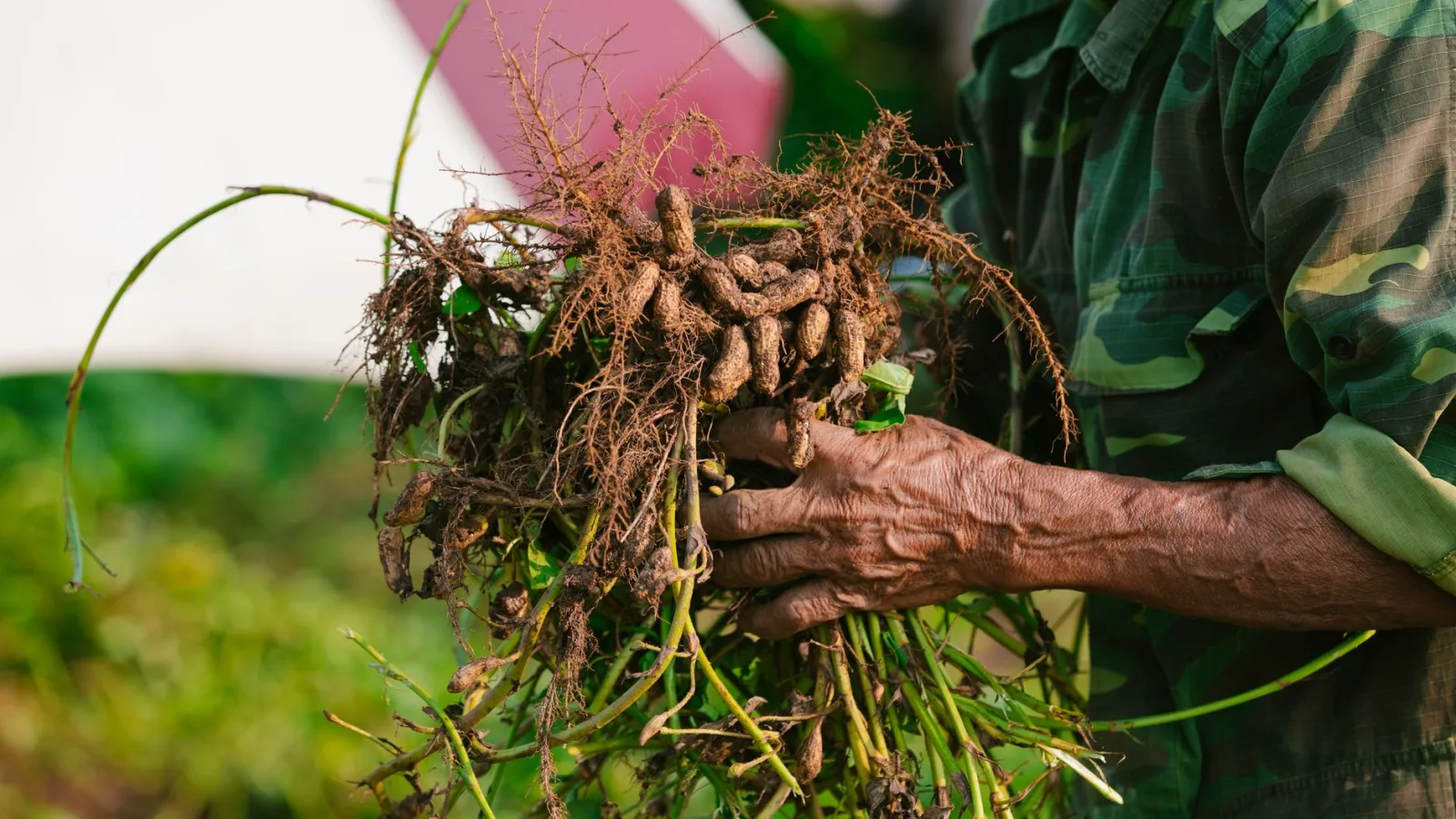
In a Corner of Your Garden
Peanuts do something no other crop in your garden does. Once the flower fades, the stalk bends down and burrows into the soil, and the pod forms underground. That is how the plant got its old East Asian name, nakhwasaeng (落花生)—literally "born of a fallen flower." You watch the yellow blossoms all summer, and then in autumn you pull up the whole plant and the pods come up with it, clustered along the roots like beads on a string. Anyone who has grown peanuts themselves knows that smell of turned earth, and it stays with you.
Roasted by the handful or boiled until soft and chewy, peanuts have never been far from the Korean table—part snack, part side dish. They show up on holiday spreads, next to a glass of soju, and in every child's lunchbox. Few foods have worked their way so thoroughly into daily life. And yet the more familiar a crop becomes, the less often we stop to consider what it actually does in the body. So let's look at how the old medical texts understood this very familiar nut.
What Dongui Bogam Saw
Korean herbal tradition described nakhwasaeng (落花生)—the peanut—as sweet in flavor and neutral in nature. "Neutral" means neither warming nor cooling, which makes it a food most people can eat without much need to weigh their constitution first. And sweetness has long been considered the flavor that comforts the biwi (脾胃), the spleen-and-stomach system, so the peanut's nature and its uses line up naturally.
Two main uses come down to us. The first is strengthening the biwi (脾胃) to support digestion. The second is softening the lungs to ease a dry cough and loosen phlegm. Think of the biwi as the household kitchen of the body—the place where food is taken in, broken down, and turned into usable energy. Peanuts were used as a nourishing food to restore strength when the stomach felt empty and appetite had gone, and as something to moisten the lungs when the throat turned scratchy and a dry cough set in. Filling you up on one side, softening and moistening on the other: the old texts saw both of these qualities packed into a single peanut.
One thing is worth adding, though. Peanuts are native to South America and arrived in East Asia relatively late. As a result, the older classical medical texts have little to say about them. The old physicians didn't write at length about peanuts—not because they found little benefit in them, but simply because the two met so late in the story.
Alongside Modern Nutrition
What the old texts saw as a nourishing food that supports digestion and softens the lungs, modern nutrition describes in an entirely different vocabulary.
Peanuts are high in unsaturated fats such as oleic and linoleic acid, and rich in vitamin E and plant protein. That profile is why research on nut consumption and cardiovascular health keeps coming. The old view—"a nourishing food that restores your strength"—and today's version—"a nut full of good fats and protein"—use different words, but they seem to meet at a single point.
None of which means the research on nuts guarantees any particular outcome. Take it simply as this: the old records and the modern view don't contradict each other, and they sit comfortably side by side. One point does need to be said plainly, however. Peanuts are one of the most common food allergens there is. Depending on your constitution, even a small amount can trigger a reaction—and that is not something to brush aside.
From the Garden to the Table
Peanuts you've harvested yourself will keep for a long while if you brush off the soil and dry them thoroughly. Roasting brings out the toasty richness; boiling gives you a softer, sweeter bite. On days when you want something that fills you up—just as the old texts described—a handful alongside your meal does the job nicely.
For the change of seasons, when the throat turns scratchy and a dry cough starts up, there's an old practice of simmering peanuts gently into a porridge or soup. Ground fine and cooked down with rice, a bowl of peanut porridge goes down easily even on days when nothing else appeals—which suits both traditions at once: the one that says peanuts steady the digestion, and the one that says they moisten the lungs. Because they're an oily nut, though, your stomach will thank you for eating them in small amounts spread out rather than a large portion at once. And peanuts that have gone soft and stale or picked up an off smell are worth throwing out without a second thought.
Finally, for young children or anyone concerned about allergies, start with a very small amount and watch carefully. May the peanuts you've grown and gathered with your own hands make many a satisfying meal at your table.