On the morning after the first frost, the outer leaves of the napa cabbage have frozen to a glassy translucence. This year's harvest is nearly all in, and about the only job left is pulling the last of the radishes. On evenings like this, a chunk of pork ends up in the pot. As I fill the spice bag that goes in with it, one small seed lands in my hand. It is about the size of a longan pit, pointed at one end, with a smooth shell. This is Katsumada cardamom, known in Korean as chodugu.
The Donguibogam Calls It Hot and Pungent, With a Husk That Has No Scales
The Donguibogam, Korea's 1613 medical compendium, lists this seed in the herb chapter (草部) of its materia medica under the name chodugu (草豆蔲). A Tang (唐) mark beside the name flags it as an ingredient once imported from China. The book calls its nature hot and its flavor pungent, and says it carries no toxicity. In shape it resembles a longan pit but comes to a point, its husk bears no scales (皮無鱗甲), and the seeds inside are packed like pomegranate arils. The buying standard is a single line: the sharper and stronger the bite, the better the grade. The preparation instructions are more specific. Wrap the seed in a flour-and-water dough, bury it in hot ashes to cook, then peel away the dough and use only the seed. In the framework of the old medical texts, a "hot" nature meant an ingredient that warms the body. Because this is a historical record, we don't place it on the same footing as what modern medicine says about how the seed acts. The original passage and a commentary are available in the Katsumada cardamom entry of Homiclub's Donguibogam guide.
The Husk Is Also How You Tell It From Green Cardamom
Ask for Katsumada cardamom at a spice shop and you'll find it sharing a shelf with green cardamom, white cardamom, and nutmeg. In Korean, all four names share the syllable "dugu," but the plants are all different. Green cardamom, the one most people simply call cardamom, is the green pod of the genus Elettaria. Nutmeg isn't even in the ginger family. Katsumada cardamom belongs to the ginger family, genus Alpinia, and its botanical name is Alpinia katsumadai. When you're sorting them by eye, the Donguibogam's note that "the husk has no scales" is as useful as ever. A green cardamom pod has distinct ridges running lengthwise. Katsumada cardamom has no ridges, just a smooth brown shell holding a cluster of seeds. It's a rare case where a line from a four-hundred-year-old text serves as a shopping guide today.
What Modern Analysis Has Found in the Seed
Katsumada cardamom is also listed in the Chinese Pharmacopoeia, under the name Alpiniae Katsumadai Semen. Several studies have analyzed the seed's chemistry. Beginning with a 1983 report in Chemical and Pharmaceutical Bulletin from a Japanese team led by Masanori Kuroyanagi, analyses have repeatedly isolated cardamonin and alpinetin from the seed. Cardamonin belongs to the chalcone family and alpinetin to the flavanones, and alpinetin takes its name from the genus Alpinia. In the essential oil, cineole has been identified. It's the volatile compound best known as the main component of eucalyptus leaf oil, and it is the main source of Katsumada cardamom's sharp aroma. That's as far as the analysis of composition goes. What these compounds do in the body has mostly been studied in cells and in animals, so the Homiclub crop guide does not publish efficacy figures.
There are points where the old record and the new one overlap. The rule that sharper and stronger is better points in the same direction as choosing seeds that still hold plenty of essential oil. Stale seed that has lost its fragrance was marked down by the old authors just as it is today. There are also points where they part ways. The Donguibogam explained this seed through a "hot" nature. Modern analysis explains it through the names of compounds. The two accounts can't be swapped for one another.
In a Korean Garden, It's a Seed You Buy, Not One You Grow
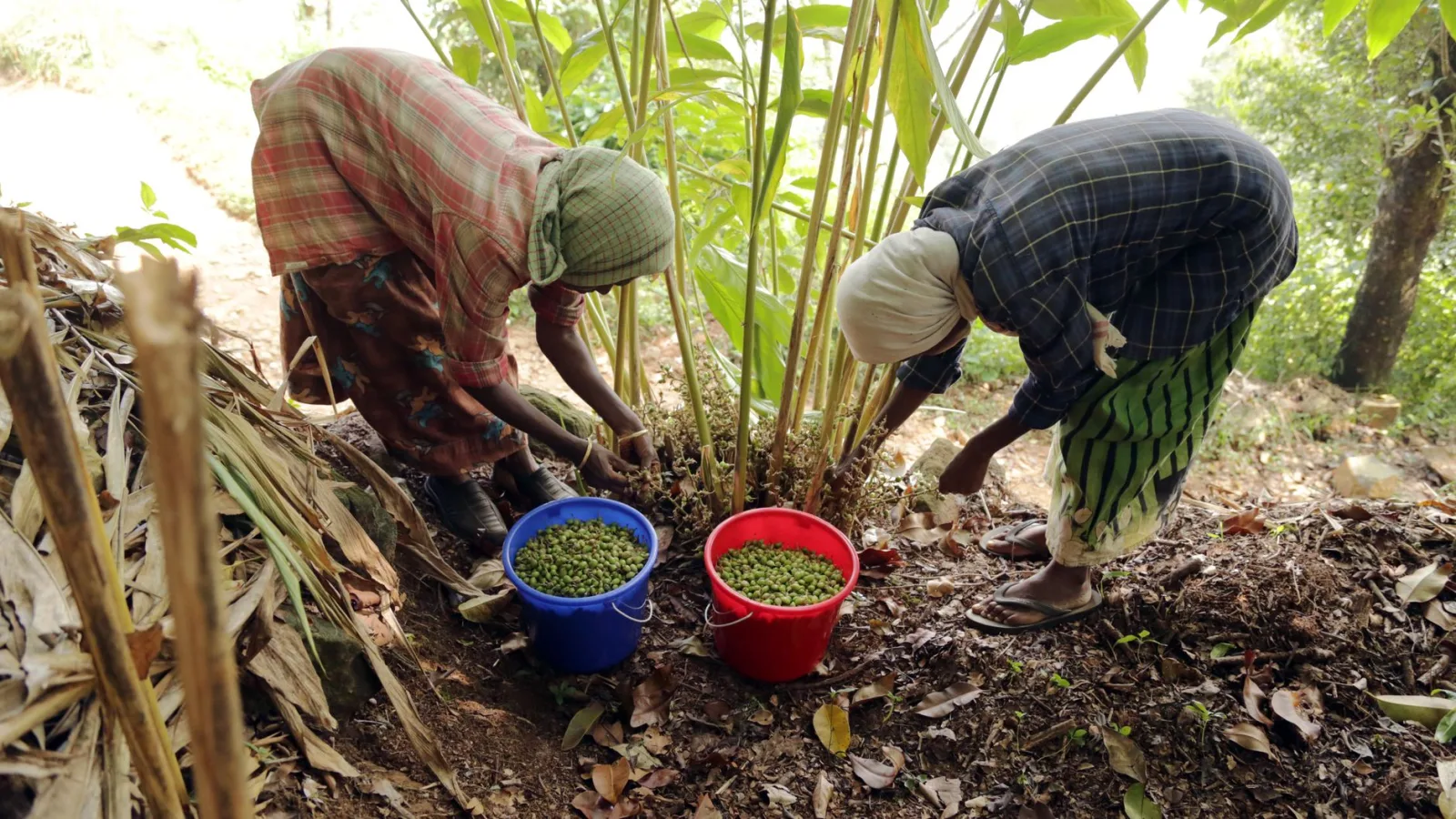
Katsumada cardamom is a perennial in the ginger family, grown mainly in southern China, in Guangdong, Guangxi, and Hainan. Frost kills it, so it won't survive a winter outdoors in Korea, and the planting and harvest calendar for it in the Homiclub crop guide is blank. The realistic approach is to grow ginger, its relative in the same family, in your garden plot and buy Katsumada cardamom as dried seed. When shopping, check that the shell is smooth and that a sharp fragrance rises the moment you crack one open by hand. Its components and what it pairs well with are summarized in the crop guide's Katsumada cardamom entry.
Try it in suyuk, Korean boiled pork, or in jangjorim, soy-braised meat. For 1 kg of pork, measure out 2 L of water. Press 2 whole Katsumada cardamom seeds with the flat of a knife, just enough to crack the shell, and put them in a muslin bag with 1 star anise and a 5 cm piece of cinnamon bark. Add 20 g of ginger and the white bottoms of 2 large scallions from the start, and simmer over low heat for 60 minutes. Salt only after the meat is cooked, and lift the bag out along with the pork. The gaminess of the pork softens and the aroma gains layers. There's a separate way to use it as a finishing spice. Crush the kernels from inside the seed and sprinkle them over the cooked meat, only as much as sits on the tip of a knife, never more than a pinch. The fragrance flies off with long cooking, so this is where it comes through most clearly.
The old method, wrapping the seed in dough and burying it in hot ashes, and today's method of tying it in a muslin bag and dropping it in the pot do much the same work. They hold a strong fragrance inside a single layer, then remove that layer when the job is done. The dough was peeled off and thrown away. The bag gets lifted out. In the simmering pot, neither era puts the seed itself on the plate. The pinch of crushed seed sprinkled at the end is a use that came later.