- Type
- Grains
- Difficulty
- Hard
- Season
- Spring·Summer
- Sowing
- From seed
Rice
Oryza sativa
Starch and bran oryzanol · a paddy in a water tub
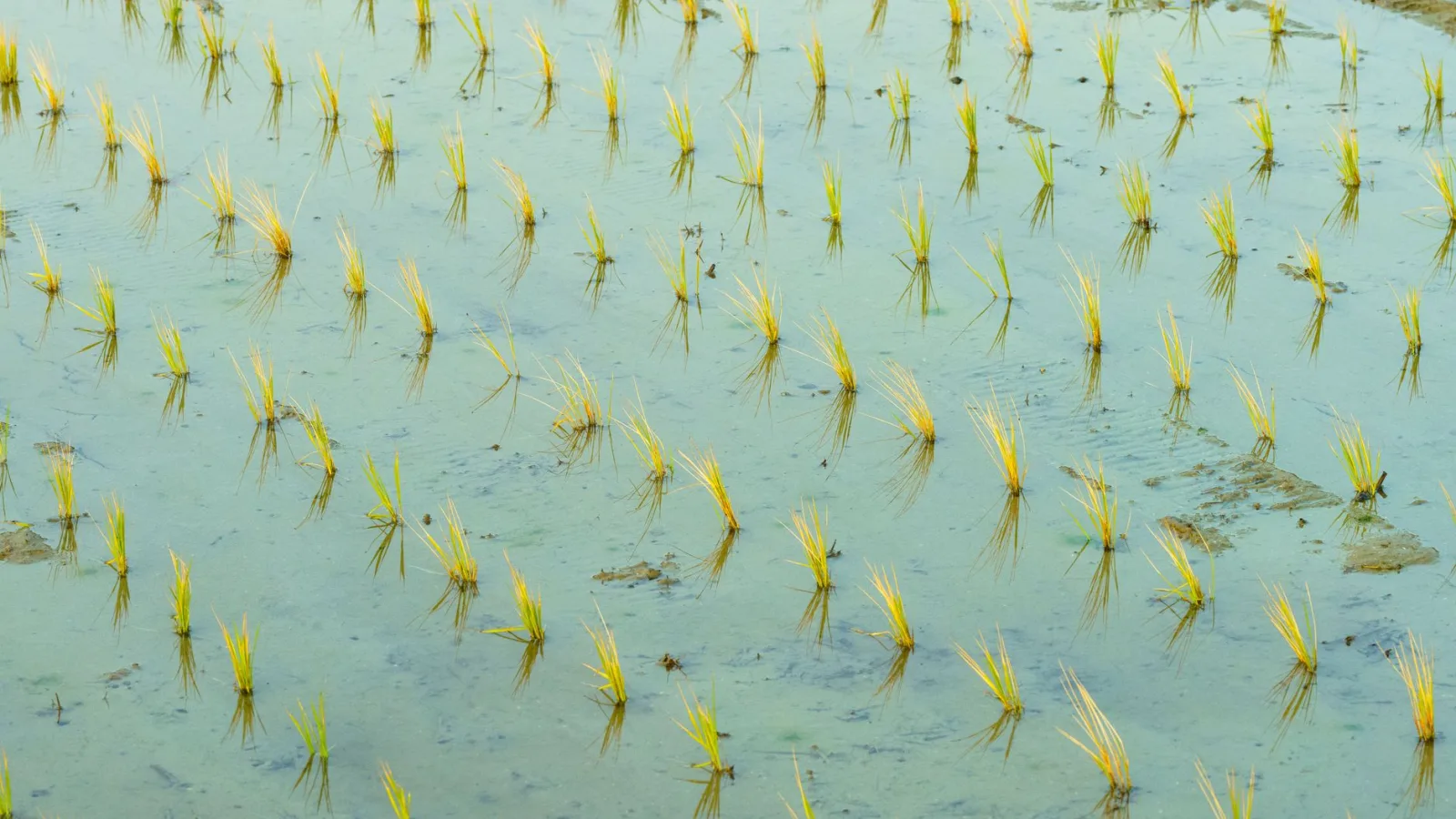
Rice is an annual cereal grown in flooded fields, and the hulled grain is what reaches the table. In a city, one or two plants can be raised in a large rubber tub or glazed jar kept full of water — a container paddy. The Donguibogam lists it in the Grains section as 粳米 (gaengmi), noting a neutral nature, a sweet and bitter taste, and no toxicity. It reads the character 粳 as hard, marking the non-glutinous grain against sticky rice, and rates late-season white rice highest, saying grain harvested after the first frost is best. A single plant yields less than one bowl of rice, but it lets you watch five months from transplanting to harvest at close range.
Year-Round Calendar
- 1
- 2
- 3
- 4
- 5
- 6
- 7
- 8
- 9
- 10
- 11
- 12
- 4
- 5
- 9
- 10
Where It Grows
-
Origin
The Yangtze basin, where cultivated rice was domesticated, is its native ground, and it still produces more than anywhere else in the world. South of the Yangtze, two crops a year are planted. Harvest September, October
- 9
- 10
-
Main producer
Production ranks second after China, and exports are the largest in the world. The kharif crop, planted in the rainy season, is the mainstay. Harvest October, November, December
- 10
- 11
- 12
- Main producer The irrigated paddies of Java are the centre, and with two or three plantings a year the harvest times are spread out.
-
Main producer
Most of the country is paddy land, divided into the rainy-season crop (aman) and the dry-season irrigated crop (boro). Harvest April, May, November, December
- 4
- 5
- 11
- 12
- Major producer In the Mekong Delta, two or three plantings a year mean harvesting goes on effectively year-round, so it is hard to pin the harvest to a few set months.
-
Major producer
The rainy-season crop on the central plain is the mainstay, and exports of aromatic rice are large. Harvest November, December
- 11
- 12
Cultivated rice splits into the japonica line, domesticated in the Yangtze basin, and the indica line, which diverged in South and Southeast Asia — so it has more than one place of origin. Close to nine-tenths of today's production is concentrated in the Asian monsoon belt, and the growing regions are precisely where irrigable plains coincide with the summer rains. Korea, Japan and northern China grow mainly japonica; South and Southeast Asia grow mainly indica.
- Optimum
- 25~30℃
- Range
- 15~35℃
- Hardiness
- Not hardy
- Day length
- Short-day
Rice is an annual that wants warmth and plenty of water. Soil must be above 13℃ for the seed to germinate, and days of 25–30℃ suit it through the growing season. If temperatures stay below 17℃ for several days around heading, the grains fail to fill; above 35℃, empty husks increase. It is a short-day plant that heads as the days shorten, though temperate varieties have been bred to respond only weakly to this.
In Korea Nationwide
Seed is sown in the seedbed in April–May, the seedlings are transplanted in May–June, and the crop is cut in September–October. In the south, double cropping (two crops from the same field in one year) — transplanting in June after the barley or wheat has been taken in — is a long-established practice, so planting and harvest both run about a month later. The broad plains of South Chungcheong, North Jeolla and South Jeolla are the growing regions.
- 4
- 9
- 10
- 5
- 10
How to grow
- Light
- Six hours or more of direct sun. Too little light and the heads never fill
- Soil and depth
- Paddy soil or heavy clay that holds water. Put at least 15 cm of it in a watertight container
- Spacing
- Two or three plants in a 40 cm tub, at least 20 cm apart
- Watering
- Keep 3 to 5 cm of standing water over the soil. Lower it after heading and drain two weeks before harvest
- Feeding
- Mix base fertilizer into the soil, then top-dress once about 25 days before heading
- Harvest
- Cut when about 90 percent of the grains have turned gold. Dry the whole heads for two weeks, then thresh
What makes the difference. If mosquito larvae appear in the tub, add a couple of loaches. They keep the water clean and eat the larvae
Why this one is harder. Water management. The smaller the tub, the faster it runs dry, and in midsummer shallow water heats enough to damage roots. Put the tub where it gets afternoon shade and top it up each morning
Common problems
- Brown planthopper You will see Small insects massing at the base of leaf sheaths; the plant browns and collapses What to do Check the base of the stems often and, early on, wash them off or use an approved organic product
- Rice stem borer You will see Hollow stems and heads that stand white and dry What to do Pull and destroy affected stems, and do not leave rice straw standing through winter
- Sparrows You will see Ripe heads stripped, with empty sockets where grain sat What to do Net the tub once the heads emerge and hang reflective tape nearby
This page describes how a crop is grown and used. It does not claim health effects for any food, nor is it intended to prevent or treat disease. Component and study notes are references only and do not mean the same result occurs in people. Consult a medical professional about health concerns.
Health Benefits
The Donguibogam record. The Donguibogam lists rice in the Grains section as 粳米 (gaengmi). Its nature is described as neutral, its taste as sweet and bitter, and it is recorded as carrying no toxicity. The character 粳 is glossed as hard, marking it against sticky rice; late-season white rice is rated highest, grain gathered after frost is called best, and the text says to cook it thoroughly as rice or porridge rather than leave it underdone. Rice long kept in a granary appears separately as 陳廩米, with a warning that it is cold in nature and brings on loose stools if eaten often, aged meaning grain kept three to five years. This is an old medical record and differs from modern medical judgment.
GABA in germinated brown rice. Several studies have reported that germinating brown rice raises its GABA content above that of white or ordinary brown rice. The same reports note wide variation depending on germination temperature and duration.
Milling degree and post-meal glucose. Studies have reported that rice milled less produced a gentler rise in post-meal blood glucose than fully milled white rice. The findings come with the caveat that variety, cooking method and cooling conditions all shift the result.
Nutrition
- Starch (Most of the grain by weight) — Sets stickiness and mouthfeel
- Amylose (17 to 20 percent in Korean non-glutinous rice; near zero in sticky rice) — The dividing line for stickiness
- Gamma-oryzanol (Held in the bran layer) — Stays in brown rice, almost absent from white
- GABA (Rises in germinated brown rice) — Used as a marker of germination
Milling decides the composition How much of the grain is polished away determines what is left in it. Brown rice keeps the bran and germ, so it carries more fiber, B vitamins and minerals than white rice. White rice is mostly endosperm, higher in starch and softer to chew. Partial milling at 70 or 50 percent gives a middle ground between the two.
Amylose and stickiness How sticky cooked rice turns out depends on the amylose share of its starch. Korean non-glutinous varieties generally sit in the 17 to 20 percent range, while sticky rice has almost none and the grains cling once cooked. Lower amylose means stickier rice that stays softer after cooling. Eating-quality ratings printed on a variety description are usually read together with this figure.
Oryzanol and oil in the bran The bran layer concentrates gamma-oryzanol and tocotrienols, which is why rice bran oil is pressed from it. That same oil content makes brown rice go rancid faster than white rice, shortening its shelf life. In summer it keeps better in the refrigerator. Buy brown rice in smaller amounts and use it up.
GABA in germinated brown rice Analyses have repeatedly reported that soaking brown rice until it just begins to sprout raises its GABA content. The change comes from enzymes in the germ becoming active. At home, water at around 30 degrees for a day is usually enough to swell the germ tip. Change the water every six hours or it turns sour.
Pairings
○ Soybeans and adzuki — Rice is short on lysine and beans supply it, so cooking them together rounds out the amino acid profile. Bean rice and adzuki rice are the long-standing Korean versions. Soak soybeans first, and discard the first boiling water from adzuki before adding them. Adzuki Bean · Soybean
○ Seaweed — Serving rice with laver or seaweed soup adds the iodine and minerals cereals lack. Gimbap and rice balls work the same way. When salty seaweed is on the table, lighten the seasoning of the soup. Sea Mustard (Wakame)
○ Fermented side dishes — Plain rice is mild, and the Korean table settled on fermented sides to carry it. Kimchi and doenjang add sourness and savoury depth that make a bowl of rice go down. Fermented foods bring lactic acid bacteria along with sodium, so leaving the broth behind is the better habit.
△ Cooked rice left out at room temperature — Rice held warm or at room temperature for hours lets Bacillus cereus multiply, and the toxin it produces is not reliably destroyed by reheating. Cool leftovers quickly, then refrigerate or portion and freeze them. Do not reheat the same rice repeatedly.
△ Using long-stored rice as is — The Donguibogam itself set aged granary rice apart as 陳廩米, warning that it is cold in nature and brings on loose stools when eaten often. Check old rice for smell and for signs of rice moth before cooking, and rinse until the water runs clear. Discard it outright if it smells musty.
△ Cooking brown rice without a long soak — The bran layer is tough, and brown rice cooked without enough soaking stays hard in the middle and sits heavily. Soak it three to four hours at minimum, overnight if possible. Without a pressure cooker, use about 1.3 times the water you would give white rice.
Varieties
- Sindongjin (seed) — Large-grained variety widely grown in the south
- Samgwang (seed) — Variety with strong eating-quality scores
- Chucheong (seed) — Also known as Akibare
- Heukjinju (seed) — Black-bran line grown as black rice
Source: Donguibogam, Grains section, 粳米 · Rural Development Administration (Nongsaro)