- Type
- Trees & Vines
- Difficulty
- Moderate
- Season
- Fall
- Sowing
- Plant a sapling
Pomegranate
Punica granatum
Punicalagin, anthocyanins · a fruit you eat one seed at a time
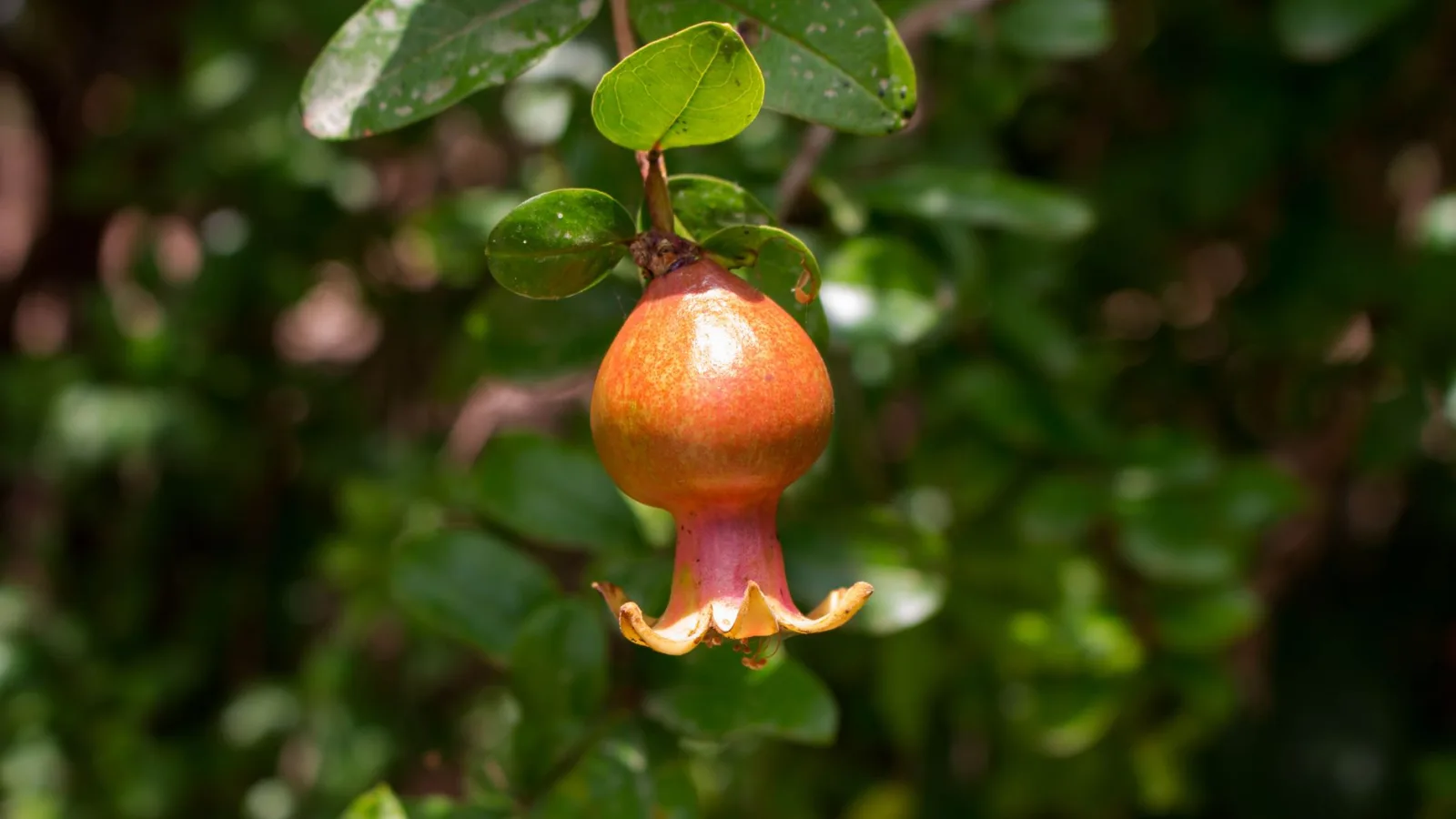
A pomegranate is a leathery red shell packed with hundreds of juice sacs, each wrapped around a seed, so eating one means chewing seeds as well. In Korea the main growing areas are Goheung in South Jeolla and parts of South Gyeongsang, with fruit arriving from September into October. City growers usually keep a dwarf variety that tops out around one to two metres in a pot, as much for the long-lasting red flowers as for the fruit. The Donguibogam noted two kinds, sweet and sour, and said the sweet was for eating while the sour went into medicine. That note belongs to the old record; the rind and the sour fruit are not something to simmer into a drink at home.
Year-Round Calendar
- 1
- 2
- 3
- 4
- 5
- 6
- 7
- 8
- 9
- 10
- 11
- 12
- 3
- 4
- 9
- 10
Where It Grows
- Main producer The dry country of the Deccan Plateau, including Maharashtra, is the largest producing area in the world. Irrigation supplies the water, allowing several cropping cycles a year.
-
Origin
The belt from the Iranian plateau to northern India is the crop's home ground, and Iran is still one of the leading producers. Harvest September, October, November
- 9
- 10
- 11
- Major producer Growing areas lie on the dry hills of Shandong, Shaanxi and Sichuan.
-
Major producer
The growing areas are the Mediterranean and Aegean coasts. Harvest September, October, November
- 9
- 10
- 11
- Major producer It is grown on irrigated land along the Nile.
-
Major producer
The area around Elche, in Alicante, is the largest producing region in Europe. Harvest September, October, November
- 9
- 10
- 11
It originated in the belt running from the Iranian plateau to northern India, and it spread to the Mediterranean and Central Asia very early on. Today India leads in production, with West Asia and the Mediterranean coast following. In the southern hemisphere, Peru, Chile and South Africa harvest from March to May, the reverse of the northern hemisphere, supplying fruit in the off-season.
- Optimum
- 20~30℃
- Range
- 10~38℃
- Hardiness
- Half-hardy
It does best where summers are hot and dry and winters are mild. It takes heat and drought well, but if moisture levels swing sharply while the fruit is ripening the skin splits, and in places where the winter minimum drops below -12℃ overwintering (surviving the winter outdoors) in open ground is difficult.
Harvested 2–4 years after planting. A young tree takes two to four years after planting before it sets fruit. The planting months (March and April) and the harvest months (September and October) do not fall in the same year.
In Korea Southern Korea
Goheung in South Jeolla and the South Gyeongsang area are the main producing regions. The trees flower in May and June and the fruit is picked in September and October. From the central part of the country northward, overwintering in open ground is difficult, so dwarf varieties are planted in pots and brought indoors for the winter.
How to grow
- Light
- Six hours of direct sun or more. In less light the tree still flowers but the fruit will not set.
- Soil and depth
- Free-draining sandy loam. For pots, mix about 30 percent coarse grit into potting soil.
- Spacing
- Three to four metres in the ground. For a dwarf variety in a pot, at least 40 cm across and 40 cm deep.
- Watering
- Water deeply when the top of the soil dries. Sharp swings in watering during August and September, while the fruit is swelling, split the skin.
- Feeding
- Base feed in March, top dressing in June and September. Too much nitrogen gives you branches instead of flower buds.
- Harvest
- September into October. Pick when the skin has coloured, the sides have gone slightly angular, and a fingernail tap sounds dull.
What makes the difference. Split fruit almost always traces back to uneven watering. Mulch the pot surface with straw or wood chips so it does not dry out abruptly after the rainy season. Flower buds form at branch tips, so do not shear all the tips off in winter pruning.
Why this one is harder. Cold tolerance is poor. North of the central region it will not survive outdoors, so the pot has to come inside for winter.
Common problems
- Aphids You will see Clustered on new shoots and flower buds; leaves curl and ants run up and down the stems. What to do Wash them off with a jet of water and treat leaf undersides early with an approved organic spray.
- Peach pyralid moth You will see A hole in the fruit with frass pushed out around it. What to do Bag the fruit while it is pea-sized and clear fallen fruit as it drops.
- Scale insects You will see Brown bumps along the branches, sticky leaves, then sooty mould. What to do Apply horticultural oil in winter; scrape small numbers off with an old toothbrush.
This page describes how a crop is grown and used. It does not claim health effects for any food, nor is it intended to prevent or treat disease. Component and study notes are references only and do not mean the same result occurs in people. Consult a medical professional about health concerns.
Health Benefits
What the old record says. Pomegranate appears in the Donguibogam's fruit section as seongnyu. The same passage cautions that eating much of it harms the lungs, and the rind was handled there as a medicinal material. This is a record from an old medical text, not a modern medical judgement, and because the rind belongs to that medicinal use it is not something to simmer into a drink at home.
What today's evidence shows. Most of the reported research was run on pomegranate extract or concentrated juice, which differs in both form and dose from eating the arils. Human trials have been small and inconsistent, so what can be said today stops at composition: polyphenols such as punicalagin, along with potassium and vitamin C.
Nutrition
- Punicalagin (An ellagitannin polyphenol, abundant in the rind and juice) — Gives the astringent taste; a frequent subject of antioxidant assays
- Anthocyanins (The pigment of the red juice) — The polyphenol behind the red colour
- Vitamin C (About 10 mg per 100 g of fresh fruit) — Used in building connective tissue
- Potassium (About 236 mg per 100 g of fresh fruit) — A mineral involved in fluid balance
The polyphenols sit in the peel Most of a pomegranate's polyphenols are in the rind and the white membrane rather than the arils you actually eat. Press the whole fruit in a juicer and those parts go in too, which is why the juice turns astringent. Squeeze only the arils by hand and you get a softer taste but far fewer polyphenols. That difference in pressing method is a large part of why commercial pomegranate juices vary so widely on the label. The rind is the part the old texts handled as a medicinal material, so it is not something to simmer at home.
Potassium Fresh arils carry about 236 mg of potassium per 100 g, roughly twice what an apple has. Juice makes it easy to take in more at one sitting, and concentrate packs the mineral into a smaller volume once the water is gone. If you are managing potassium intake for kidney reasons, small amounts of whole arils are easier to gauge than juice.
Sugar Pomegranate arils contain around 14 g of sugar per 100 g. The strong sourness masks it, so the fruit tastes less sweet than it is. Concentrated juice packs more sugar into the same glass. Read the label and decide the day's amount from that rather than from taste.
Pairings
○ Yogurt — The tartness of pomegranate sits alongside yogurt's acidity instead of competing with it. Scattering whole arils keeps the burst of texture, so you need less of anything else. Arils are also easier to portion than juice.
○ Roast chicken or lamb — Iranian and Middle Eastern cooking reduces pomegranate juice into a sauce for meat. The sour and astringent notes cut through fat well. Reduced juice glazes without added sugar, because the fruit's own fructose is doing the work.
○ Nuts — Arils and walnuts together in a salad set sourness against a toasted, oily note. The moisture in the arils takes the dryness off the nuts. Choose a milder leaf so the bitterness does not pile up. Lettuce
△ If you take regular medication — Laboratory work has reported that pomegranate juice affects liver enzymes involved in drug metabolism. The effect is generally described as weaker than grapefruit's, but if you are on blood pressure medication or an anticoagulant it is worth asking your pharmacist before making daily juice a habit. Eating a little fruit and drinking juice every day are very different amounts.
△ Teeth — The organic acids in pomegranate soften tooth enamel. Older herbals do carry a line about overeating harming the teeth, but the caution that appears in the Donguibogam's own entry concerns the lungs. Rinse with water after juice and wait about half an hour before brushing.
△ Eating a lot at once — The Donguibogam advised against eating pomegranate in quantity. By modern measures juice concentrates both sugar and potassium. About a cup a day is plenty.
Varieties
- Dwarf pomegranate (Sapling) — Stops at around 1 m, so it suits a pot. The fruit stays small.
- Sweet pomegranate (Sapling) — High in sugar and eaten fresh. The arils are large.
- Sour pomegranate (Sapling) — Sharply tart, used for juice or syrup. It corresponds to the sour side of the old text's sweet-versus-sour split.
- Wonderful (Sapling) — Introduced from the United States. Deep red juice; grown outdoors in the south of Korea.
Source: Donguibogam, Fruit Section (石榴) · Rural Development Administration (nongsaro.go.kr)