- Type
- Mushrooms
- Difficulty
- Moderate
- Season
- Fall
- Sowing
- Foraged
Matsutake
Tricholoma matsutake
Methyl cinnamate and 1-octen-3-ol · one autumn season under the pines
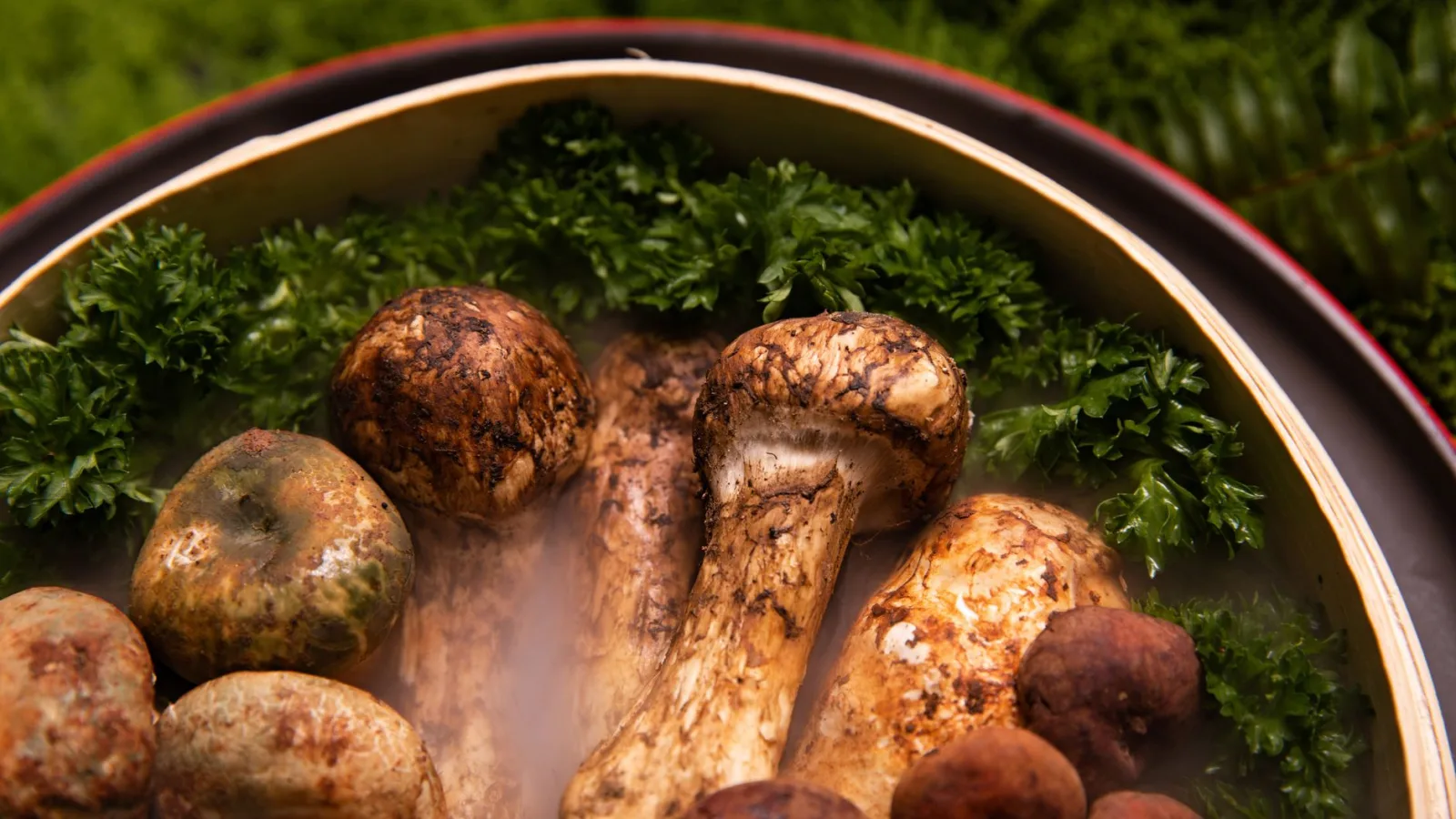
Matsutake pushes up from the ground under old pines. It lives in mycorrhizal partnership with living pine roots, which is why no method of growing it on sawdust blocks or logs yet exists. From late September into October, once the daytime temperature drops and rain has passed through, it lifts the pine litter as it comes. Methyl cinnamate and 1-octen-3-ol are reported as the principal aroma compounds, and both are highly volatile, so washing takes the aroma straight off. Scrape the soil from the base with a knife, wipe the cap with a damp cloth, and use it as it is. The Donguibogam lists it in the Vegetable section as 松耳, recording a neutral nature, a sweet taste and no toxicity. It calls the aroma and flavour excellent, says it carries the air of pine, places it under old pines in the mountains growing by borrowing the pine's breath, and ranks it first among mushrooms of the woods. Pine woods also carry deadly species behind repeated poisonings in Korea, so a wild mushroom you cannot identify with certainty is neither picked nor eaten.
Year-Round Calendar
- 1
- 2
- 3
- 4
- 5
- 6
- 7
- 8
- 9
- 10
- 11
- 12
- 9
- 10
Where It Grows
-
Main producer
The largest harvests come from the high-altitude conifer forests of Yunnan and Sichuan and from the Changbai Mountains of Jilin. They supply most of Japan's imports. Harvest July, August, September, October
- 7
- 8
- 9
- 10
-
Major producer
It grows in 20- to 60-year-old pine forests in the Taebaek and Sobaek ranges. Yangyang and Inje in Gangwon, and Bonghwa, Uljin and Yeongdeok in North Gyeongsang, are the known sources. Harvest September, October
- 9
- 10
-
Major producer
It grows in Nagano, Iwate and elsewhere, but as pine forest has dwindled, production has fallen sharply since the middle of the 20th century. It is the largest consumer. Harvest September, October
- 9
- 10
-
Major producer
It comes up in Himalayan conifer forest during the summer rains and is exported to Japan. It is close to the southwestern Chinese lineage. Harvest July, August, September
- 7
- 8
- 9
- Major producer It is gathered in the Pacific coastal conifer forests of British Columbia, but the North American mushroom is a different species, Tricholoma murrillianum.
Its native range is the pine forests of East Asia, and the Korean, Japanese and northeastern Chinese lineage is genetically distinct from the Himalayan lineage of southwestern China and Bhutan. The mushroom of the North American Pacific coast (Tricholoma murrillianum) and the one found in northern Europe and Turkey are treated as separate species or lineages, so when they are shaded onto a single map the species has to be stated. There is still no method for cultivating it, so every producing area is a collecting ground harvested from natural forest.
- Optimum
- 15~19℃
- Range
- 5~25℃
- Hardiness
- Not applicable
- Day length
- Not applicable
What decides when it comes up is the temperature in the ground, not the air. The soil temperature has to fall below 19℃ and a round of rain has to follow before the mushrooms push up; the mycelium spreads best at 22–25℃. If the summer runs too hot, or the autumn rain fails, there is almost no crop that year. It grows only by forming mycorrhizae with living pine roots, so the age of the trees and the state of the forest are themselves the conditions of the growing area.
In Korea Mountain areas
The centre of production is the dry pine slopes of the Taebaek and Sobaek ranges on the east-coast side. The season begins in mid-September in northern Gangwon and works its way south, but by the calendar it falls broadly within September and October.
How to grow
- Light
- It cannot be planted or grown. It comes up in young pine woods with broken light, on dry slopes under a thin layer of litter
- Soil and depth
- Nothing is planted in soil. The fungus joins living pine roots in mycorrhiza, and fruiting bodies rise only from that partnership
- Spacing
- It often comes up in rings or lines in the same spot. Replace the soil and litter after picking, or the spot yields nothing the following year
- Watering
- It fruits in late September once daytime temperatures drop and rain has passed through. In an autumn without rain there is almost nothing
- Feeding
- Not something that gets fed. Instead, when buying, choose one with a thick, firm stem and the cap still joined to it
- Harvest
- Late September into October. Lift it carefully from the base with its soil before the cap opens, and replace the soil and litter afterwards
What makes the difference. Never wash it. Scrape the soil from the base thinly with a knife and wipe with a damp cloth. For longer keeping, slice and freeze
Why this one is harder. Because it needs mycorrhiza with a living pine, it cannot be raised on a block or a log. There is still no way to grow it in a plot or on a balcony, so buying, choosing and handling is the whole of this entry
Common problems
- Beetle larvae and grubs You will see Holes at the base of the stem, with tunnels visible when it is split What to do Cut the base and check, then use only the sound flesh. Grub-bored specimens are graded out and priced far lower
- Damp and mould You will see The surface turns slippery and white mould settles on it What to do Do not wash it. Wipe with a damp cloth, wrap in paper and refrigerate. A sealed plastic bag will sweat
- Caps opening You will see The cap flattens within a day or two and the aroma fades What to do Use it the day it is bought. To keep it longer, slice it and freeze the slices in a single layer
This page describes how a crop is grown and used. It does not claim health effects for any food, nor is it intended to prevent or treat disease. Component and study notes are references only and do not mean the same result occurs in people. Consult a medical professional about health concerns.
Health Benefits
The old record — songi (松耳). The Donguibogam lists this mushroom in the Vegetable section as 松耳. It records a neutral nature, a sweet taste and no toxicity. The aroma and flavour are called excellent and it is said to carry the air of pine. It is placed under old pines in the mountains, growing by borrowing the pine's breath, and ranked first among mushrooms of the woods, on the authority of a folk source. This is a historical medical record and differs from how it is judged today.
Analyses of the aroma. Methyl cinnamate and 1-octen-3-ol are reported as the principal aroma compounds of matsutake. Both are highly volatile, and the same work reports that how much survives depends on preparation and heating. This is a compositional analysis.
Mycorrhiza and cultivation. Matsutake grows in mycorrhizal partnership with living pine roots. That is why inoculating spawn into a block or a log does not work, and why it is still not cultivated. This is an account of its ecology.
Nutrition
- Methyl cinnamate (reported as a principal aroma compound) — the volatile behind the characteristic matsutake scent
- 1-octen-3-ol (widespread among mushrooms) — the volatile alcohol known as mushroom alcohol
- Water (most of a freshly picked cap) — why it softens and loses aroma so quickly
The aroma compounds Methyl cinnamate and 1-octen-3-ol are reported as the principal aroma compounds of matsutake. Both are highly volatile and leave with soaking or long cooking. To keep the aroma, handle it as little as possible and keep it off the heat.
Never washed Matsutake is not washed. Running water takes the aroma and softens the flesh. Scrape the soil from the base thinly with a knife and wipe the cap once with a damp cloth. Tearing it along the grain by hand leaves a rough surface that carries more aroma than a knife cut.
Water content and keeping A freshly picked cap holds a lot of water, and within a day or two it opens and the aroma fades. Sealed in a plastic bag it sweats and softens, so wrap it in paper and refrigerate. For longer keeping, slice it and freeze the slices in a single layer.
A mycorrhizal life Matsutake lives in mycorrhizal partnership with living pine roots, taking the sugars the tree makes and passing back water and minerals. Without the tree there is no fruiting body. That is why the shiitake approach of inoculating spawn into a block does not work here.
Pairings
○ Salt and sesame oil — Tear it along the grain, sear it briefly in a hot pan, and dip it in salt or sesame oil. Every seasoning added buries more of the aroma, so it is hard to do less than this. Keep it on the heat only long enough to warm the surface.
○ Beef — Add it to the pan where sirloin or striploin has just been seared. The rendered fat holds the aroma. In a hot pot, put it in last and turn the heat off.
○ Rice — Lay sliced caps on the rice just as it comes to the steaming stage and put the lid back. Cooked in from the start, the aroma is gone. Serve the soy dressing separately at the table.
△ Washing — Matsutake is not washed. Running water takes the aroma and softens the flesh. Scrape the soil from the base thinly with a knife and wipe the cap with a damp cloth. Where soil has worked in deeply, cut that part away instead.
△ Wild mushrooms picked in the woods — Pine woods also carry Amanita virosa and Amanita subjunquillea, deadly species behind repeated poisonings in Korea. This is not a difference settled by cap colour or a photograph. Do not pick or eat a wild mushroom you cannot identify with certainty. Forest produce on state and private land also cannot be taken freely.
△ Eating it raw — Matsutake is sometimes sliced thin and served raw, but mushrooms are safer cooked. Raw mushroom unsettles some people's stomachs. To keep the aroma, cook it briefly over high heat rather than slowly.
△ Heavy seasoning and long simmering — Doenjang and chilli powder used with a heavy hand bury the aroma completely. In a soup, add it at the end and turn off the heat straight away. With a mushroom whose aroma is most of what it costs, cooking time is loss.
Varieties
- Cap still closed (grade) — A thick, straight stem with the cap still joined to it. Reckoned the top grade
- Cap opened (grade) — The aroma fades and the flesh thins. The price falls sharply
- Damaged or grub-bored (grade) — Graded out. Sound sections are sometimes cut away and used
- Imported matsutake (origin) — Closely related species of the same genus circulate alongside it. The grain of the aroma differs slightly
Source: Donguibogam, Vegetable Section 松耳 · Korea Forest Service