- Type
- Roots & Stems
- Difficulty
- Hard
- Season
- Fall
- Sowing
- Division
Manchurian Wild Rice
Zizania latifolia
Fibre and potassium · the white swollen stem of a waterside grass
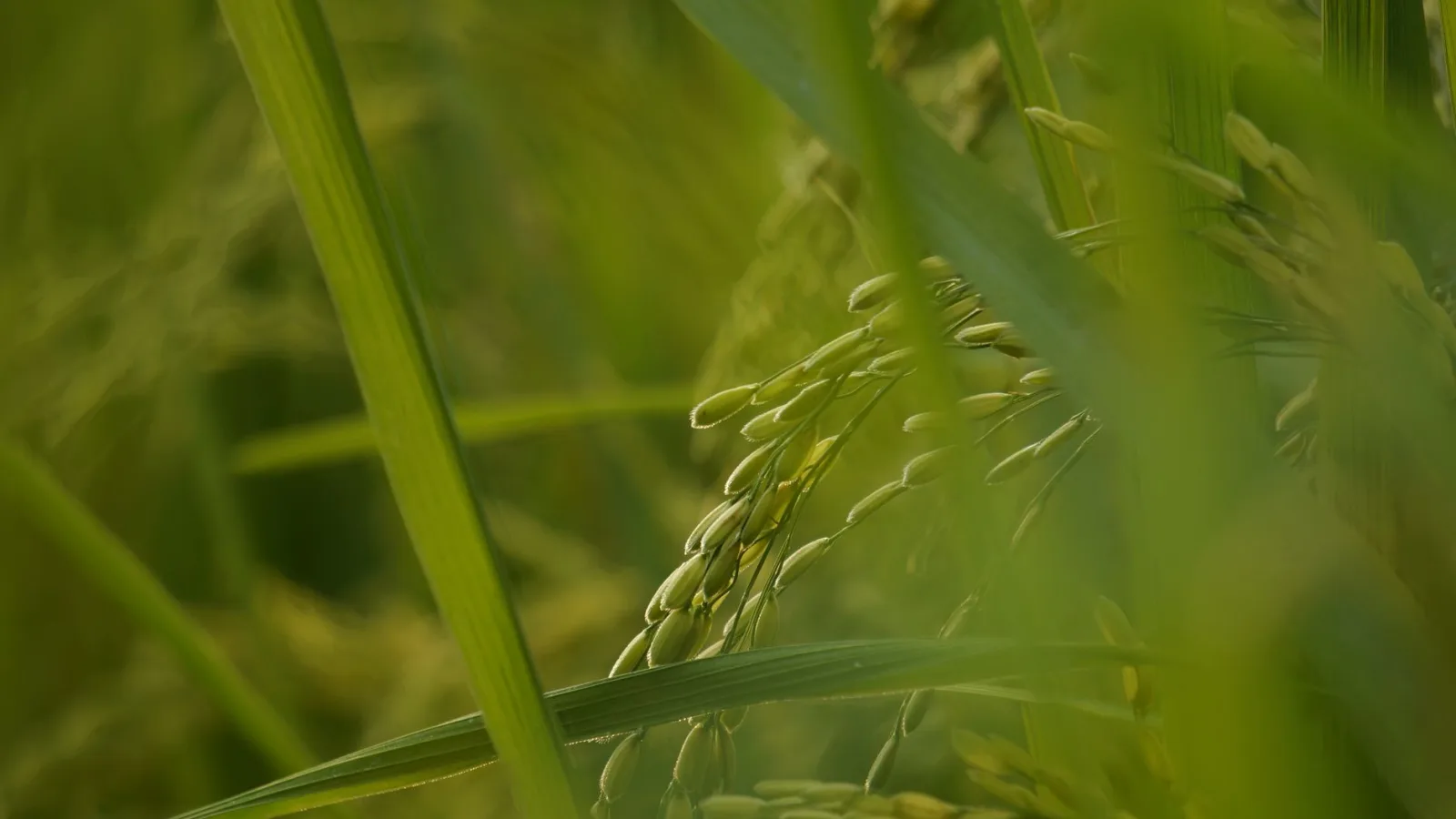
Manchurian wild rice is a tall grass that grows in stands in the shallow water of ponds and streams. What is eaten is not the root but the white core that swells at the base of the stem: when a smut fungus enters the culm, the tissue thickens and fattens into something like a bamboo shoot. China and Taiwan grow it as jiaobai (茭白) and usually stir-fry it, and Korean records describe cutting it at the waterside and blanching it. The grain that ripens in autumn was written down in old texts as johomi (彫胡米) and cooked as rice. The Donguibogam lists it in the Herb section as gogeun (菰根), recording a very cold nature, a sweet taste and no toxicity. It sets down the form as well — it grows in water, the leaves resemble sugarcane or silvergrass, and an old root coils thick — and attaches a caution against eating much of it. A core mottled with black inside means the fungal spores have fully ripened: it turns harsh and refuses to soften, so split one open when choosing.
Year-Round Calendar
- 1
- 2
- 3
- 4
- 5
- 6
- 7
- 8
- 9
- 10
- 11
- 12
- 4
- 5
- 9
- 10
Where It Grows
-
Main producer
Jiangsu and Zhejiang, around Lake Tai, are the largest producing area in the world. There are separate strains: one harvested only once, in autumn, and another harvested twice, in summer and in autumn. Harvest May, June, September, October
- 5
- 6
- 9
- 10
- Main producer Puli in Nantou is the noted producing area, where the crop is grown in paddies fed by cold spring water.
- Major producer In the Red River Delta it is called niễng and is harvested in autumn.
- Major producer It is called makomotake, and is grown in paddies next to the places where it grows wild.
- Wild population It grows in stands along the edges of ponds, reservoirs and streams. It is rarely grown as a field crop.
Its native habitat is the ponds and streamsides of temperate East Asia, and it grows across Korea, China, Japan and northern Vietnam. The part that is eaten is neither root nor seed but the stem base, swollen where the smut fungus Ustilago esculenta has entered it, so cultivation has settled on one method: selecting only infected plants and propagating them onward from their rhizomes. Production is therefore concentrated in a few narrow places where water stands year round, such as the shores of Lake Tai and Puli in Taiwan. The wild rice harvested for grain in North America is a different species of the same genus (Zizania palustris and others), with a different edible part and a different use.
- Optimum
- 20~28℃
- Range
- 10~35℃
- Hardiness
- Hardy
A large member of the grass family that lives only where water stands shallow, 10–30 cm deep. In winter the above-ground growth dies back and the plant comes up again from rhizomes on the bed beneath the water. For the base of the stem to swell and thicken, the summer heat must be followed by a cool season.
Harvested 1–2 years after planting. If the rhizomes are divided and planted in spring, the tender inner stalk fills out from the autumn of that year or the autumn of the year after. Being a perennial, it comes up every year once established, but the clumps must be divided every two or three years.
In Korea Nationwide
It grows in stands along the edges of ponds, reservoirs and streams. It is rarely grown as a field crop, and is usually cut from wild stands.
How to grow
- Light
- Full sun at the waterside. In shade the core never swells thick
- Soil and depth
- A deep silt bed under water. Choose a spot holding 10 to 30cm of water
- Spacing
- 60 to 80cm between plants. The rhizomes run sideways and fill the space within a few years
- Watering
- It must never dry out. Keep shallow water standing over it, and moving water is better than still
- Feeding
- A little compost once it has taken in spring. Heavy nitrogen builds leaf and starves the core
- Harvest
- September and October. Cut at the base when the base has swollen to about two fingers thick and the leaf sheath begins to open. Peel back the outer sheath and the white core is inside
What makes the difference. Keep the cut core in its outer sheath, wrapped in paper, in the vegetable drawer. Peeled, it dries and coarsens within a day
Why this one is harder. It cannot live without water, so a dry plot is out of the question. A large rubber tub of silt topped up with water works, but the rhizomes fill the tub quickly, so divide it every two or three years
Common problems
- Leaf-eating caterpillars You will see Leaves grazed from the margin inward until only the veins remain What to do With few plants, pick them off by hand. At the waterside it is better not to spray at all
- Penned water and root rot You will see Leaf tips scorch yellow and the plant lies over limply What to do Cut a channel so the water is not trapped. Dig out rotted crowns and replant elsewhere
- Plants that set no core You will see A flower stalk rises and the base never swells What to do That plant carries no smut fungus. Divide rhizomes from a plant that reliably sets a core
This page describes how a crop is grown and used. It does not claim health effects for any food, nor is it intended to prevent or treat disease. Component and study notes are references only and do not mean the same result occurs in people. Consult a medical professional about health concerns.
Health Benefits
What the Donguibogam records — gogeun (菰根). The Donguibogam lists the plant in its Herb section as gogeun (菰根). It records a very cold nature, a sweet taste and no toxicity, and attaches a caution against eating much of it. It sets down the form — growing in water, leaves like sugarcane or silvergrass, an old root coiled thick. What rises like a mushroom in summer it calls gochae (菰菜), the white tender stalk rising at the centre of a plant more than three years old gosu (菰首), and the grain ripening in autumn johomi (彫胡米), cooked as rice. The entry quotes the Bencao. This is a historical medical record and differs from modern medical judgment.
The white core and the smut fungus. That the white core is stem tissue swollen after infection by the smut fungus Ustilago esculenta has been addressed in plant pathology and crop science. The same work reports that uninfected plants throw a flower stalk and set no core. This is an analysis of tissue formation and has nothing to do with preventing or treating disease.
Nutrition
- Dietary fibre (forms the grain of the white core) — the fibre behind a bite close to bamboo shoot
- Potassium (present in the core) — a mineral common across vegetables
- Water (most of the core by weight) — why it stays low in calories for its bulk
- Starch (in the grain that ripens in autumn) — the main component of the johomi once cooked as rice
Why the white core forms The white core that is eaten is not the stem itself but stem tissue swollen thick after the smut fungus Ustilago esculenta enters it. A plant the fungus has not entered simply throws a flower stalk and sets no core. This tissue is what China and Taiwan grow under the name jiaobai (茭白).
Water and fibre The core is mostly water, so it stays low in calories for its bulk, and the fibre running through it gives a bite close to bamboo shoot. Left standing it coarsens, so use it soon after cutting.
A core with black spots Black mottling inside the core means the fungal spores have fully ripened. It turns harsh and will not soften, so it is not sold as first grade; split one open and pick the ones that are white through.
The autumn grain The grain that ripens in autumn was written down in old texts as johomi (彫胡米) and cooked as rice. Ripe grain shatters easily, which makes a single harvest difficult. It rarely reaches the table today.
Pairings
○ Hard fry over high heat — Cut the white core on the diagonal and fry it hard in oil. It holds a lot of water and goes slack over low heat. Salt alone leaves the vegetable itself in front.
○ Blanched and dressed — Blanch, rinse cold, and dress with sesame oil and salt. The handling is much like a bamboo shoot dish. Throw the blanching water away.
○ Stock — The firm lower end of the core goes into stock. It is too coarse to chew comfortably but lends a sweetness to the liquid.
△ Cutting carelessly at the waterside — Manchurian wild rice grows mixed in with reed and silvergrass. Leaves alone will not separate them, so confirm a swollen base holding a white core before cutting. If you are not certain, do not cut.
△ Standing water and farm drains — Do not use plants from water that is penned in or fed by farm drainage. The plant lives with its roots in water, so the state of that water follows it. Take only what grows in moving water, away from where people work.
△ A core that is black inside — Do not use a core packed with black spots when split. The spores have fully ripened, so the taste turns harsh and the tissue coarsens. Split and check even what you bought.
Varieties
- Wild stands (division) — The native population at Korean waterways. Yields both the white core and the autumn grain
- Jiaobai cultivated lines (division) — Lines grown in China and Taiwan for the white core. They do not throw a flower stalk and the core swells thick
Source: Donguibogam, Herb Section 菰根 · Korea National Arboretum, Korean Plant Names Index